

Published Nov 10, 2026 | 10:00 AM ⚊ Updated Nov 10, 2026 | 10:00 AM

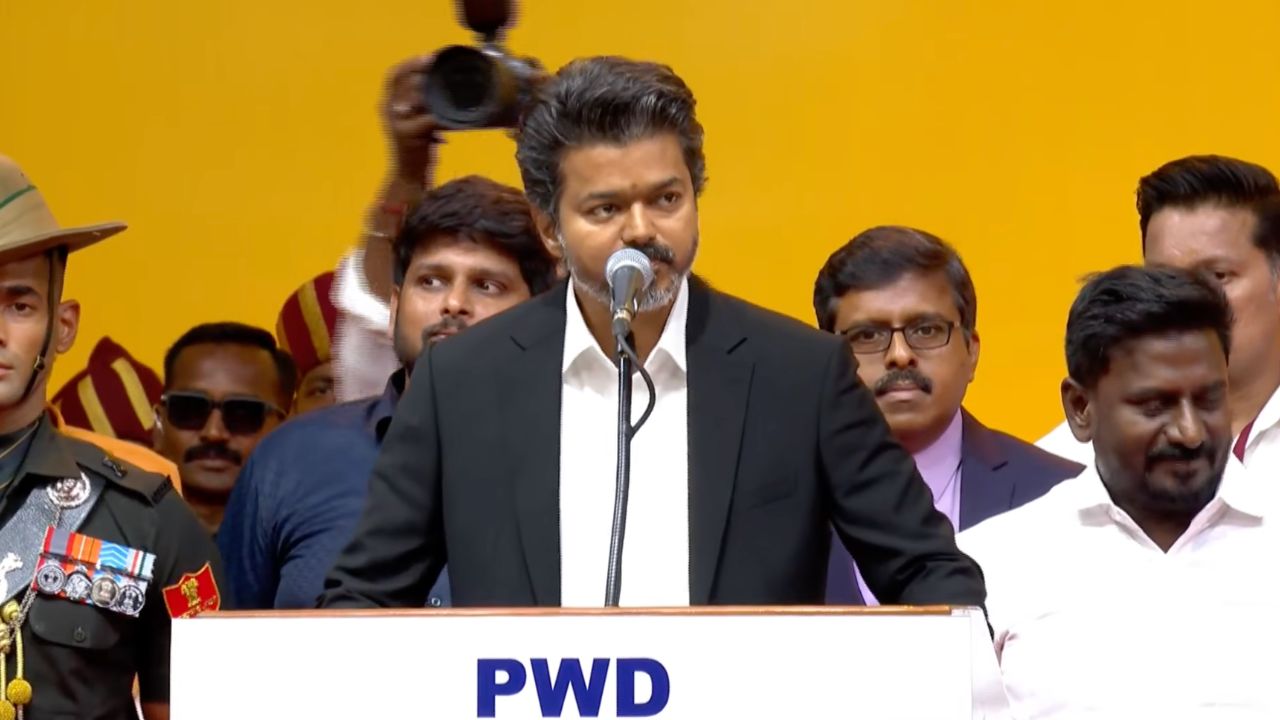
Vijay seen taking oath as the Chief Minister of Tamil Nadu on 10 May 2026. (File photo)

Synopsis: A South First survey of more than 100 people across Tamil Nadu found widespread dissatisfaction with Chief Minister C Joseph Vijay’s TVK government after its first six months in office, with concerns over law and order, women’s safety, rising prices, employment and corruption-free governance. While some respondents believe the government deserves more time, 60.9 percent say it has failed to meet public expectations and 71.3 percent express little or no confidence in its ability to deliver on its promises.
Six months ago, when C Joseph Vijay took oath as the Chief Minister of Tamil Nadu, he inherited more than the responsibility of running a state. He inherited enormous expectations.
For a political party that had positioned itself as an alternative to Tamil Nadu’s established Dravidian political order, the electoral victory was an opportunity to demonstrate that a new political formation, led by a popular actor with limited administrative experience, could deliver a different model of governance.
The Tamilaga Vettri Kazhagam (TVK) government, which assumed office on 10 May 2026, repeatedly urged people to give it at least six months to demonstrate its administrative capabilities and fulfil its electoral promises.
That six-month period has now elapsed. And the question is no longer simply whether Vijay can command public attention or retain his political popularity.
It is whether his government has managed to translate the expectations surrounding its arrival into tangible improvements in people’s lives.
To assess the first six months of the TVK government, South First surveyed over 100 people across Tamil Nadu, covering different locations and age groups, from 18 to 65 years.
The survey, conducted on 8 and 9 November 2026, sought their views through 10 questions covering the government’s overall performance, Vijay’s leadership, corruption-free governance, women’s safety, law and order, public services, price rise, employment, fulfilment of electoral promises and confidence in the government’s ability to deliver over the next four and a half years.
The survey also invited participants to identify the most urgent area requiring government intervention and share their overall assessment of the administration.
The findings reveal a significant divergence between the government’s political promises and public perceptions of its performance.
While a section continues to support Vijay and believes the government deserves more time, dissatisfaction is particularly pronounced over law and order, women’s safety, the cost of living and the government’s ability to establish transparency and accountability.
Also Read: Reels, narratives, and governance: Is Tamil Nadu’s new government being run through social media?
The survey does not indicate a complete rejection of the TVK government. A section of those who took part continues to rate its performance positively, and some believe the administration has made a reasonable beginning despite having limited time in office.
Around 22.6 percent rated the government’s overall performance as either good or very good. Another section remained neutral, suggesting that not everyone has arrived at a definitive assessment of the administration.
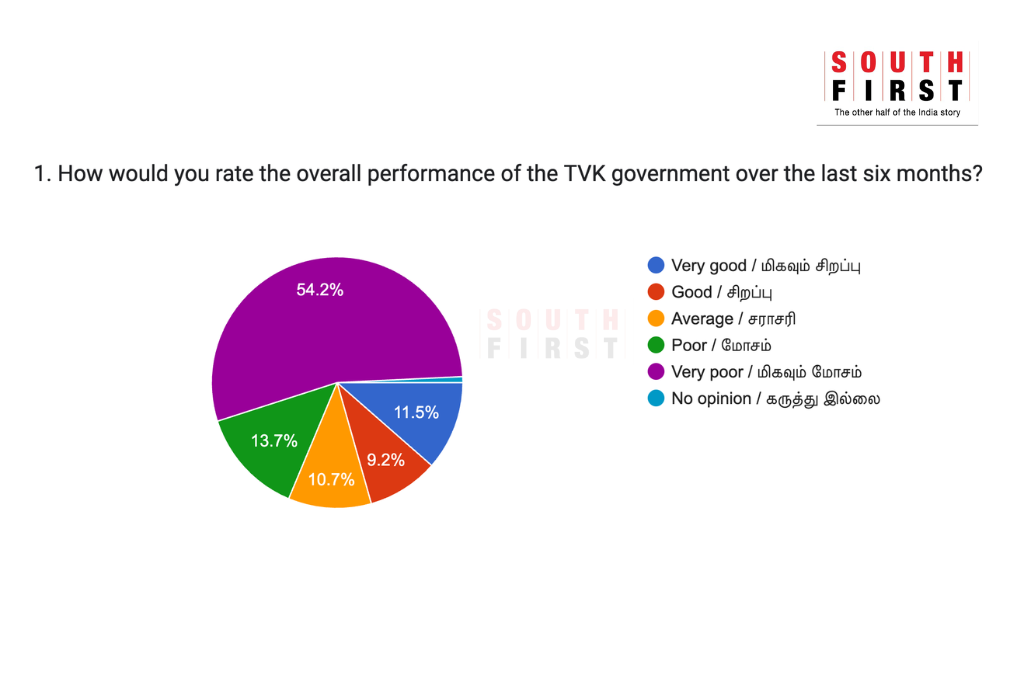
54.2% of those surveyed rated the TVK government’s performance as very poor.
Several people who expressed favourable opinions also acknowledged that the government had areas to improve.
Siva Malathi, 24, from Coimbatore, said she had not voted for TVK but believed the new government was performing better than its predecessor.
“I didn’t vote for them. But seeing them after coming into power feels like they are way better than the previous ones. Still more to improve for sure, but as of now they are doing good,” she said.
Lavanya, 35, from Tirunelveli, also expressed a positive assessment of the government, saying it had performed well so far.
Shaki, 39, from Kanniyakumari, described the government’s performance as excellent. Others from Tirunelveli and Chennai said the administration was moving in the right direction.
Keerthana M, 26, from Madurai, argued that Vijay had fulfilled the promises he could during the initial six months and should be given an opportunity to complete his five-year term.
She expressed hope that he would govern well over the next five years and urged people to allow the administration to function without unnecessary obstacles.
Harini R, 20, from Chennai, said the government’s first six months had demonstrated a strong focus on public welfare, women’s safety and development.
However, she added that the government must convert its promises into long-term results and demonstrate its commitment through transparent and effective governance.
Even those who expressed support for the administration were therefore not necessarily offering unconditional approval.
Nisha, 26, from Chennai, whose opinion of Vijay had improved significantly after he assumed office, said the TVK government still needed to prove its administrative experience, economic decision-making and ability to handle complex issues.
This is an important distinction. The government retains a supportive constituency, but even among some of its supporters, there is an expectation that its initial political enthusiasm must now translate into administrative performance.
Also Read: Inside the Vijay push: Paid reels, PR networks and the ‘next PM’ narrative
One of the most revealing aspects of the survey is the change in people’s perception of Vijay after he became Chief Minister.
Before the election, Vijay’s appeal was built around the promise of political change, his image as an alternative to established parties and the expectations he generated among sections of young and first-time voters.
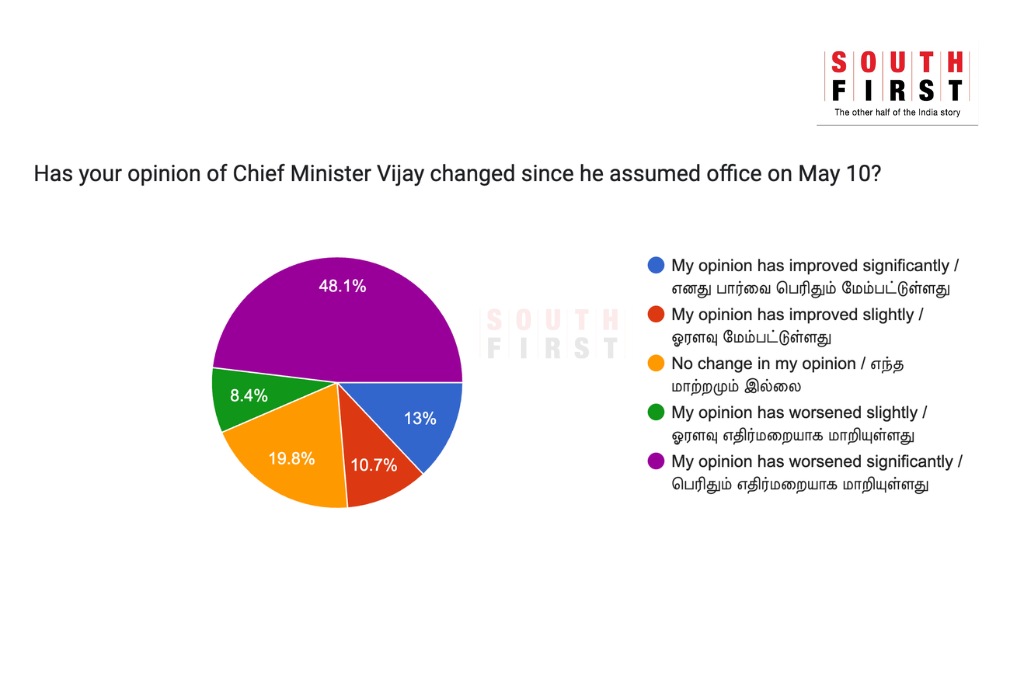
48.1% said their opinion of Chief Minister Vijay had worsened significantly since he assumed office.
However, the survey suggests that his transition from actor-politician to Chief Minister has prompted a reassessment among a substantial section of those who took part.
Around 50 percent said their opinion of Vijay had worsened after he assumed office, with a significant proportion reporting that the change was substantial.
In contrast, approximately 27 percent said their opinion of him had improved, while others said there had been no change.
The distinction between Vijay’s popularity as a political leader and his credibility as an administrator is becoming increasingly important.
Ramya, 32, from Chennai, expressed concern about the direction in which the state was heading, citing privatisation, institutional independence, education policy and the weakening of Tamil Nadu’s rationalist and social justice values.
She also questioned the growing reliance on social media narratives and political public relations instead of transparency and accountability.
“Citizens deserve to understand how their personal data is collected, exploited, and monetized, rather than being reduced to consumers of carefully crafted political imagery,” she said.
She also raised concerns about women’s safety, children’s protection, human dignity, access to quality education and the environment.
“What is the value of economic growth and technological development if people’s safety, rights, privacy, and future are compromised?” she asked.
Her criticism was not simply about the performance of individual ministers or the implementation of welfare schemes. It was about the ideological direction of the state and the institutions that protect its interests.
Manikandan, 33, from Anna Nagar, Chennai, questioned whether Vijay’s screen persona was being translated into meaningful political leadership.
He expressed disappointment over employment opportunities, the privatisation of education and public sector institutions, and alleged that some TVK functionaries were collecting money.
Another participant, Michael Raj, 56, from Kanniyakumari, described the administration as irresponsible and raised concerns about its ability to learn and function independently.
Among those whose opinion of Vijay had improved significantly, 88.2 percent expressed high confidence in the government’s future.
Conversely, among those whose opinion of Vijay had worsened significantly, 90.2 percent reported having little or no confidence in the government’s ability to deliver during the remainder of its term.
Also Read: Bribery demands waning under Vijay? The reality behind TVK’s ‘clean government’ claim
One of TVK’s central electoral promises was to establish a clean administration free from corruption.
The party’s political positioning relied heavily on the promise of offering an alternative to the corruption and administrative failures it attributed to previous governments.
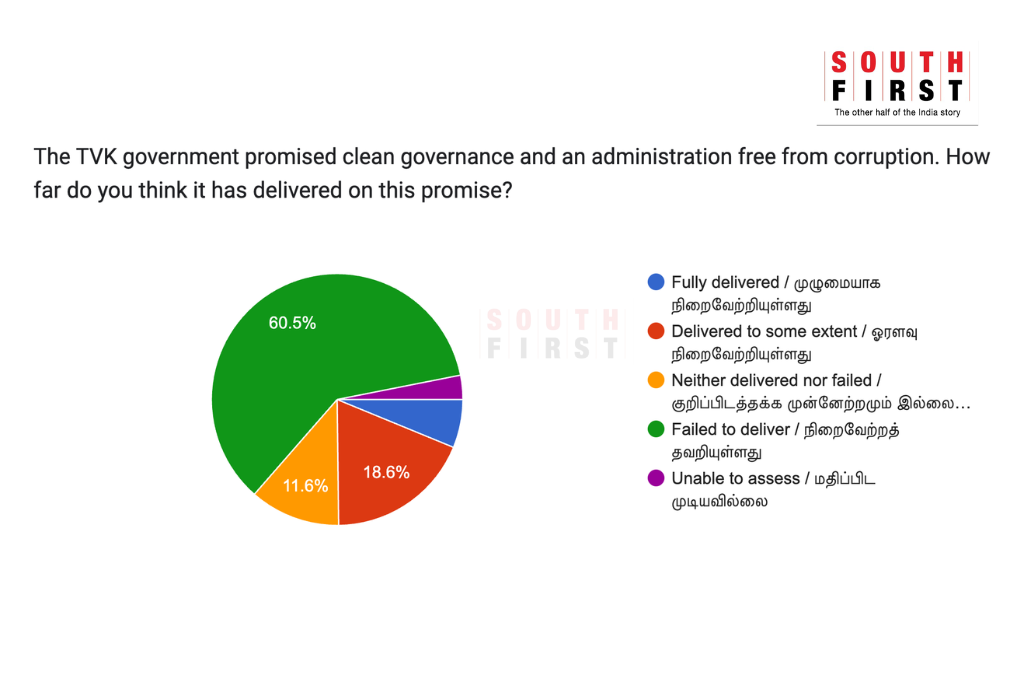
60.5% said the TVK government had failed to deliver on its promise of corruption-free governance.
However, the survey indicates that the government has not yet convinced a substantial section of those who took part that it is delivering on that commitment.
Around 57 percent said the government had failed to deliver on its promise of clean governance. Only around 6.1 percent believed it had fully delivered, while another section felt it had made progress to some extent.
Transparency and accountability also emerged as one of the most frequently identified areas requiring immediate improvement.
Subala Kathirvel, 25, from Coimbatore, said: “There is no transparency in anything. The government must fulfil its promise of being corruption-free.”
Madhumitha, 22, from Vellore, expressed concern over what she perceived as a deterioration in accountability.
A participant from Chennai, Prabaharan, alleged that the government was adopting a diversionary political strategy, raising one issue to shift attention away from another.
He argued that this prevented public dissatisfaction with the administration from becoming a sustained political discussion.
Another participant from Thoothukudi, Manju, criticised the government’s approach to welfare schemes, alleging that initiatives introduced by the previous DMK government were being renamed and presented as achievements of the new administration.
Interestingly, the demand for accountability was not confined to those who rated the government poorly. Even some supporters said that the administration needed to demonstrate greater transparency.
Also Read: Dhanush, TVK and the politics of film stardom
Among the areas examined in the survey, law and order and women’s safety emerged as two of the most significant concerns.
Around 70.5 percent rated the government’s handling of law and order as ineffective, with 54.8 percent describing it as very ineffective.
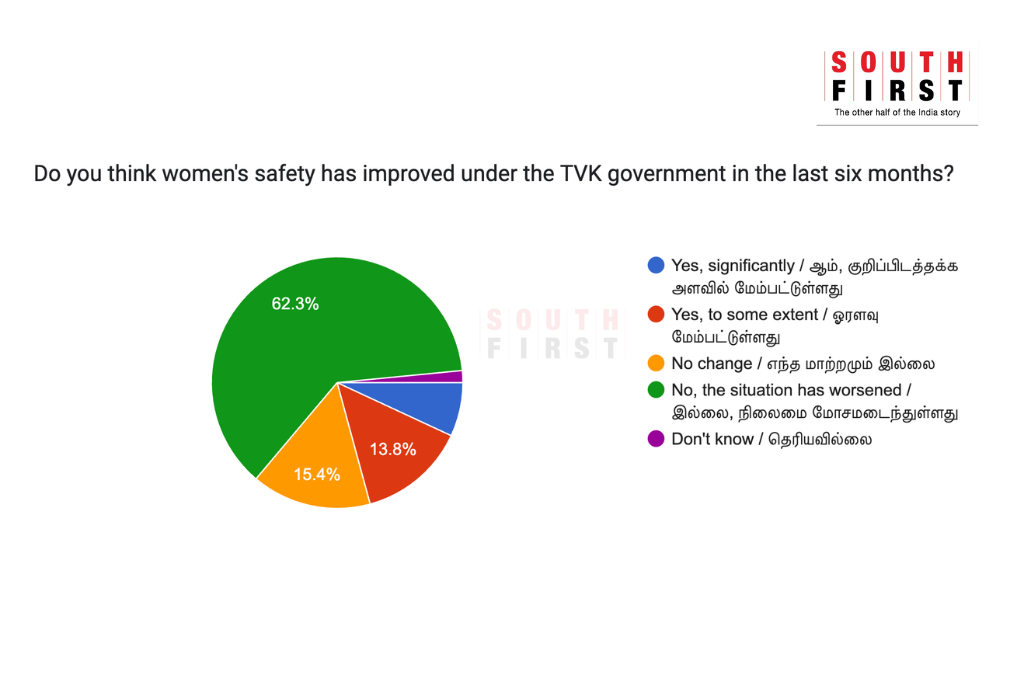
62.3% said the situation concerning women’s safety had worsened under the TVK government.
The responses also indicate that 58.3 percent believe women’s safety has worsened during the government’s first six months.
Several people raised concerns about murders, crimes against women, drug use and the perceived lack of effective policing.
Viswanathan, 35, from Pudukkottai, said the government had failed to ensure women’s safety and maintain law and order.
Arulnithi, 41, from Jolarpet, offered a wider assessment of the situation.
He argued that Tamil Nadu was experiencing a serious decline across law and order, economic development, education, healthcare, women’s and children’s safety and the cost of living.
He also questioned the public’s willingness to accept everything Vijay does because of his popularity.
“People in Tamil Nadu are in a mindset where they accept whatever actor Vijay does. Bringing them out of that mindset is the most important task at present,” he said.
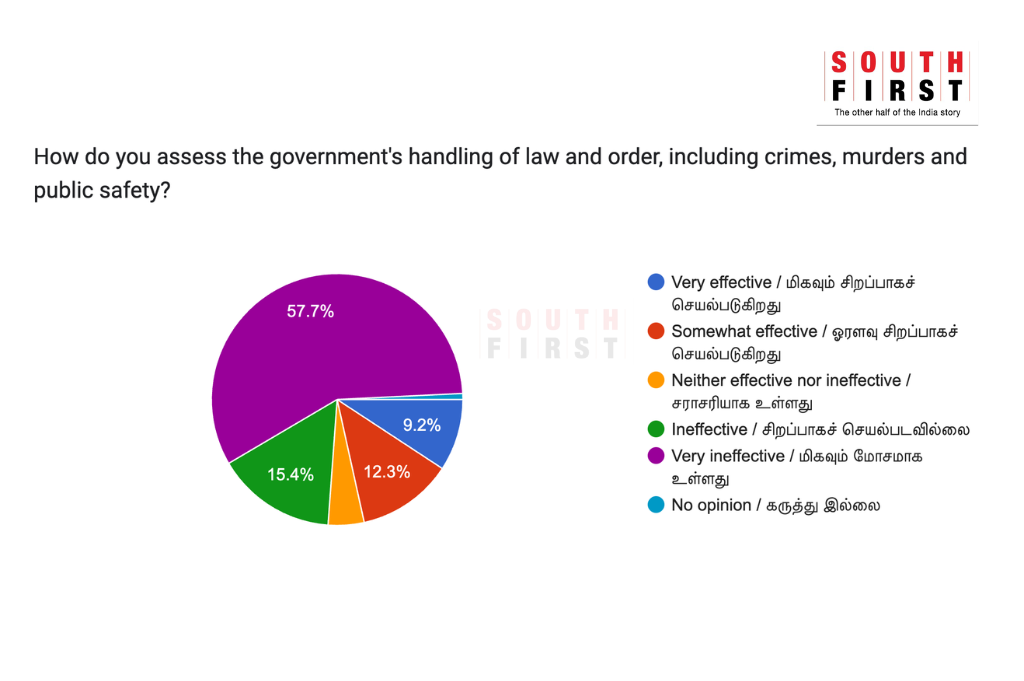
57.7% rated the government’s handling of law and order as very ineffective.
Praveen, 26, from Chengalpattu, raised concerns about women’s safety and the growing problem of drug use.
A participant from Besant Nagar in Chennai also questioned the functioning of traffic police and alleged that public money was being wasted on unnecessary infrastructure work.
The criticism was not limited to those who opposed the government. Anoj, 29, from Thoothukudi, offered a relatively balanced assessment.
He said the government was trying hard to fulfil people’s needs but acknowledged that some decisions had faced backlash or failed to benefit the public.
“Law and order, along with women’s safety, needs a fresh and more effective approach,” he said.
While law and order dominates much of the political criticism, the cost of living emerged as the most frequently identified immediate concern in the survey.
Around 24.8 percent identified price rise and the cost of living as the biggest area requiring immediate government intervention.
Law and order followed closely, with around 23.9 percent identifying it as their top priority. Transparency and accountability were identified by approximately 15.9 percent.
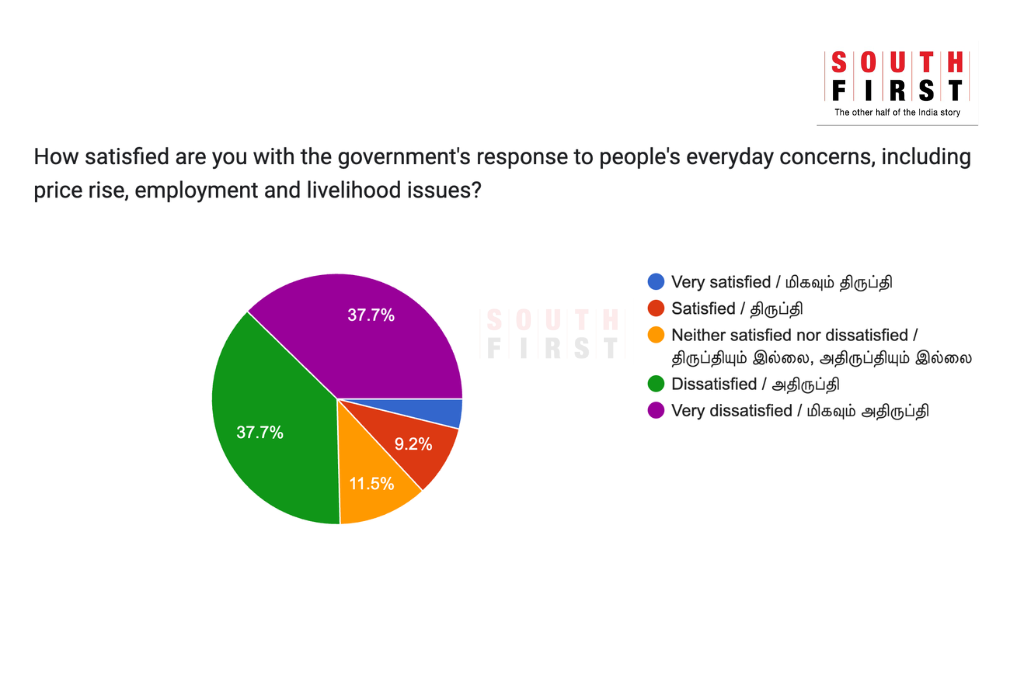
75.4% expressed dissatisfaction with the government’s response to price rise, employment and livelihood concerns.
The responses to the question on everyday economic concerns were even more revealing.
Around 73 percent expressed dissatisfaction with the government’s handling of issues such as price rise, employment and livelihoods.
For ordinary households, the assessment of governance is often determined by the prices of essential commodities, employment opportunities and the ability to manage everyday expenses.
Positron, 25, from Coimbatore North, summed up the frustration by saying that the government had made big promises but was struggling to meet expectations.
Nikesh Kumar, 28, from Thiruvallur, linked public disappointment to what he described as revenge politics.
“Earlier, we had some hope for change. But now, witnessing revenge politics, it seems that ordinary people are gaining nothing. The only noticeable change is the increase in FMCG prices, while the common man’s expectations and struggles remain unchanged. Ultimately, political revenge benefits politicians, not the people,” he said.
Steffi, 31, from Viluppuram, raised concerns about ration supplies and rising prices. She also suggested that Vijay should communicate with the public regularly.
She said the Chief Minister should interact with people on a weekly basis and demonstrate accountability towards those affected by government decisions.
Another participant from Tondiarpet questioned whether increasing freebies could add to the financial burden of middle-class and upper-middle-class families.
Employment opportunities were also repeatedly mentioned in the open-ended responses.
Beema, 26, from Madurai, identified employment as the most important area requiring immediate attention.
Kavya, 27, from Kanniyakumari, suggested that the government should formulate and implement schemes at the panchayat level.
She argued that effective implementation of local-level programmes could bring meaningful change.
Also Read: How Vijay’s fan ecosystem turns routine governance into personal miracles
The survey also examined whether people had noticed improvements in government hospitals, schools, public transport and local administration.
The responses suggest that the government has not yet established a convincing record of improvement in public services.
A substantial section said services had worsened or that they had not noticed any significant improvement.
R Stephen, 61, from Ambasamuthiram, argued that the government should move away from excessive reliance on freebies and prioritise education, agriculture, healthcare and public health.
He said education and medical services should not become commercialised and must remain accessible to economically weaker sections.
“Education and healthcare must improve. They should not become businesses, and even the poorest sections must be able to access them fairly. Agriculture should be given priority,” he said.
Pooja A, 23, from Chennai, raised concerns about women working at Amma Unavagams.
While expressing an otherwise favourable opinion of the government, she urged it to pay attention to the employees.
She claimed that women working at Amma Unavagams were not receiving bonuses or festival holidays and were being paid only ₹10,000 a month.
Her response highlights how people assess governance through everyday working conditions and the delivery of public services, not merely through major policy announcements.
Beyond administrative performance, several people raised concerns about the ideological direction of the government.
Tamil Nadu’s political identity has historically been shaped by the Dravidian movement, rationalist politics, social justice and the assertion of state rights.
Some participants expressed concern that the TVK government was moving away from these principles.
Ramya from Chennai raised concerns over what she perceived as the dilution of Tamil Nadu’s rationalist and social justice values.
Mahalakshmi K, 40, from Tiruvannamalai, questioned what she described as attempts to change institutions and policies that have long been associated with Tamil Nadu’s identity.
She referred to the dissolution of the Justice Kurian Joseph-led Centre-State Relations Committee, concerns surrounding universities and the debate over the National Education Policy 2020.
She also questioned the government’s communication regarding education policy and expressed concern over what she described as the normalisation of murders and missing children.
Another participant, Anantharaj M, 26, from Tiruchirappalli, called on the government to abandon political vendetta and focus on its ideological commitments.
He said the administration should concentrate on taking the principles of Periyar and Anna to the people while functioning with responsibility and transparency.
“Instead of criticising others and engaging in diversionary politics, the government should focus on taking the principles of Periyar and Anna to the people. It should function with responsibility and transparency,” he said.
He added that the Chief Minister should not behave as though he would remain in office permanently.
“The people have entrusted the government with a five-year responsibility. It must discharge that responsibility properly,” he said.
Also Read: BJP is passé; in Tamil Nadu, TVK is turning into the new political ‘washing machine’
The most direct assessment of the government’s political credibility comes from the question of whether it has fulfilled the expectations it created before coming to power.
Around 60.9 percent said the government had failed to meet those expectations.
This is significant because the TVK government had repeatedly asked people to give it six months to demonstrate its ability to govern.
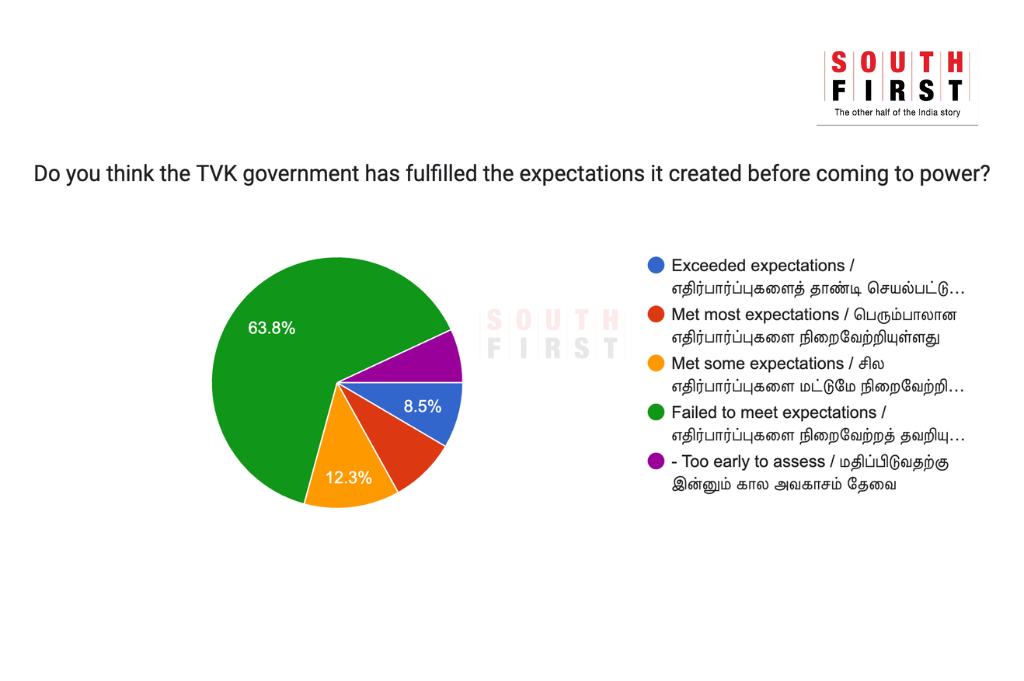
63.8% said the TVK government had failed to meet the expectations it created before coming to power.
The responses suggest that the period of waiting has not produced the level of satisfaction that the government may have hoped for.
Harine, 22, from Vandalur, acknowledged that the government had introduced some promising welfare initiatives but argued that there was still a significant gap between electoral promises and actual governance.
“The government must focus less on announcements and more on measurable results. People voted for change, and that change should be visible in their everyday lives,” she said.
Nisha from Chennai, despite rating the government positively, said TVK still needed to establish its administrative experience and ability to handle complex issues.
Antony Suresh A, 30, from Coimbatore, argued that the government was moving backwards rather than delivering meaningful development.
Another participant, Dhilip Antony, 26, from Chinnasalem, criticised what he described as poor administration and the use of vulnerable young people for political purposes.
However, some participants urged people not to arrive at a definitive conclusion after only six months.
Ramya, 21, from Namakkal, said it was too early to judge a government elected for a five-year term.
“The government has been in power for only six months. How can we decide its performance now? Only after five years will we be able to assess how the government has functioned. We should wait until the next election,” she said.
A Gokulakrishnan, 33, from Alandur, said the TVK government, which came to power promising change for the people, must demonstrate that change through actual governance.
He urged the administration to abandon political animosity and establish itself as a government that works for the people.
The contrast between these responses is important. Even those who believe the government deserves more time are not necessarily dismissing the concerns raised by critics. They are asking for patience, while expecting the administration to demonstrate results.
Also Read: Vijay and the meritocratic shift TVK’s arrival signals in erstwhile Dravidian Tamil Nadu
The final question in the survey sought to understand how confident people were about the TVK government’s ability to deliver on its promises over the next four and a half years.
The findings suggest that this is another major challenge for the administration.
Around 71.3 percent expressed low or no confidence in the government’s future performance.
More than half said they were not confident at all, while another section said they were not very confident.
This is perhaps the most consequential finding for Vijay. Dissatisfaction with the first six months is one problem; a lack of confidence in the government’s ability to improve during the remaining term is another.
Some participants have suggested that the Chief Minister should communicate with people more regularly. Others have called for transparency in decision-making, stronger policing, better public services and a focus on employment and the cost of living.
Shanmuga Priya, 27, from Chennai, criticised ministers for repeatedly saying that they were still learning instead of demonstrating that they were improving their administrative capabilities.
She argued that ministers should concentrate on acquiring knowledge and correcting their mistakes rather than spending time on television appearances and public relations exercises.
Michael Raj from Kanniyakumari also raised concerns about the government’s apparent unwillingness to learn from its mistakes.
For Vijay, this is an important test. The political capital he accumulated before the election cannot indefinitely substitute for administrative credibility.
Also Read: Vijay may soon discover that defeating Dravidian parties is easier than replacing them
The survey reveals a government that still has a supportive constituency but is facing considerable dissatisfaction across several important areas of governance.
The positive assessments demonstrate that some people believe the TVK administration has made a promising beginning. Others remain willing to give Vijay more time, arguing that six months is insufficient to judge a five-year government.
But the criticism is equally clear.
People are raising questions about women’s safety, law and order, employment, price rise, public services, corruption-free governance and the government’s commitment to transparency.
There are also concerns about the ideological direction of the administration and whether it is prioritising political messaging over the delivery of public services.
The most important finding is perhaps the relationship between people’s perception of Vijay and their confidence in his government’s future. The survey suggests that the Chief Minister’s personal political credibility and the administration’s ability to deliver are increasingly interconnected.
The TVK government entered office promising to change the way Tamil Nadu was governed. Six months later, the demand from a significant section of those who took part in this survey is for that change to become visible in their everyday lives.
The honeymoon period may be ending. The government now has to demonstrate that it can do more than win public attention, sustain political enthusiasm and promise a different kind of politics.
(Edited by Dese Gowda)



