

Published Jun 27, 2026 | 7:00 AM ⚊ Updated Jun 27, 2026 | 7:00 AM

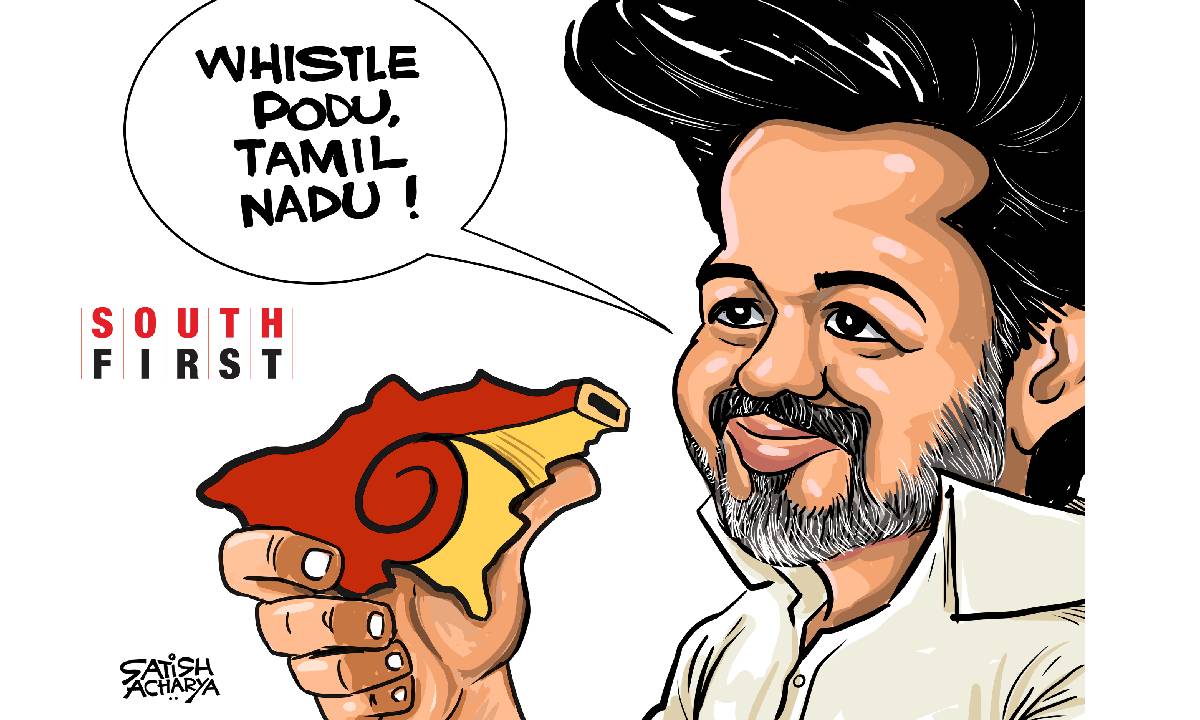
What changes will CM Vijay whistle into Tamil Nadu? Cartoon: Satish Acharya

Synopsis: The TVK aims to dismantle Tamil Nadu’s patron-client politics with a more professionalised state. This bold experiment will test if scientific prudence can finally turn fans into citizens.
The 2026 Tamil Nadu election did more than change a government; it attempted to rewrite the very definition of a “Dravidian State”.
By shifting from “identity-driven populism” toward what we must now analyse as the “professionalised state,” the Tamilaga Vettri Kazhagam (TVK), led by C Joseph Vijay, has replaced the traditional political machine with a “meritocratic” engine.
By selecting a group of 108 candidates, most of whom are graduates or postgraduates, several of whom also hold advanced qualifications such as PhD degrees, Vijay has challenged the “fame vs skill” binary that has long troubled Indian leadership.
Also Read: Vijay may soon discover that defeating Dravidian parties is easier than replacing them
A crisis of competence
The entry of the TVK represents not only a political decision but also a response to a broader systemic “crisis of competence”.
When we look at the data analysed by the Association for Democratic Reforms (ADR) from the 2024 Lok Sabha elections, it was indeed shocking to see ‘educational inequality’: 121 candidates were illiterate, and 647 had not even crossed class 8. This created a ‘dirt stigma’ with which a psychical gap was constructed between the intelligent and the “political” fields.
In Tamil Nadu, this stigma manifested as a “patrimonial political culture,” where the relationship between the leader and the voter was that of patron and client. The TVK’s primary challenge was to dismantle this “patron-client” cycle. The goal may have been to prove that politics could shift from being the private business of “party bosses” to a noble profession of “national service.”
Pragmatic Dravidianism: Science meets the soil
The “Pragmatic Dravidianism” approach advocated by the TVK aims to redefine the state’s political identity. “Whistle“, the TVK’s election symbol, signifies a call to address corruption and inefficiency.
The TVK’s ‘Vettri Tamil Nadu’ manifesto is largely welfare-oriented and is particularly targeted at women, youth, farmers and the less privileged. Yet, it differs from its predecessors by framing welfare not as a “gift” for the voter, but as a “commitment to Knowledge Supremacy.” This strategy specifically resonated with women and first-time voters who saw a path to “dignity” rather than just “dependency.”
Also Read | From social justice to Singapenn: The new ideological grammar of Vijay’s TVK
The data-driven mandate
TVK’s focus on educated leadership is supported by strong evidence.
Research on the Indian parliament shows that leaders with higher education are 7% more active. Areas led by educated representatives have also seen a 1.5% higher economic growth rate.
These results are based on data, showing that educated leaders help their regions grow faster and improve infrastructure.
The Ambedkarite blueprint
The TVK model reflects Dr BR Ambedkar’s vision of “Economic Democracy.”
Ambedkar argued that political democracy is incomplete without economic democracy, which requires eradicating caste-based discrimination and ensuring fair resource distribution. He established a school to train political leaders, aiming to develop representatives committed to nation-building. After his passing, this initiative and his vision for institutionalised leadership training diminished.
By selecting 108 candidates, many of whom are highly educated and domain experts, TVK has taken a big stride towards moving beyond the “Illusion of Democracy” and creating a “Substantive Reality” where governance is recognised as a specialised skill.
This also mirrors the Nordic concept of “Bildung“—a holistic approach to education that links individual self-cultivation with civic responsibility. If the TVK leaders follow these political ideas, they would not be rulers but “Instructional Leaders” who can facilitate “Distributed Intelligence” across the state.
Also Read | Politics of goosebumps; democracy as spectacle: Rise of Vijay as Tamil Nadu CM
Cabinet with its share of expertise
On May 10, 2026, the swearing-in of the TVK government revealed a “Hybrid Cabinet“, a team formed to handle challenges like the “Brazil Paradox,” which sees highly educated leaders sometimes struggling with the ground-level “retail politics” of winning elections in a multi-party system.
To address this, the party formed the Technocratic Vanguard of competent people, like Dr KT Prabhu (Dental Sciences), R Nirmal Kumar, who has degrees in engineering and law, Dr KG Arunraj, a former Indian Revenue Service officer and doctor, CTR Nirmalkumar, who holds a Master’s in Criminology and Police Administration, and S Keerthana (Master’s in Statistics).
At the same time, long-serving leaders like the 10-time MLA KA Sengottaiyan also contribute many years of experience that help keep “smart policy” grounded in “political reality”. This creates a strong balance between new ideas and proven wisdom.
The AI-driven state
To turn this technocratic vision into a reality for the common man, Vijay unveiled his “Agenda for 21st Century Good Governance”.
The cornerstone of this reform will be the Tamil Nadu Citizen Privilege Card. Functioning as an “Aadhaar-Plus” system, this card contains comprehensive data on every family member to ensure that welfare benefits reach doorsteps automatically from birth, eliminating the need for applications or bribes.
This “scientific” approach relies heavily on Artificial Intelligence (AI) to map and deliver schemes directly to citizens. To manage this, Vijay has announced the establishment of the country’s first Ministry of AI and plans to build an “AI City” to attract global tech giants.
By setting up AI innovation hubs in Madurai, Coimbatore, Salem and Tiruchi, the government aims to support 1,000 deep-tech start-ups. This is the “scientific” answer to the “stories” narrated by opposition or traditional politicians.
Cost of ensuring dignity
The TVK faces a significant challenge known as the “Disruptor’s Dilemma,” where the massive scale of their social vision is matched only by the massive scale of the resulting financial bills.
These welfare promises are the most expansive in the state’s history. This huge government spending includes schemes such as a monthly grant of ₹2,500 for women heading households, ₹4,000 for 10 lakh unemployed graduates, and 6 free LPG cylinders per family annually. To further support citizens, the plan includes 8 grams of gold and a silk saree for brides, as well as total crop loan waivers for farmers.
This massive push is estimated to cost nearly ₹1 lakh crore annually, a 52% spike in the welfare bill. Critics have warned that this “freebie politics” could lead to “economic decline” and “bankruptcy” by shrinking infrastructure investment. This has sparked a “Disruptor’s Dilemma”- while the TVK wants to move toward a “politics of dignity,” it must first survive the “competitive cycle” of welfare spending that has defined Tamil Nadu for decades.
However, the TVK differentiates itself by moving from “Gifts” to “Privileges.” They plan to fund this by erasing the 30% budget corruption inherited from the past and using the AI City to attract new investment. As senior political analyst Krishnaswamy John Sundar notes, Vijay has a “six-month window of goodwill” to prove his pre-poll promises, such as transparency and the eradication of corruption, can indeed generate revenue.
Fiscal transparency as a shield
In a rare move for a new administration, Vijay’s first act was to sign an order for 200 units of free electricity, while simultaneously releasing a Fiscal White Paper.
By exposing the ₹10.5 lakh crore debt, he has asked for “patience.” This is “Transparency as a Shield,” allowing the “Specialists” to audit the system before the full weight of the promises is felt.
Bridging the trust deficit
The TVK’s victory represented a psychological triumph rather than a political one, fueled by the strategic leverage of two distinct voter behaviours: “Ingroup Bias” and “Deference.”
In urban hubs like Chennai and Coimbatore, highly educated voters showed a strong association between their social identity and the TVK candidates, seeing them as mirrors of their own professional values. Meanwhile, in rural areas, marginalised voters exhibited a “Deference” toward the assumed competence of doctors and engineers, treating their advanced degrees as a reliable symbol of trust and intelligence.
This was amplified by a “Digital-First” social media strategy that successfully activated the “Standby Citizen”- the educated youth who had previously avoided the perceived “dirt” of politics but were waiting for a professional alternative. Ultimately, by bridging these two worlds, the TVK has restored “Political Trust” during a critical phase of the state’s development.
Also Read: Sridhar Vembu hails Vijay for fast-tracking rural school where DMK allegedly demanded money
From fandom to citizenship
The TVK’s success signals the birth of a “Participatory Political Culture“. By using social media, the TVK has turned a “fan-led movement” into an “institutional government.”
By selecting candidates like meat shop owner Madhar Badhurudeen alongside PhD holders, they have created an “Inclusive Meritocracy.” This prevents education from becoming a “new form of elitism” and instead promotes “Public Judgment.”
For the fishing community, the shift is already tangible. Increasing relief to ₹20,000 during ban periods and offering ₹5 lakh for seized boats proves the government is moving from rhetoric to “Durable Governance.”
New Dravidian standard
The rise of the Tamilaga Vettri Kazhagam represents a structural realignment in Indian politics. It’s an experiment in ” The Meritocracy Model.” It is a test to see if “Scientific Prudence” can overcome the “Freebie Trap.”
By aligning Ambedkar’s vision with modern technocratic excellence, C Joseph Vijay is attempting to change the very “grammar of governance.” It represents the combination of the “Actor-Politician” and “Expert-Statesman” models, demonstrating that education is the most fundamental criterion for building a truly excellent democracy.
(Views are personal. Edited by R Rajesh Kumar.)



