

Published Jul 02, 2026 | 2:00 PM ⚊ Updated Jul 02, 2026 | 2:47 PM

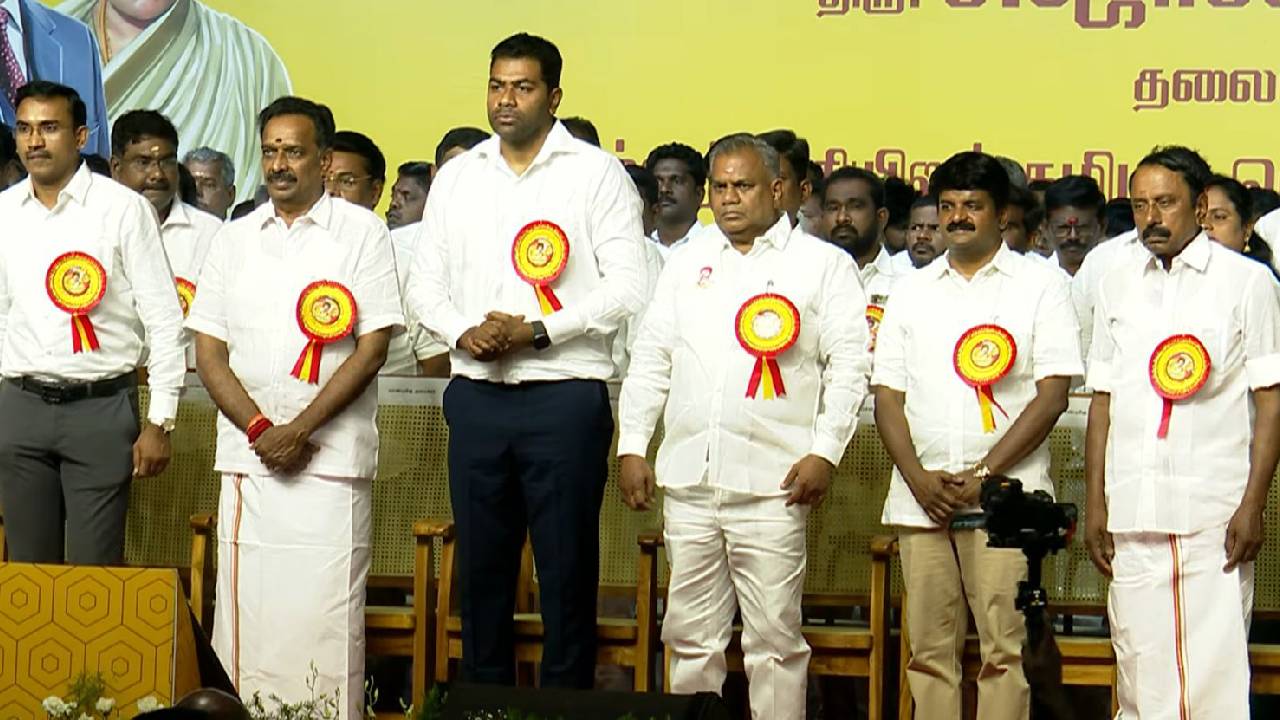
Several former AIADMK legislators joined the TVK on 2 July 2026.

Synopsis: From projecting itself as Tamil Nadu’s clean political alternative to inducting leaders accused in corruption cases, TVK’s latest political moves are drawing scrutiny. Critics now argue Vijay’s party risks turning into the state’s newest political “washing machine”.
Twenty-two-year-old S Yuvaraj was among those who voted for Tamilaga Vettri Kazhagam (TVK) in the Tamil Nadu Assembly election 2026. Although a fan of actor Ajith Kumar, Yuvaraj said he firmly backed TVK because it promised political change and its proclaimed commitment to building a corruption-free government.
However, in recent months, as leaders and cadres from several other parties have begun joining TVK, one particular trend has stood out: The steady influx of leaders from AIADMK, including former ministers, former MLAs, and sitting legislators.
Watching these developments closely, Yuvaraj has begun to worry that TVK could eventually transform into yet another corruption-ridden political party.
Speaking about his concerns, Yuvaraj said, “As a strong supporter of TVK, I believe CM C Joseph Vijay has done a commendable job in his first month. He has brought some much-needed changes. Though there are still several critical areas that need immediate course correction.”
“While expanding a political party naturally involves taking in members from other factions, the heavy influx of former AIADMK members, especially ex-ministers and MLAs with known histories of corruption, is a massive threat. If this continues, TVK risks losing its core identity and becoming just another corrupt party,” he added.
With the induction of former AIADMK ministers C Vijayabaskar and MR Vijayabhaskar, along with thousands of their supporters, on Thursday, 2 July, TVK inducted nearly six former AIADMK ministers, over 10 former MLAs, and thousands of district, union, and branch-level AIADMK functionaries.
The issue, critics pointed out, is that almost all of these leaders face at least one case, ranging from protest-related FIRs to land disputes, corruption investigations, and even cases being investigated by central agencies like the CBI.
This has become politically significant because until the election campaign, TVK repeatedly projected itself as a “clean force” and an anti-corruption alternative, often describing rival parties and their leaders as “evil forces.” Today, many of those same leaders are being welcomed into the party.
Senior journalist RK Radhakrishnan has gone so far as to describe TVK as “Tamil Nadu’s new washing machine”.
Also Read: ‘Attempt to poach 10 of us’, alleges TVK MLA
Among the leaders who joined TVK recently, former health minister C Vijayabaskar faces the most serious legal scrutiny.
In October 2021, the Directorate of Vigilance and Anti-Corruption (DVAC) registered a disproportionate assets case against him, alleging that he had amassed wealth far beyond his known sources of income. This was followed by searches across multiple properties linked to him.
In a separate multi-crore Gutka scam case, the CBI named him as an accused in an alleged bribery network connected to the illegal sale of banned tobacco products. In 2022, the CBI sought prosecution sanction, and the case was later transferred to a special court in 2024.
Former transport minister MR Vijayabhaskar also came under DVAC scrutiny in July 2021 when raids were conducted at 26 locations over allegations of irregularities in transport department tenders, including the procurement of GPS devices, speed governors and reflective stickers during his tenure.
Former minister Udumalai K Radhakrishnan was booked in 2017 after allegations that AIADMK workers obstructed Income Tax officials during raids connected to the investigation into the alleged cash-for-vote issue in RK Nagar, linked to C Vijayabaskar.
Former information minister Kadambur C Raju has also faced multiple controversies. During the 2021 Assembly election campaign, he was booked under Indian Penal Code (IPC) Sections 353 and 506 after allegedly obstructing election flying squad officials from checking his vehicle in Kovilpatti. The case was later quashed by the Madras High Court.
However, in October 2024, he, along with former minister SP Velumani and AIADMK cadres, was again booked in Thoothukudi following allegations of assaulting a church pastor after a road altercation.
More recently, former Adi Dravidar welfare minister N Subramanian, who served in the AIADMK government between 2011 and 2015, also joined TVK in the presence of party chief Vijay as part of the party’s latest round of inductions from AIADMK.
Subramanian is also under legal scrutiny after the DVAC registered a case against him and his daughter in September 2024 over an alleged job scam. According to the complaint, he allegedly collected nearly ₹65 lakh from multiple individuals between 2015 and 2016 by promising government jobs as cooks in Adi Dravidar welfare hostels.
After failing to secure the appointments, only part of the money was allegedly returned, leading to a complaint that was later transferred to DVAC for investigation.
These developments, according to senior journalist RK Radhakrishnan, show that TVK is gradually becoming Tamil Nadu’s new political washing machine.
Speaking about the leaders who recently joined the party, he says, “Most of the AIADMK leaders joining TVK are facing DVAC or CBCID cases. Some of them also face CBI investigations. TVK has become a local washing machine. The moment these leaders enter TVK, state-controlled investigative agencies are unlikely to aggressively pursue cases against them.”
However, on 1 July, Energy and Law Minister CTR Nirmal Kumar defended the party.
Speaking to reporters, he said, “If those joining our party have cases against them, those cases will be investigated according to the law.”
Radhakrishnan strongly rejected that explanation. “Nirmal Kumar is openly misleading the public. Either he doesn’t know enough, or he has no business with this. If a politician believes a party will continue investigating their own cases after joining, why would they join in the first place? This is basic common sense. By claiming legal action will continue, he is underestimating the intelligence of Tamil people.”
Reiterating his position, he said, “As far as I’m concerned, TVK is Tamil Nadu’s new washing machine.”
Meanwhile, a senior TVK functionary, who did not wish to be named, defended the party’s decision to induct leaders from other parties.
“Even in the DMK, leaders like O Panneerselvam were accommodated, given an MLA seat, and helped secure victory. So there is absolutely nothing wrong with an individual joining another political party as a member. That does not mean we will compromise on any issue concerning allegations or cases related to them,” he told South First.
He further argued that the growing exodus from the AIADMK reflects dissatisfaction within the party. “The reason senior leaders from AIADMK are joining TVK is that many of them see (AIADMK general secretary) Edappadi K Palaniswami as a betrayer. When they see him maintaining close ties with leaders like Senthil Balaji and the DMK, they believe that he has betrayed the party. As a result, genuine AIADMK loyalists are leaving and joining TVK,” he said.
Also Read: DMK seeks FIR against Vijay over alleged attempts to engineer political defections
Political commentator and professor Arun Kumar argued that TVK is pursuing survival politics.
“For them, the priority is to keep the government stable, and they will go to any extent for that. Congress may not pose a problem, but other alliance partners, such as the communist parties, have repeatedly opposed several political decisions from the beginning. Nobody knows when that support may weaken. So TVK is constantly looking for ways to strengthen its own independent political numbers.”
According to him, this is exactly why TVK is welcoming leaders whom it previously described as “corrupt forces.”
“We do not know how committed TVK truly is to anti-corruption politics. If it genuinely stood firm on that principle, leaders like Sengottaiyan, who face several allegations, would not have been welcomed. Right now, the party’s focus seems to be on running the government without instability.”
When asked why TVK is moving with such urgency despite currently enjoying strong public support and appearing capable of winning another election comfortably, Arun Kumar offered another explanation.
“The votes TVK received were not purely pro-TVK votes. A large part of it was anti-DMK and anti-AIADMK sentiment. So they cannot fully rely on their current 35 percent vote share. That is why they are pulling influential leaders from other parties into their fold.”
However, he also warned that this strategy could create problems in the future.
“Vijayabaskar may be electorally strong in Viralimalai, but what matters is how people across Tamil Nadu perceive him. More importantly, loyal young TVK workers who have worked hard for the party may feel betrayed. When powerful leaders enter districts, naturally they begin dominating local structures. Existing Vijay supporters who built the party from scratch will feel sidelined. The impact may not be immediate, but over time these decisions will definitely have consequences.”
He added, “The very voters who supported TVK expecting political change may eventually realise that nothing has really changed. The day that happens, the anger could turn against TVK itself.”
Journalist and writer Rajasangeethan said he sees nothing unusual in TVK’s actions.
“I am neither surprised nor shocked by what TVK is doing. Political parties engaged in electoral politics simply do what every other party does. TVK is no different.”
He compared the situation with national politics. “At the national level, the BJP has often used strategies aimed at weakening opposition parties in states. What TVK is doing in Tamil Nadu is somewhat similar. Within electoral politics, this is a well-tested formula, and no political party willingly gives up such an advantage.”
He argued the “washing machine” criticism may ultimately remain only a political narrative. “Whether TVK is a washing machine or not is not necessarily the biggest concern for the people who voted for them. Voters had many different reasons for electing this government. Right now, we are discussing this intensely because it has become a political narrative.”
For now, the question remains unanswered: Is TVK expanding strategically, or is the party slowly abandoning the anti-corruption ideals that helped bring it to power?
(Edited by Muhammed Fazil.)



