

Published Nov 07, 2026 | 9:30 AM ⚊ Updated Nov 07, 2026 | 9:30 AM

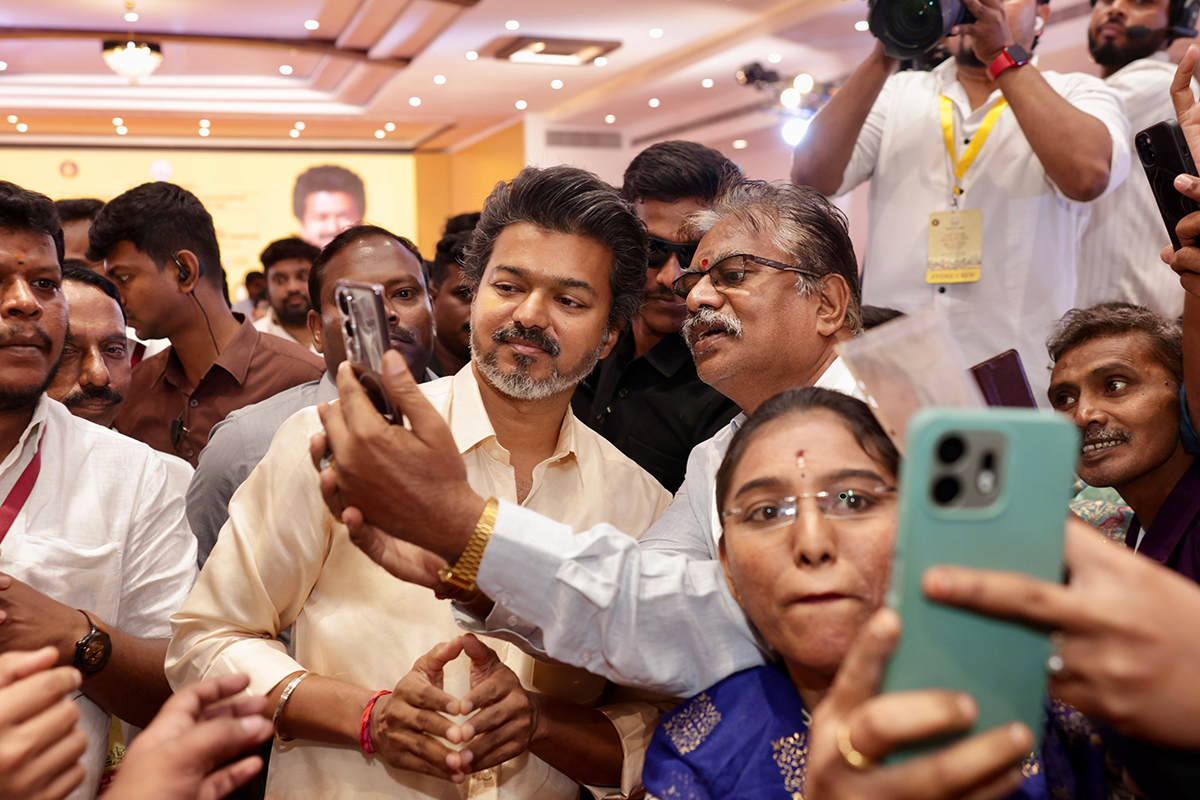
Tamil Nadu Chief Minister C. Joseph Vijay poses for a photograph during a public event. (Photo | x.com/CMOTamilnadu)

“I don’t even know when the Tamil Nadu government last bought new AC buses.”
That was the line a post on X led with on 25 August, alongside footage of Chief Minister C Joseph Vijay flagging off 130 air-conditioned electric buses at the Secretariat in Chennai. It closed with three approving hand signs and the word his supporters use for him: Anna.
Across social media, the rollout was celebrated as a signature triumph of the new Tamilaga Vettri Kazhagam (TVK)-led government’s first 100 days.
Nothing here is a complaint about the government. It put contracted buses on the road, which is its job. The TVK-supporting ecosystem around it did something else, and that will make complaining about the government harder when the time comes.
An electric bus fleet needs financing, a tender, a concession agreement, depots fitted for charging and months of manufacturing before a single vehicle reaches the road. Chennai’s fleet runs on the Gross Cost Contract model, under which the state pays a private operator, here Ashok Leyland’s OHM Global Mobility, a per-kilometre fee to supply, run and maintain the buses, while the Metropolitan Transport Corporation (MTC) sets the fares.
Strictly, no government “buys” a bus under this model. In ordinary speech, buying buses means putting new ones on the road and, by that measure, the answer to the question posed by the social media user is public record.
The 130 buses are the first batch of a 600-bus package backed by the World Bank and the Asian Infrastructure Investment Bank under the Chennai City Partnership. MTC floated the tender on 11 February 2025. The contract was awarded in November 2025, under the previous DMK-led government.
When netizens pointed out that electric buses had been running in Chennai since mid-2025 and air-conditioned ones since 11 August 2025, when 55 were flagged off from the Perumbakkam depot under the same model, the person behind the original post replied: “I did not say they were not running; I just said I did not know when they were bought.”
She is right. That is exactly what she said. And that is exactly the point.
The historian of science Robert Proctor calls it agnotology: the study of ignorance not as an innocent gap, but as something produced. His best-known case was the tobacco industry, which never needed to prove that cigarettes were safe. It only needed to keep uncertainty alive.
As a 1969 industry memo put it, “Doubt is our product”. By funding biased studies, creating fake debate and highlighting minority scientific opinions, the industry successfully manufactured confusion.
The bus post is agnotology in miniature. It asserts nothing, so nothing in it can be proved false. That is why it is not disinformation and why it works better than disinformation would.
It carries a conclusion it never has to state: there were no new buses for so long that nobody remembers, until Vijay Anna arrived. Not knowing is not a gap in the argument. It is the argument.
You can fact-check a lie. You cannot fact-check professed ignorance.
The ecosystem does not lie about what Vijay does. It erases everything around him, so that every routine act of the state becomes a personal feat of the man. The tender disappears. So do the engineers who readied the depots, the officials who negotiated the contract, the lenders who financed it and the government that signed it. What remains is one man and a ribbon.
The buses are not an exception.
When Vijay walked barefoot at the late composer Deva’s residence in October, as anyone in Tamil Nadu would at a house of mourning, posts called him the “most humblest CM ever” and declared the whole state “blessed”.
When he helped relight a ceremonial lamp at a conclave, it was rare composure.
When he held a rope steady at his first Independence Day flag hoisting, it was “unmatched preparedness“.
Bare feet at a funeral, a relit flame, a hand on a rope. These are everyday routines. The applause is not for the act. It is for the man performing it.
Two explanations are possible, and fairness demands both.
Some of this may be a coordinated operation; every major party in India now runs a digital war room, and none is above astroturfing. Or the people posting may simply admire Vijay and see in his ordinary gestures what admirers have always seen in their heroes. I am willing to give them that benefit of the doubt.
The argument does not depend on which is true. A paid campaign and a sincere fan arrive at the same destination: a state with no institutional memory and a leader with no ordinary moments. The intention differs. The effect does not.
Nor is credit-taking the problem. Every government cuts ribbons on projects it inherited. The DMK did it with metro phases begun under the AIADMK. The AIADMK did the reverse.
Continuity is honest when it is named. It becomes manufactured ignorance the moment the history is deleted, and a saviour is put in its place.
When this history was pointed out online, the replies followed a familiar sequence. The person who posted the original message insisted that “nobody with basic knowledge of governance” believes buses are built in 100 days, then demanded a five-year audit of the previous government’s fleet. Another called the critic a “DMK stooge” and pivoted to old tender rows. When neither worked, others turned to abuse.
Watch the order. Deny what the post implied. Bring up the last government. Go after the person asking.
And then comes the line every critic in Tamil Nadu knows by heart. “Did you ask the DMK-led government the same question?”
It does not matter. Questions go with the office, and whoever moves into the Secretariat inherits them along with the files. Nobody, in all of this, answered the one thing actually asked. When were these buses contracted?
That is the real damage. Once a leader is a hero, every question about the government becomes an attack on the man, and every questioner becomes an enemy.
Why does it work?
In 1957, the political scientist Anthony Downs argued that voters have little incentive to master policy detail, because a single vote rarely decides an election. He called it rational ignorance. That is not an insult to the electorate. It is a description of the terrain and political ecosystems know how to exploit it.
They do not have to fabricate a new history. They only have to count on nobody looking up the old one.
The tobacco industry’s product was doubt. The ecosystem’s product is a hero, and the method is the same: not a lie, but a carefully kept absence of knowledge.
A leader credited personally with the state’s routine work is also insulated from its failures.
If the buses are his gift, the next depot breakdown belongs to the officials. If walking barefoot at a funeral proves a pure heart, then a policing lapse, a flooded monsoon or a broken promise becomes a regrettable detail, forgiven before it is examined. Devotion does the work that scrutiny should.
Citizens are meant to judge a government as a government by its budgets, its contracts and its timelines. The ecosystem is teaching them to judge a hero as a hero.
Heroes are forgiven. Governments have to answer.
Also Read:
Dhanush, TVK and the politics of film stardom
Inside the Vijay push: Paid reels, PR networks and the ‘next PM’ narrative
(Shankar Prakash is a social and behavioural science researcher. He posts on X as @PhSoCr. This article draws on his X series “We Are Living in an Interesting Time” (#WALIAIT), which tracks the online politics of Tamil Nadu. Views are personal. Edited by R Rajesh Kumar.)



