
Published Jun 23, 2026 | 9:00 AM ⚊ Updated Jun 23, 2026 | 9:00 AM

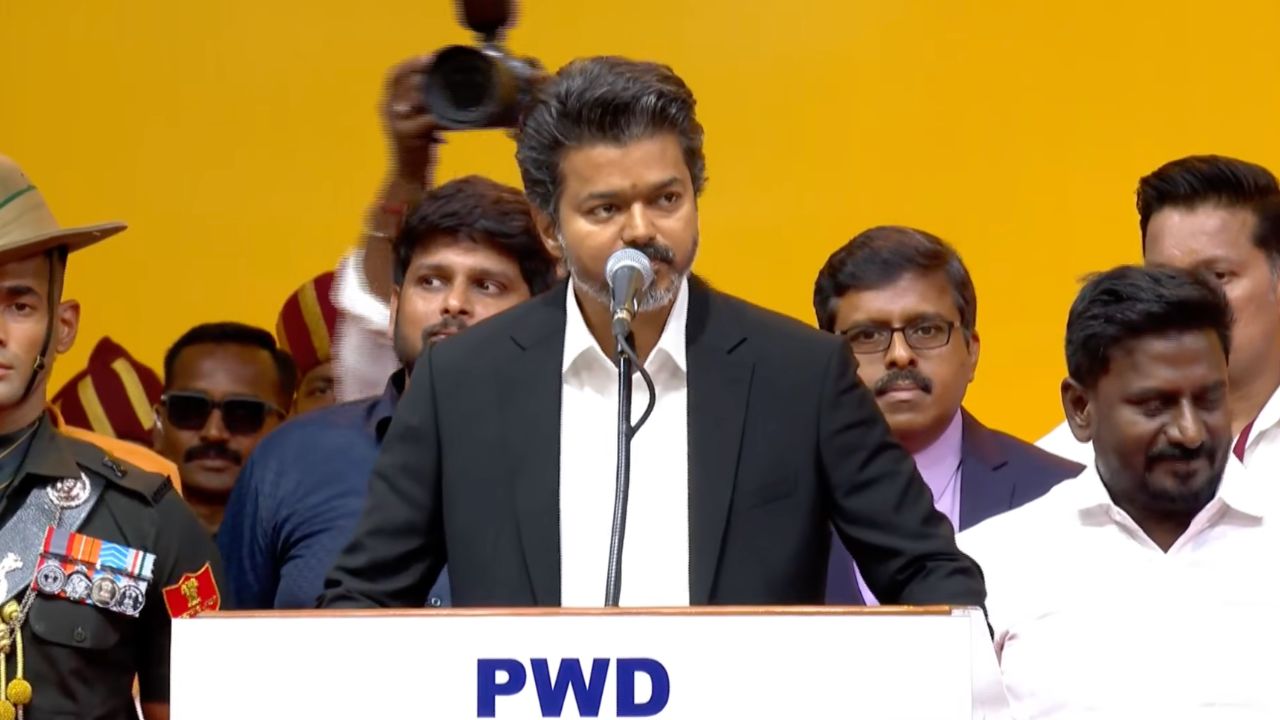
Vijay seen taking oath as the Chief Minister of Tamil Nadu on 10 May 2026. (File Image)

Synopsis: Vijay and the TVK have been given a mandate that comes with strict conditions and high expectations. These are early days for the government, but it is not too early to ask if a clear direction has emerged. And we must not forget the big challenges ahead…
Tamil Nadu’s 2026 election has been called a political earthquake. It was not. An earthquake reshapes the terrain. What happened in Tamil Nadu was closer to a controlled demolition.
Voters brought down a structure they had grown tired of, without being entirely sure what they wanted to build in its place. Vijay’s TVK emerged as the single largest party with 108 seats in the 234-member Assembly. It fell short of a majority and had to assemble a coalition to form the government. This is not a sweeping mandate. It is a provisional contract between voters and a new political force, one that comes with strict conditions and high expectations.
The real question raised by this election is not whether the Dravidian parties are in decline. That has been discussed for years. The deeper question is whether Tamil Nadu is witnessing the end of the Dravidian political order itself, or merely the weakening of the parties that have long represented it, and what is in store for the state. The distinction is crucial because that understanding will shape the state’s politics for the next decade.
The AIADMK faces the most fundamental challenge.
The party was held together for decades by charismatic leadership, first under MGR and later under Jayalalithaa. After Jayalalithaa’s death, it survived partly because voters did not see a credible alternative and because the DMK remained its principal rival. TVK has now emerged as that alternative. Internal rebellions may have subsided for the moment, but the party’s deeper problem remains unresolved.
Its identity was built less on a coherent ideology than on opposition to the DMK. That strategy worked as long as voters saw it as the principal challenger. Today, that position is no longer secure. The question before the AIADMK is no longer whether it can return to power. It is whether it can remain a major political force.
The DMK’s crisis is different but equally serious.
Its organisation remains intact. Its cadre base remains strong. Its ideological framework remains largely unchanged. However, almost its entire alliance has moved away.
Congress shifted quickly towards TVK. It was followed by the IUML, VCK, and eventually the Left parties. This exodus suggests that these parties no longer see the DMK as the indispensable centre of anti-BJP politics in Tamil Nadu. For decades, alliance partners needed the DMK more than the DMK needed them. Today, that relationship appears to have reversed. The party now faces the difficult task of redefining its political purpose rather than relying on its past dominance.
However, the most consequential challenge belongs to TVK itself. Unlike the AIADMK and DMK, its problem is not survival but performance. TVK came to power largely because voters invested their hopes in Vijay. Many of its candidates were unfamiliar figures with limited public profiles. Voters were effectively placing their trust in the leader rather than in the party’s broader leadership structure. That creates a politically risky situation. Expectations rise rapidly, and disappointment can follow just as quickly.
It is still too early to judge the government’s overall performance. However, it is not too early to ask whether a clear direction has emerged.
So far, the signals have been mixed. The promised free travel scheme for women has not taken off. Complaints about power cuts have triggered protests in several places. Farmer organisations argue that the government’s loan-waiver announcement falls short of the promises made during the campaign. Law and order, a major issue on which TVK criticised the DMK, has not shown visible improvement. Even the Singa Penn women’s safety initiative appears largely to be a continuation of an earlier scheme under a different name.
Questions have also emerged about the government’s administrative capacity.
Most ministers are first-timers. Campaigning and governing require very different skills. Early warning signs are already visible. Faced with complaints about power cuts, the Energy Minister suggested that the problem was being amplified through a conspiracy angle involving stolen fuse carriers. Another minister angered farmer groups by remarking insensitively that the life of a sportsperson was more difficult than that of a farmer, at a time when farmers were already unhappy about the government’s handling of loan waivers.
Equally striking is the government’s approach to public accountability. Despite leading a government elected on promises of change and transparency, Vijay has shown little inclination to engage with the press or submit himself to unscripted questioning. This reflects a wider trend in Indian politics where some leaders prefer controlled communication over direct media scrutiny.
These issues may appear minor when viewed separately. Taken together, however, they raise questions about the experience, judgment, and accountability required to govern a complex state.
TVK inherited voter expectations, but it did not inherit the decades of administrative experience, welfare delivery systems and local political networks that the Dravidian parties built over time. Electoral popularity can win power. It cannot by itself ensure effective governance.
Also Read: Political vengeance or routine? TVK-led government reshapes bureaucracy it once opposed
For the TVK, the next major test will come with the by-elections to the seats following the resignation of some members. The local body elections will also be an acid test.
Assembly elections can be won on the strength of public sentiment and leadership appeal. Local elections require organisation, negotiation, and the careful distribution of political rewards. TVK will have to accommodate the aspirations of Congress, VCK, IUML, the Left parties, and of course, its own cadres.
If allies receive too much, the party’s cadre may become dissatisfied. If they receive too little, coalition tensions will grow. Every coalition government faces this challenge. TVK must manage it while also proving that it is meant to stay beyond one election cycle.
An interesting paradox is at play here. TVK may soon discover that defeating the Dravidian parties was easier than replacing them. Tamil Nadu’s political culture remains deeply shaped by ideas associated with the Dravidian movement: social justice, welfare politics, linguistic identity, state autonomy, and secularism. These ideas do not belong only to the DMK or the AIADMK. They have become part of the state’s political dictionary. Any party that governs Tamil Nadu must eventually work within that framework.
In that sense, Vijay’s government already faces a contradiction. It rose to power by positioning itself against the Dravidian establishment. Yet it can govern successfully only by adapting many of the political practices and policy assumptions that emerged from that very tradition.
The signs are already visible. TVK is attracting AIADMK leaders and cadres and has even described the AIADMK as its “Thai Katchi” (mother organisation). The party that presented itself as an alternative to the existing order is gradually inheriting parts of it. Thus, the 2026 election should not be read as the end of the Dravidian era. What it ended was the comfortable duopoly through which the DMK and AIADMK dominated Tamil Nadu politics for more than five decades. What comes next, however, remains uncertain.
Nevertheless, three broad possibilities are visible.
TVK may govern competently, manage its coalition effectively, and establish itself as a durable political force, forcing both the DMK and AIADMK to reinvent themselves.
Alternatively, coalition tensions and administrative failures could weaken the government, creating an opportunity for the DMK to recover.
A third possibility is that TVK survives without decisively succeeding or dramatically failing, while the opposition remains too weak to offer a credible alternative. In that case, Tamil Nadu may enter a period of political drift marked by lowered expectations and incremental governance. And that would mean trouble for the state and the people.
Of course, at this stage, none of these outcomes can be predicted with confidence. That is why, for me, the most important story in Tamil Nadu today is not Vijay’s victory. It is the uncertainty that has followed it. The old order has weakened, but the new one has not yet taken shape. How that transition unfolds will determine the future of Tamil Nadu politics and the state’s growth and development.
(Edited by R Rajesh Kumar.)



