

Published Jul 10, 2026 | 9:00 AM ⚊ Updated Aug 10, 2026 | 11:17 AM

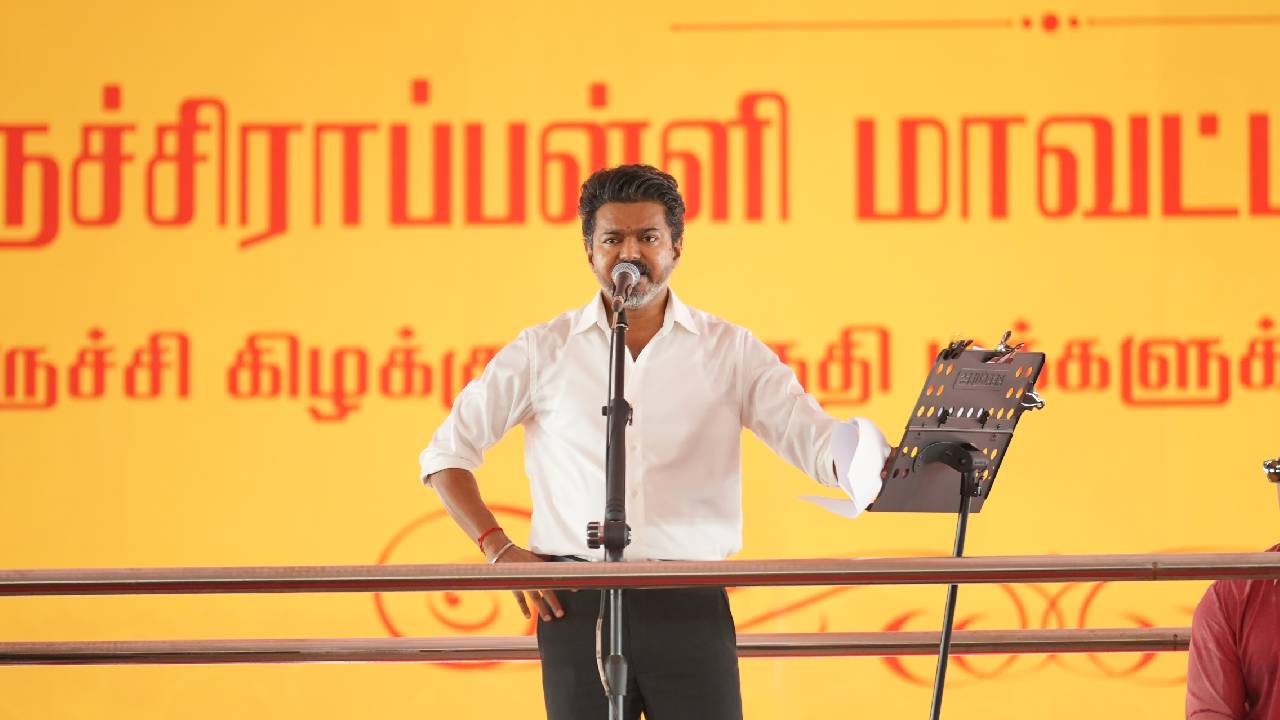
Tamil Nadu Chief Minister C Joseph Vijay addressing a rally in Tiruchirappalli on Monday, 1 June. (File Photo)

Synopsis: From viral Instagram reels to official government communication, the Tamil Nadu government’s first 60 days have been shaped as much by online narratives as by policy decisions. But where does governance end and perception management begin?
While scrolling through Instagram, a news card suddenly appears in Malayalam. It features a photograph of Tamil Nadu Chief Minister C Joseph Vijay alongside a group of students holding what appear to be school identity cards.
Curious, you translate the post. Published by an Instagram page with the username visit.travncore, which has over one lakh followers, it claims that Vijay has ordered the removal of caste names from students’ school identity cards. The caption praises the move, saying: “Vijay is providing a governance that is what the common people want.”
The post received hundreds of likes, numerous comments applauding the decision, and several shares. Thousands have viewed it.
Naturally, it creates a fear of missing out. You immediately check whether such an order has actually been issued by the Tamilaga Vettri Kazhagam (TVK) government in Tamil Nadu in the nearly 60 days since it assumed office.
There is no such government order.
Instead, what actually happened was this: Revenue and Disaster Management Minister KA Sengottaiyan, during a press conference, mistakenly stated that caste certificate details would be included in students’ identity cards. The statement sparked controversy. The very next day, he clarified at another press briefing that no such proposal existed and assured that caste details would not be added to school identity cards.
However, the Instagram page presented the issue as though Vijay had corrected an existing discriminatory practice.
This is only one among hundreds of social media posts that circulate every day about the Tamil Nadu government and its functioning. Some of them are true. Many others are exaggerated, misleading, or entirely false.
Also Read: BJP is passé; in Tamil Nadu, TVK is turning into the new political ‘washing machine’
Since Vijay assumed office on 10 May, similar videos have appeared across numerous Instagram accounts based outside Tamil Nadu.
Many of these videos follow an identical script. They begin with lines such as, “0% interest in Tamil politics… until Vijay became chief minister.”
Reportedly, the same reel has appeared not only on North Indian Instagram accounts but also on accounts based in Pakistan, raising questions about whether a coordinated social media campaign is underway.
Just as political parties, particularly TVK, effectively used Instagram and other social media platforms during the election campaign, concerns are now emerging that the same methods are continuing even after forming the government, influencing public perception of governance itself.
Soon after Vijay became the chief minister, the government announced the closure of about 717 TASMAC (Tamil Nadu State Marketing Corporation) liquor shops across the state.
Social media celebrated the announcement enthusiastically. Thousands of accounts praised the move as an unprecedented reform, with lakhs of people sharing posts portraying it as a historic first.
However, critics pointed out that the closure of several TASMAC outlets is a routine administrative exercise whenever a new government takes office.
More importantly, several liquor outlets located dangerously close to schools, hospitals and places of worship continue to operate.
One such example is TASMAC Shop No. 8825 in Ennore, Chennai, situated adjacent to a hospital campus. Residents have demanded its closure for years, yet it continues to function despite the latest round of closures.
The government’s own ministers have increasingly become subjects of social media discussion.
Recently, Industries Minister S Keerthana visited a government school in Virudhunagar district. During the inspection, she asked a student to answer questions in English. The video quickly went viral and triggered widespread criticism online.
Similarly, since TVK assumed office, district-level party functionaries have repeatedly visited government hospitals wearing doctors’ coats, conducted inspections in schools, insisted that portraits of the chief minister be displayed inside classrooms, celebrated Vijay’s birthday inside schools by asking students to wish him on camera, and uploaded these videos as reels across social media platforms.
The trend became so widespread that the Tamil Nadu government had to subsequently issue a warning that no one should visit government hospitals or schools merely to shoot social media reels and cautioned that action would be taken against violators.
Also Read: Industries Minister Keerthana tests government school student’s English, lands in hot water
Arun Kumar, a political science faculty member at a private university, told South First that this is information politics.
“They deliberately leak information first. If the public reaction is negative, they respond and modify the narrative. If the reaction is positive, they simply allow it to continue. That strategy has continued even after coming to power.”
According to him, even information about whether the chief minister will visit Karur often circulates unofficially before any formal government confirmation.
In Karur, 41 people were killed following a stampede during an election campaigning programme of Vijay.
Arun argued that the government’s communication strategy resembles Prime Minister Narendra Modi’s style of politics. “They believe social media alone can drive public opinion,” he said.
“Just as Modi rarely holds press conferences or engages directly with journalists, preferring formats such as Mann Ki Baat, Tamil Nadu is increasingly witnessing a similar model of political communication.”
Media entrepreneur Muralikrishnan Chinnadurai, founder of Muralikrishnan Chinnadurai MediaCorp OPC Pvt Ltd, believes the government is consciously building political narratives.
“The government is setting up narratives and believes governance itself can be driven through them. They are not merely using social media. They are also using government communication machinery,” he claimed.
He cited the Tamil Nadu Department of Information and Public Relations (DIPR) as an example.
During the first Assembly session under the TVK government, the official DIPR social media page uploaded a short video of Vijay’s Assembly speech under the headline, “Chief Minister’s strong reply to the opposition.”
Following criticism that an official government platform should not use politically loaded language, the video was deleted.
“You cannot use an official government communication platform to make political arguments,” said Muralikrishnan. “But they casually describe the chief minister as giving a ‘strong reply to the Opposition.'”
He also pointed to Assembly proceedings. “When the Speaker adjourns the House, Opposition MLAs leave. Afterwards, ministers continue responding to issues, and those videos are uploaded through official government channels. People unfamiliar with Assembly procedures may assume the Opposition fled in fear while the ruling party continued delivering powerful rebuttals. This is how narratives are constructed using government institutions.”
Muralikrishnan also referred to another recent example.
“A narrative was circulated claiming that the old practice of collecting ‘party fund’ had been abolished and that this would generate thousands of crores in additional government revenue. But where exactly was this money being collected? Who collected it? What evidence exists? How much financial loss did the government actually suffer? None of these questions has been answered,” he said
“If collecting party funds was illegal in the first place, how can that money suddenly become government revenue?”
Yet, he argued, such questions rarely receive attention because supportive PR agencies and coordinated social media networks amplify these narratives instead.
Also Read: Vijay and the meritocratic shift TVK’s arrival signals in erstwhile Dravidian Tamil Nadu
According to Arun, the government’s communication style should not be dismissed as inexperience arising from its first term in office. “This is not immaturity. This is how they intend to govern.”
He argued that during the government’s first 60 days, very few genuinely new initiatives had emerged. “Several announcements, including Singappen Task Force, are essentially continuations or rebranding of existing schemes.”
“Claims that corruption has already been eliminated cannot be verified within two months. Such assessments require six months, one year, or even until the next election. In reality, there has not yet been any fundamental transformation,” he said.
He also pointed to an election promise regarding electricity. “Before the election, they promised 200 units of free electricity every month. Now it has become 200 units every two months.”
According to him, the actual fruits of governance have not yet reached ordinary people.
“As time passes, people will not remain satisfied simply by watching reels. If tangible improvements do not materialise on the ground, they will begin asking difficult questions.”
“The real test for this government will come during periods of crisis. Social media reels alone cannot sustain governance forever”, said Arun.
(Edited by Muhammed Fazil.)



