

Published Nov 07, 2026 | 12:45 PM ⚊ Updated Nov 07, 2026 | 12:48 PM

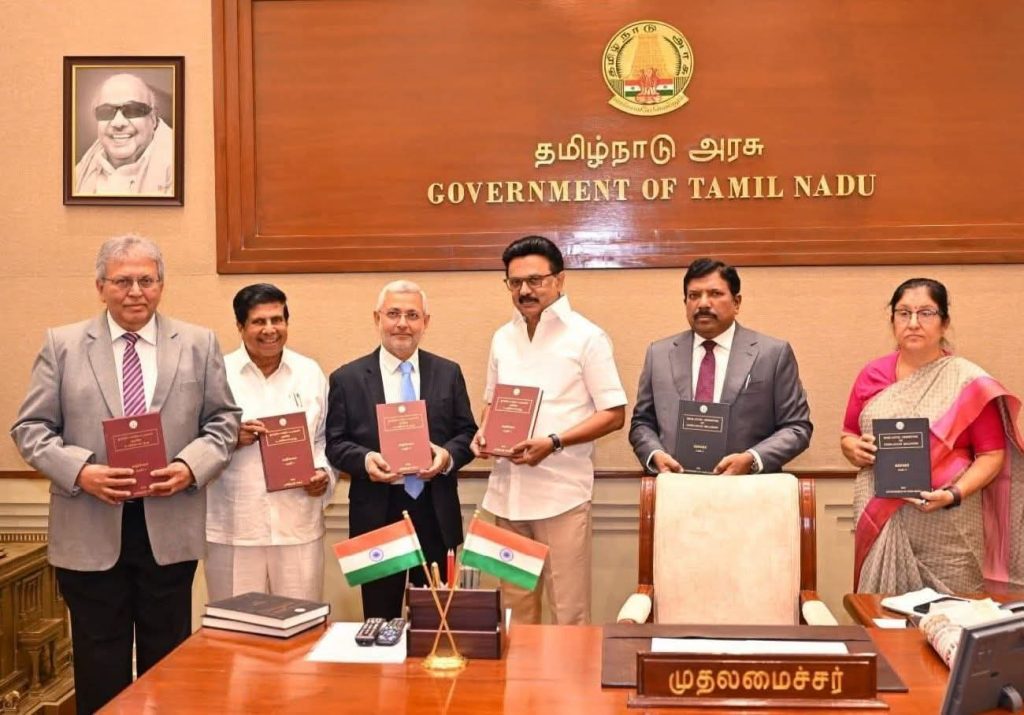
Retired Supreme Court justice with ex-CM MK Stalin. (Special Arrangment)

Synopsis: The TVK government has dissolved the Justice Kurian Joseph-led committee on Union-State relations, citing overlapping responsibilities with the State Law Commission, months after allegations surfaced that the government was systematically weakening the panel.
The Tamilaga Vettri Kazhagam (TVK)-led government has announced the immediate discontinuation of a High-Level Committee on Union-State relations, which was constituted by the previous Dravida Munnetra Kazhagam (DMK) government under the chairmanship of retired Supreme Court judge Justice Kurian Joseph.
The committee was constituted in 2025 to examine Centre-State relations and recommend measures to strengthen the autonomy of states.
Committee sources have alleged that the decision to disband the panel was part of a planned exercise by Law Minister CTR Nirmal Kumar.
In the Government Order, dated November 6, the Public (Law and Order-F) Department stated that the committee’s functions considerably overlapped with those of the Tamil Nadu State Law Commission, which was reconstituted in August 2026 with a mandate to examine Centre-State relations, review existing laws and recommend improvements to the state’s legal and institutional framework.
The government has directed officials to hand over all records and relevant documents to the State Law Commission. However, the order does not explicitly reject the recommendations already submitted by the committee or clarify whether its unfinished work will be continued by the State Law Commission.
Sources raised concern that the committee’s official website may soon be taken down, rendering its first report inaccessible to the public.
Also Read: How Vijay’s fan ecosystem turns routine governance into personal miracles
Committee sources have questioned the government’s justification for citing the State Law Commission as the reason for discontinuing the panel.
They pointed out that the State Law Commission was first constituted in 1994 and has subsequently been reconstituted periodically, generally for three-year terms. According to them, the terms of reference have largely been carried forward from one reconstitution to another through successive government orders.
They argued that the existence of the State Law Commission and its broader legal mandate cannot, by itself, explain why a specialised committee examining Centre-State relations had to be discontinued.
“We came to know about the developments only after 7 pm on November 6. We immediately vacated the office. They seem to have deliberately chosen a long weekend to carry out this exercise,” a source said.
South First had earlier reported that the committee was facing pressure under the TVK government, including allegations of efforts being made to persuade Justice Kurian Joseph to step down as chairman. The reports also highlighted the alleged role of Law Minister CTR Nirmal Kumar in the attempts.
There were indications that the committee faced growing administrative difficulties after the TVK government assumed office in May 2026.
Committee sources alleged that the government had been weakening the institution by failing to renew the contracts of its employees and research personnel. The non-renewal of contracts gradually affected its ability to continue the research and prepare the remaining volumes of its report.
Sources also pointed out that Justice Kurian Joseph was yet to meet Chief Minister C Joseph Vijay after the new government assumed office. They alleged that the Law Minister was instrumental in the developments.
“When I spoke to people in the higher levels of the administration, several of them firmly indicated that Law Minister CTR Nirmal Kumar was behind this. The name of Chief Secretary B Sai Kumar also came up during these discussions. Therefore, I believe these two officials were responsible for the developments,” a source said.
“When even the Union government had not shown much interest in this committee, it is difficult to understand why the TVK government was so concerned about it that it decided to discontinue it,” they added.
The DMK government, led by former Chief Minister MK Stalin constituted the three-member High-Level Committee on Union-State Relations on April 15, 2025, with the objective of examining the constitutional and legal framework governing relations between the Union and state governments.
Headed by retired Supreme Court judge Justice Kurian Joseph, the committee comprised former Vice-Chancellor of the Indian Maritime University K Ashok Vardhan Shetty and former Vice-Chairman of the Tamil Nadu State Planning Commission Professor M Naganathan.
The committee was constituted against the backdrop of longstanding disagreements between the state and central governments over the distribution of legislative, administrative and financial powers.
The DMK government argued that the increasing centralisation of powers, the role of Governors, the expansion of the Concurrent List, centrally sponsored schemes and the Union government’s influence over subjects traditionally administered by states had weakened India’s federal structure.
The committee was expected to examine constitutional provisions, existing laws, government orders and administrative arrangements affecting Centre-State relations. It was also tasked with examining subjects originally placed in the State List but subsequently moved to the Concurrent List and recommending measures to restore greater autonomy to states.
The exercise was also intended to revisit the recommendations of the Justice P.V. Rajamannar Committee, constituted by the then DMK government in 1969, and examine the political, social, economic and constitutional developments that had taken place since then.
The Rajamannar Committee had submitted its report in 1971, making several recommendations to strengthen state autonomy. The Sarkaria Commission (1983–1988) and the Punchhi Commission (2007–2010) subsequently examined Centre-State relations at the national level.
The Justice Kurian Joseph Committee was intended to undertake a fresh and comprehensive review of India’s federal structure in the context of contemporary political and constitutional developments.
Also Read: Defamation case over CM Vijay remarks | Police must act without discrimination: Madras HC
The committee submitted Part I of its report to the then Chief Minister MK Stalin on February 16, 2026. The 387-page report was subsequently tabled in the Tamil Nadu Legislative Assembly.
It covered ten major areas, including decentralisation and state autonomy, constitutional amendments, territorial integrity, language policy, the role of Governors, delimitation, elections, education, healthcare and the Goods and Services Tax.
Among its significant recommendations were changes to the process of appointing Governors, restrictions on their discretionary powers, greater safeguards for states in constitutional amendments, protection against language imposition, restoration of education to the State List and changes to the GST Council’s decision-making structure.
The committee also recommended extending the freeze on the allocation of Lok Sabha seats between states until 2126 or until fertility rates converge among states.
These recommendations were intended to strengthen the constitutional position of states and address what the committee viewed as an imbalance in India’s federal structure.
Importantly, the committee’s work did not end with the submission of its first report.
The remaining volumes were expected to examine Union-State financial relations, public services, inter-State river water disputes, emergency provisions, national security, legislative and administrative relations, mines and minerals, local governance, disaster management, forests, environment, climate change and digital governance.
The committee had informed the government that its expanded exercise could continue until December 2027.
With 60-70% of the work on the second volume already complete, the government’s decision to disband the committee raises serious doubts about whether the report’s final part will ever be published.
The committee’s difficulties had already become a political issue in September 2026.
South First reported on September 17 that the committee was facing administrative uncertainty, with staff contracts not being renewed and its ability to continue the research for the remaining reports being affected.
On September 24, South First reported allegations that pressure was being exerted on Justice Kurian Joseph to step down as chairman. A subsequent report on September 26 examined the alleged role of Law Minister CTR Nirmal Kumar in the committee’s uncertain future.
The issue also drew criticism from DMK leaders. Leader of Opposition Udhayanidhi Stalin accused the TVK government of deliberately weakening the committee by allowing staff shortages to disrupt its functioning.
Also Read: Dhanush, TVK and the politics of film stardom
The decision to disband the committee has drawn criticism from political leaders and legal experts across the country.
Senior Supreme Court advocate Sanjay Hegde, in a post on X, criticised the government’s decision.
“A shame that a thoughtful, academic exercise into the nature of Indian federalism, headed by one of India’s most respected judges, has been abruptly terminated like this. The committee’s first report produced a very incisive look into various aspects of our federal architecture. I wonder if any other state Government could ask the same committee to continue the task and produce further reports,” he wrote.
Leader of Opposition Udhayanidhi Stalin condemned the decision and accused CM Vijay of “betraying” the state.
“I strongly condemn this dummy government for dissolving the committee constituted under our Dravidian Model government to examine Union-State relations. By dissolving this committee, headed by former Justice Kurian Joseph and comprising administrative, legal and economic experts, this Dummy CM has betrayed Tamil Nadu. Having cancelled the committee by citing the functions of the Tamil Nadu State Law Commission, what other plans do they have to protect the rights of the states?” he asked in a post on X.
Former Chief Minister and DMK president M.K. Stalin also reacted to the development through a brief post on X.
State Rights❌
Theatre Rights✅— M.K.Stalin (@mkstalin) November 7, 2026
The discontinuation of the committee raises questions about the future of Tamil Nadu’s efforts to strengthen state autonomy.
While the TVK government has maintained that the committee’s functions overlap with those of the State Law Commission, the two bodies had different institutional purposes and approaches.
The Kurian Joseph panel was specifically constituted to undertake an extensive examination of federalism and the distribution of powers between the Union and states.
Although the government has ordered the transfer of the committee’s records to the State Law Commission, it has not clarified whether the remaining two volumes will be completed, whether the original research team will be retained or whether the recommendations in the first report will be pursued.
The first report remains part of the public and legislative record. However, the specialised exercise to examine the remaining constitutional and institutional questions has now been discontinued.
The larger question is whether the TVK government intends to continue the previous government’s initiative to strengthen Tamil Nadu’s case for greater state autonomy or whether the transfer of responsibilities to the State Law Commission will effectively bring the exercise to a halt.
(Edited by Fayisa CA)



