

Published Oct 08, 2026 | 12:20 PM ⚊ Updated Oct 08, 2026 | 12:30 PM

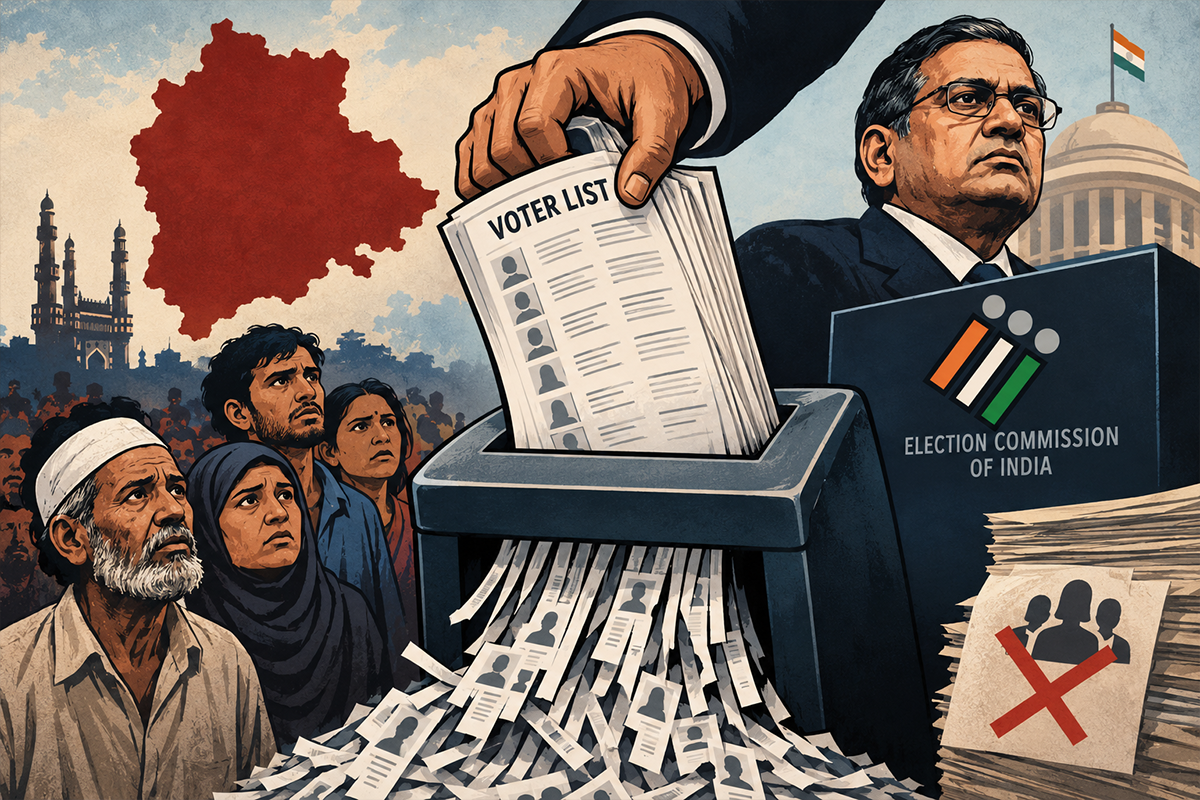
Image used for representational purpose. (AI generated image)

Synopsis: As we get to know more about the SIR process in Telangana, questions are being raised over the deletion of 73 lakh names, notices issued to 60 lakh people, disproportionate deletions of Muslim voters and the use of pre-printed Form 7 applications in several constituencies.
The destruction being carried out by the Election Commission, under the stewardship of Chief Election Commissioner Gyanesh Kumar, in the name of the Special Intensive Revision (SIR)—specifically in relation to voters and, more broadly, in relation to Indian democracy as a whole—is throwing up more and more skeletons the deeper one digs into the massacre of electoral rolls. It is becoming clearer by the day that the Special Intensive Revision is not really what it says at all. It could well be a Special Intensive Removal, or a Sangh-sponsored Intentional Removal.
So far, broad figures and details have emerged showing that 13 crore plus voters have been deleted across the country, and that in individual States 60 lakh, 70 lakh or even 90 lakh voters have been made to vanish. The protests by the Opposition, the agitation by the Cockroach Janata Party, the suppression of the views of his fellow Election Commissioners by the Chief Election Commissioner, as revealed by an investigative report in The Indian Express, and the Election Commission’s lie that the Supreme Court had permitted the exercise—one juicy episode after another is coming to light every day.
However, among these nationwide details and statistics, not much has emerged so far specifically about Telangana.
There have been reports that 73 lakh names disappeared from the draft electoral rolls and that notices were served on 60 lakh people. Some comical details have also emerged about who received notices and how they received them. But the more closely one investigates, the more shocking facts are coming to light. In particular, it is becoming clear that the deletion of Muslim voters has been disproportionately high compared with their share in the population and has been carried out arbitrarily, without hearing their claims, raising the possibility of ulterior motives behind it.
Before the SIR process began in Telangana, the total number of voters on the electoral rolls was 3,38,26,448. In the draft roll published after the SIR process, 73,40,339 names were removed, reducing the list to 2.65 crore. Of these, 53,97,791 names were removed under the ASDD categories—Absent, Shifted, Dead and Duplicate.
The big question is whether those removed actually belonged to these four categories, or whether a decision was taken at some level to remove them and the decision was then implemented. It is equally questionable whether the reasons cited in the notices were valid and whether the right to vote is actually being restored when people respond to the notices and submit the documents demanded of them.
Against this background, there needs to be a great deal of investigation into the irregularities committed by the Election Commission in the revision of electoral rolls in Telangana. Political parties should take up the task, and civil society should take it up as well. At the very least, the media should investigate these irregularities and place complete, factual information and analyses before the people.
Unfortunately, however, neither the Telugu, English and Urdu newspapers published from Telangana, nor the 24-hour news streams that otherwise make more noise than necessary, have taken up even this minimum public-interest responsibility. It is not that they have published no stories at all about irregularities in the electoral rolls or the farcical state of the SIR process.
They have published one or two stories. But they have not undertaken the kind of comprehensive investigation necessary to reveal, with examples, what exactly has gone wrong on the whole.
The attempt to undertake such an urgently necessary exercise has come from the Kolkata-based independent organisation, the Sabar Institute. Based on information provided by that research organisation, and also through its own research, collection of information and analysis, Frontline, the fortnightly magazine published by The Hindu group from Chennai, has published comprehensive reports. My thanks and congratulations to journalist Ayesha Minhaz, who, through three detailed articles in the latest issue of the magazine, packed with information, has brought the confusion surrounding the SIR process in Telangana vividly before the public and analysed it.
If one looks at the deletions from the electoral rolls in Telangana as part of the SIR process, a particular pattern is visible in the constituencies won by the Bharatiya Janata Party in the 2023 elections. In the seven constituencies won by the Bharatiya Janata Party in those elections, Muslims account for 45 per cent of the names deleted under the category “untraceable/absent”. How did such a disproportionately large number of Muslims become untraceable or absent, when their share of the population is much lower? This needs to be investigated.
Similarly, Muslims account for 17 per cent of those whose names were deleted because they were dead. It is astonishing, ridiculous and suspicious to claim that such a large number of Muslims died between the electoral rolls preceding the SIR process and the time of the SIR process, a span of a few months! The figures are different in constituencies won by other parties.
Apart from these ASDD deletions, notices were issued to 92,87,577 people whose names still appeared in the draft roll. Of these, the reason given for issuing notices to 60 lakh people was “logical discrepancy”! For 32 lakh people, the reason was that they did not match the 2002 electoral roll—that is, they were not mapped. They were given a list of documents and asked to produce them and prove that they were voters. The process of issuing these notices was carried out in a chaotic manner.
In fact, there is no meaningful basis for terms such as “logical discrepancy” and “not mapped”. Spelling errors in a person’s name or father’s name, incorrect house addresses, a difference of less than 14 years between a mother and her children and a household having more than six members have all found their way into “logical discrepancy”. Looking at them, they appear to be reasons manufactured for deleting names rather than reasons for protecting the right to vote.
The people who devised this system seem not even to have had the elementary awareness that names in the languages of this country can be written in different ways when transliterated into English, and that a person cannot be blamed merely because a computer failed to recognise the variation. Nor does the Election Commission appear to have the elementary awareness that child marriages and joint families still exist in this country, and that crores of people may not possess the documents demanded by the Commission.
Names have been indiscriminately struck off in Hyderabad and across the State under the labels ASDD, logical discrepancy and mapping. While Muslims constitute 8.8 per cent of the population in the rest of Telangana excluding Hyderabad, they account for 12.5 per cent of those whose names were deleted from the electoral rolls. Of the 532 booths examined by Sabar, in 512 booths the same reason—”permanently shifted”—was given for more than 95 per cent of those whose names were deleted.
In 13 booths, not a single person among those whose names were deleted was classified as dead or duplicate. Every single one was given only the reason “permanently shifted”. This means that these deletions were not based on actual reasons or on field verification; it indicates that they were deliberate.
The number of women among those deleted is also higher. The fact that 71 per cent of them were married women and were above the age of 45 makes the deletion suspicious. In the 104 constituencies outside Hyderabad, there were 2,350 transgender persons on the 2023 electoral rolls. Now, in the draft rolls, nearly half of them—1,152 transgender persons—have had their names deleted.
The Frontline journalist met eight voters whose names had been deleted for being “untraceable/absent”. They said that they had submitted enumeration forms during the SIR process and that they still possessed the receipts signed and issued by the BLOs. The journalist also met voters whose names had been deleted because they had “permanently shifted to other places”. There was no need whatsoever to delete their names.
Similarly, in many cases it turned out that the claim that they did not match the 2002 SIR list and had not been mapped was also not true. According to Hyderabad District Congress Committee president Syed Khalid Saifullah, 1,50,000 people whose names were on the rolls when the BLOs carried out the mapping exercise in Bahadurpura, Chandrayangutta, Charminar and Yakutpura before the SIR process were suddenly removed from the draft rolls under ASDD!
Most disturbing of all is the confusion surrounding Form 7. According to the procedure, Form 7 is to be used either to raise an objection to any name appearing on the electoral roll or to request that a particular name be deleted. Therefore, there should ordinarily not be a very large number of such applications. Yet, in many constituencies in Telangana, pre-printed Form 7 applications were found, with the names of the voters to be deleted already printed on them.
In the Musheerabad Assembly constituency, a single Bharatiya Janata Party booth-level agent (BLA) submitted 30 Form 7 applications with the names already printed on them. Similarly, 15 such applications were submitted in the Goshamahal constituency. In these pre-printed applications, the person objecting had filled in by hand their own name, Election Commission identity-card number, mobile number and signature. But the name, Election Commission identity-card number and mobile number of the person whose name was being sought to be deleted had already been printed somewhere and sent along. In other words, a decision had been taken somewhere else as to whose names were to be deleted in a particular constituency.
In reality, everything that has emerged so far is like a crow dropping in the ocean—merely illustrative of a much larger problem. As more details, documents, statistics and procedures relating to the SIR process emerge, there is no telling how many more irregularities will come to light.
Also Read:
Indira Gandhi, Narendra Modi and the march of folly: The same mistake, fifty years apart
‘India roars louder than ever’: Gyanesh Kumar SIR, please get out
Why CEC Gyanesh Kumar should resign, and why the appointment process needs to change too
(Edited by R Rajesh Kumar.)



