
Published Oct 06, 2026 | 12:17 PM ⚊ Updated Oct 06, 2026 | 1:16 PM

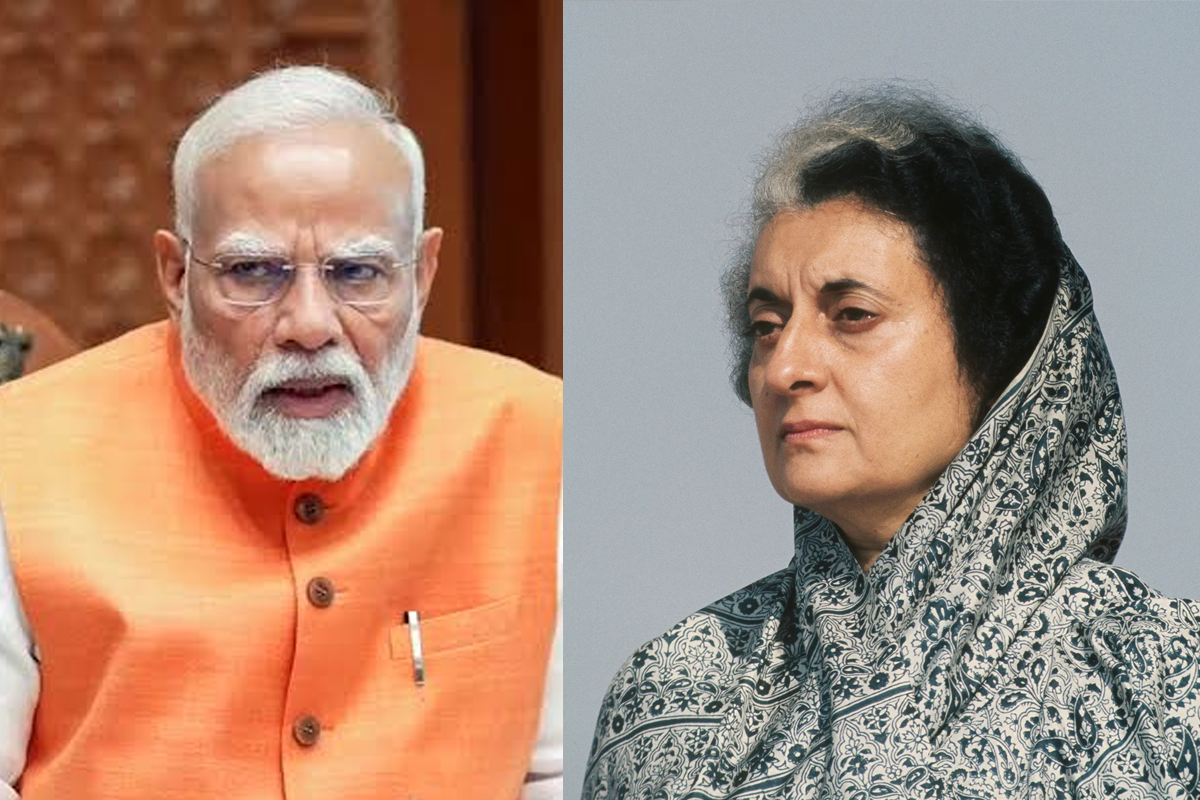
Narendra Modi and Indira Gandhi

Synopsis: It was Indira Gandhi in 1975. It is the Modi government in 2026. A look at why power at its peak refuses the simple decision that could save it.
Throughout history, there are many examples of individuals and institutions that plunged into crisis at the peak of their power, lost their sense of reality, and failed to make the simple decisions that would have defused the situation, brought them out of it and served their immediate and even medium-term interests. Even an ordinary man on the street could have advised them to take such decisions — if only they had bothered to ask.
The historian Barbara Tuchman coined a term for it, the “march of folly”: the pursuit by those in power of a course contrary to their own interest, when better alternatives were visible and available. Many Indian languages have their own phrase for it: it happens when Shani (Saturn) is dancing on one’s head.
India offers two cases of this, fifty-one years apart, on a day when demands for the Chief Election Commissioner’s resignation have intensified, with Leader of Opposition Rahul Gandhi sending the message out loud and clear through his “Gyanesh, it’s done, bro” placard.
In 1975, Indira Gandhi and the Congress, at the height of their power, faced a crisis over the legitimacy of an election and chose force over a simple retreat. In 2026, Narendra Modi and the BJP, at the height of their power, face a crisis over the legitimacy of the electoral process and appear to be making the same choice, with the latest example being the overwhelming security presence that greeted the Opposition’s march from Parliament to the Election Commission.
We know how the first story ended, but those who lived through it had the same doubts we have today. The second story, in which we are living now, might go the same way — but we do not know yet. This article places the two side by side to ask what the first story can teach us about the second, and where the comparison breaks down.
Before going further, I must declare my own position, because any analysis of this kind is coloured, even tainted and biased, by the beliefs of the person writing it. Mine are three.
First, I believe that democracy means everyone is equal before the Constitution, and that individuals and institutions, without exception, must follow the Constitution and operate within its limits.
Second, I believe that the Modi government and the BJP are deliberately damaging the very foundations of our democratic institutions and the spirit of the Constitution.
Third, I believe that the people, and particularly the youth, should peacefully protest against such tendencies, in order to protect democracy in the larger and long-term interest of the nation.
Those who were in power fifty years ago, and those who rule now, would never say that they do not respect or uphold the Constitution. They would want people to believe that whatever they are doing is only to strengthen democracy and the Constitution. They may well hold that belief as sincerely as I hold mine, and from where they stand, their beliefs may appear equally rational. I will return to them, because the argument of this article depends on taking them seriously.
In 1971, Indira Gandhi was at her zenith. She had won a landslide in the general election, and within months had led India to victory in the war that created Bangladesh. Congress ruled the centre and most of the states. Few Indian leaders have ever held so much power.
Within three years, the mood had turned. Inflation, unemployment and corruption fuelled an agitation that began not with political parties but with students. In Gujarat, the Navnirman movement of 1973–74 forced the resignation of the state’s Congress Chief Minister. The youth had won their first round. In Bihar, students invited Jayaprakash Narayan to lead them, and the movement grew into his call for “total revolution”.
Then came the decisive blow. On 12 June 1975, the Allahabad High Court, hearing an election petition filed by Raj Narain, found Indira Gandhi guilty of electoral malpractice, set aside her election to the Lok Sabha and barred her from elected office for six years. The grounds were widely regarded as technical; she was cleared of the graver charges.
But the judgment struck at the one thing that mattered most: the legitimacy of her mandate. Hold on to that phrase — the legitimacy of the mandate — because it is exactly what is at stake again today.
She had simple options. She could have stepped aside while she appealed, let a trusted colleague hold the office for a few months, and returned either vindicated by the Supreme Court or as a martyr to a technicality. That option was there; she did not choose it. Her party had an overwhelming majority, and her personal popularity remained formidable. A graceful retreat would have cost her little and might have strengthened her immensely.
Instead, on the night of 25 June 1975, she had the President proclaim a national Emergency on the grounds of “internal disturbance”. Opposition leaders — Jayaprakash Narayan, Morarji Desai, Atal Bihari Vajpayee, LK Advani and thousands of others — were arrested. The press was censored.
Parliament amended the Constitution to place the Prime Minister’s election beyond the reach of the courts, and changed the election law with retrospective effect. In April 1976, the Supreme Court, in the ADM Jabalpur case, held that citizens could not approach the courts even to challenge unlawful detention. One judge, HR Khanna, dissented, and paid for it by being superseded for the post of Chief Justice.
Every institution that might have checked her was bent to her will. And for a while, it worked. I recall all this for the benefit of the Gen Z generation: everything they are facing and dealing with today — and more — was faced by the young people of that time.
Fifty years later, the BJP and the Modi government are at the very top of their electoral fortunes. They rule most of the key states, and Narendra Modi has been Prime Minister since 2014 — twelve years of uninterrupted power at the Centre. By any conventional measure, this is a regime at its zenith.
And again, the challenge has come not from the established opposition but from the young. The Cockroach Janta Party (CJP) began in May 2026 as an online satire — its very name a mocking echo of the BJP — born of the anger of young Indians at being dismissed as lazy, unemployable and, finally, as “cockroaches”.
The CJP is not a registered party and fields no candidates. Yet within weeks it had tens of millions of followers, its account on X was withheld in India, and it had moved from the screen to the street. Like the students of Gujarat in 1974, it has already won its first round: in July 2026, after weeks of protest over the NEET examination fiasco, the Union Education Minister, Dharmendra Pradhan, resigned.
The second round concerns the Election Commission of India. Its Special Intensive Revision (SIR) of the electoral rolls, meant to remove ineligible names, has reportedly removed some 13 crore names from the draft rolls. An investigation by The Indian Express has now reported that the two other Election Commissioners, Sukhbir Singh Sandhu and Vivek Joshi, had raised objections with Chief Election Commissioner Gyanesh Kumar at least fourteen times in ten months, and that some decisions were taken without their knowledge.
The Election Commission is a constitutional body meant to act collectively; a Chief Election Commissioner overriding his colleagues strikes at its legitimacy. The Commission says differences are normal and the final decisions were unanimous. It has not refuted the reporting.
The CJP has demanded the CEC’s resignation and has been on the streets since 2 October with the Opposition. Removing a CEC requires the same demanding parliamentary process as removing a Supreme Court judge, which is why the movement is pressing for resignation rather than impeachment. It is worth noting the asymmetry: a CEC is removed through a long and rigorous ‘democratic’ process, but appointed through a far simpler one, now largely in the hands of the government of the day.
Once again, there were simple options available to the ruling party. The Election Commission is not a BJP office. The party could have said: we are not responsible for the Commission; it is an independent constitutional body and must explain itself. Better still, it could have quietly eased the CEC out on some pretext and removed the very target around which the protests are gathering. It could say that it too is not satisfied with the Commission’s functioning, and that the Commission must answer the questions raised.
Instead, the BJP has defended the Commission as if it were its own. In doing so, it has converted an allegation that was hard to prove — that the Commission acts at the ruling party’s behest — into something close to an admission. That is exactly the point the CJP’s founder, Abhijeet Dipke, made at one of his press conferences: instead of the Election Commission giving an explanation, why is the BJP speaking on its behalf?
Set the two stories side by side, and the resemblance is striking. In both, a party at the peak of its power faces a crisis over the legitimacy of the electoral mandate. In both, the challenge is led by the young, who have already won a first round. In both, a simple retreat is available. In both, the party chooses to defend rather than distance, to double down rather than correct.
The irony is sharp. The BJP’s own leaders were among those jailed in 1975. The present government has declared that 25 June be observed every year as Samvidhan Hatya Diwas — the day the Constitution was murdered. The Congress, which once suspended the Constitution, now holds it up as its emblem. The parties have exchanged roles; the behaviour of power has not changed. Whoever holds absolute power seems to forget, in time, that there is a Constitution, that there are rules, and that there are checks and balances — and begins to behave exactly like those it once condemned.
There is even a resemblance in method. In 1975, Parliament changed the law to place the Prime Minister’s election beyond judicial scrutiny. In 2023, Parliament changed the law on the appointment of Election Commissioners, replacing the Chief Justice of India on the selection committee with a Union minister chosen by the Prime Minister — shortly after the Supreme Court had proposed a more independent process. In both cases, the effect was to make the referee answerable to the player.
Honesty demands that I note the differences too, and they are real. No Emergency has been formally declared. The courts sit; the Supreme Court has heard challenges to the SIR and upheld its legality. Newspapers publish — the Indian Express investigation is itself proof of that. The present crisis is not 1975, and the question is not whether we are in 1975. The question is whether the instinct that produced 1975 is at work again. Many are already asking whether October 2026 will be a repeat of June 1975.
There is a puzzle here.
The BJP is not incapable of retreat. In November 2021, after a year of the farmers being camped at Delhi’s borders, the Prime Minister repealed the three farm laws. In July 2026, the Education Minister was let go. Indira Gandhi, too, made tactical retreats before 1975. So why do the powerful bend on some things and not on others?
My answer is this: a regime will sacrifice policies and ministers, because these are replaceable pieces on the board. It will not sacrifice the machinery that produces its power.
In 1975, stepping aside would have meant accepting that the Prime Minister’s own election was tainted. In 2026, disowning the CEC would mean accepting that the voter rolls — and perhaps the elections already held on them — may not have been fair. What looks like a simple decision from outside is, from inside, an admission about the legitimacy of the mandate itself.
Those who did not come to power entirely by following the rules of the game cannot afford to let the rules be enforced against them. Whenever their methods are questioned, their instinct is to double down rather than correct. This is the power syndrome: a sense of unaccountability, of privilege — the conviction that a large mandate places one above the rule book.
Steven Levitsky and Daniel Ziblatt, in How Democracies Die, describe the capture of the referees as an early move of elected governments that erode democracy. What they describe less often is the trap that follows: once you have captured the referee, you can never let him go. Alexis de Tocqueville observed, long ago, that the most dangerous moment for a bad government is when it begins to reform. Every authoritarian instinct understands this. Concession is not experienced as prudence; it is experienced as the first loosened brick.
This brings us to the heart of the matter. The legitimacy and authority of a government in a democracy do not come merely from winning an election. They come from two further things: that after winning, the government follows the rulebook; and that the process of winning was not a formality but genuinely free and fair — and, crucially, that the people believe it to have been so. A mandate that the people no longer believe in is not a mandate. It is only a result.
Even Indira Gandhi understood this, in the end. Nineteen months into the Emergency, with the opposition in jail and the press silenced, she called a general election in January 1977. Historians still debate why — overconfident intelligence reports, international pressure, her own sense of herself as a democrat. But one reading is inescapable: force alone could not give her what she needed. She wanted to be legitimate, and only a credible election could provide it.
When that belief in the vote erodes, governments come to depend on raw force. Force can buy time — months, sometimes years. But it often leads to disaster sooner than those who wield it imagine.
Our own region has offered recent lessons. In Sri Lanka, the Rajapaksas won a near two-thirds majority in 2020; by July 2022 the President had fled the country. In Bangladesh, Sheikh Hasina, after an election that much of the opposition boycotted, answered student protests with force in 2024; within weeks she was in exile. In Nepal, in September 2025, a ban on social media brought young people onto the streets, and the Prime Minister resigned within days.
In March 1977, the voters of India — many of them poor, many unable to read a newspaper — did what the courts, the Parliament and the press had failed to do. The Congress was swept out of power across north India.
Indira Gandhi lost her own seat in Rae Bareli to the very man who had filed the election petition against her, Raj Narain. Two years after choosing force over a simple retreat, she had lost everything that the retreat would have saved. The people silently but firmly exercised the only power they had: the vote. As long as that power of the vote remains, democracies survive.
That is the deeper lesson of 1977. Governments and parties may forget that there is a Constitution, that there are rules and checks and balances. The people seem not to forget. They resist — sometimes on the streets, sometimes silently, at the ballot box.
The 44th Amendment that followed restored many of the safeguards the Emergency had destroyed, and made it far harder to suspend citizens’ rights again. The Constitution was repaired not by the powerful but by those who had been at their mercy.
Can the same happen now? It might. The parallels are real: a party at its peak, a youth movement that has already tasted victory, a crisis over the legitimacy of elections, and a government that has chosen to defend rather than distance. My own wager is that the CEC will have to go before the end of October, and that if he does, the government’s aura of invincibility will not recover. That may well be the beginning of the end of this era.
But the other option is even worse for the government. As things stand, it appears that unless the Modi government imposes some sort of Emergency, or a 1975-like situation, it may not be possible to contain the CJP movement. That option might buy some time, but its consequences would be far more disastrous for Modi and the BJP. There is no easy way out now.
And yet events might not unfold this way at all. It would be dishonest to pretend otherwise.
Let us run the counterfactual. Suppose that in March 1977 the Congress had won — narrowly, perhaps, with the opposition fractured and the fear of the Emergency still in the air. History would have been written differently.
The Emergency would have been remembered not as a crime against the Constitution but as a hard but necessary decision, ratified by the people. Every commentator who had advised toughness would have been proved “right”. The 42nd Amendment would have stayed. Suspending the Constitution would have become a tested and validated instrument of governance, available to every future government. And the lesson drawn by every party since would have been that force, followed by an election, pays.
Now apply the same question to 2029. Suppose the government chooses the iron fist: jails the CJP leadership, files cases, clamps down on those who support it directly or indirectly, rides out the protests — and then wins the general election of 2029. Will that prove the strategy right? Many will say so. The rule book will have been bent, and the bending rewarded.
This is not a fanciful possibility. There are many examples, even in very recent times. History does not say that force always fails. It says that force sometimes succeeds — at a terrible price, paid by others.
But note what such a victory would rest on. If an election is won on rolls that a large part of the people no longer trust, the government will have its result but not its legitimacy. It will then have to rely on force again, and again, at each new challenge — buying a few more years each time, while the foundation weakens beneath it. Raw force can lengthen a rule; it cannot make it legitimate. And a rule that is long but illegitimate often ends more suddenly, and more badly, than anyone in power expects.
It is worth imagining, without caricature, how the matter looks from the other side — in 1975 and in 2026 alike. They may believe that any sign of weakness will be read as a crack in the party and the government, inviting the next challenge, both from within the party and from outside. They may believe that the young protesters have no holding power — that they are, at best, a nuisance who will tire and fade if left alone. They may try to split the movement, offering high posts to some of its leaders; the formula of luring away leaders has been used against the AAP and the TMC, and it is not that difficult. And, more darkly, they may believe that real heavy-handedness is the answer: jail the leaders, crush the movement and those who support it, and secure the next election.
In 1975, that reasoning seemed sound to many intelligent people around Indira Gandhi. In 2026, it may seem equally sound to many intelligent people around Narendra Modi, and within the aura of his charisma.
Those of us who stand outside the structures of power tend to see them as rational entities that will take rational decisions. Perhaps that expectation is itself mistaken. Their logic seems to rest on a different premise altogether: that one must be powerful, and must crush such movements, not only to remain in power but to come to power in the first place. Seen from inside that logic, retreat is not prudence; it is the beginning of defeat.
Here lies the uncomfortable part, and it applies to commentators like me as much as to anyone. If the government falls because of this crisis, we will say: we told you so; they should have distanced themselves from the Election Commission, as Indira Gandhi should have stepped aside in 1975. If the government survives by crushing the movement and wins in 2029, a different set of commentators will say: we told you so; toughness pays. Each side will claim that the outcome proves its advice was right. Psychologists call this outcome bias — judging a decision by how it turned out rather than by how it was made.
We remember the Emergency as a mistake partly because Indira Gandhi lost in 1977. Had she won, a great many people would remember it as wisdom. That should trouble us. In politics, in corporations, even in personal relationships, the only yardstick that seems to count in the end is who holds power and who keeps it. Rarely is it how that power was acquired, or by what methods it is retained.
That is precisely the yardstick a democracy cannot accept. The Emergency was wrong before the voters punished it, and it would have been wrong had they not. A government that survives by crushing dissent will not have proved that it was right; only that it was strong.
And there is a final irony. The party that fought the Emergency, and benefited from it politically, may now need an Emergency, or something like it, to stay in power. The party that once imposed the Emergency to stay in power now presents itself as the defender of democracy. The people are silently watching.
Democracy is not an event; it is a process, often a long one, with ups and downs. One thing is clear: people will use their vote to punish rulers who do not respect the Constitution and the rule of law — but only as long as the voting process is reasonably free and fair. That is what appears to be at stake now.
The present fight is about protecting the most fundamental building block of democracy: a level-playing field in elections. Guaranteeing that is the role of the Election Commission — which is now under a cloud of suspicion. Whatever happens in the coming weeks, the question that 1975 asked of us is being asked again in 2026: not whether one Chief Election Commissioner stays or goes, but whether we, as citizens, will quietly agree that survival is the only test of wisdom.
Also Read:
‘India roars louder than ever’: Gyanesh Kumar SIR, please get out
(The author is a scientist and policy analyst who has worked with several international agencies. Views are personal. Edited by R Rajesh Kumar.)



