

Published Aug 31, 2026 | 9:00 AM ⚊ Updated Aug 31, 2026 | 9:00 AM

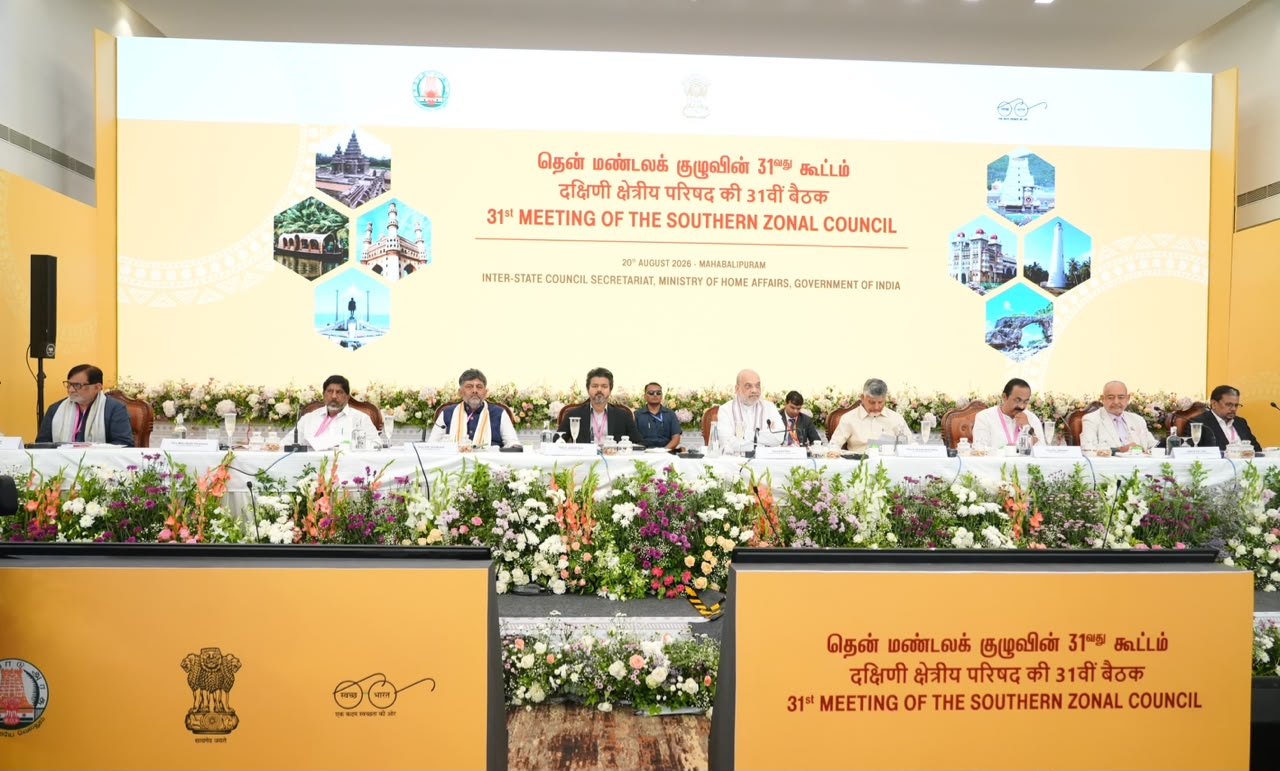
Home Minister Amit Shah and the South Indian Chief Ministers at their meeting in Chennai. (Special Arrangement)

Synopsis: The BJP’s political challenge in the South Indian states cannot be reduced to electoral arithmetic. It must compete with governments that have their own records and economies that have become central to India’s growth while retaining regional identities that remain politically powerful. That is why the South matters.
On August 20, 2026, when Union Home Minister Amit Shah chaired the 31st meeting of the Southern Zonal Council in Mahabalipuram, Tamil Nadu, a politically interesting configuration came together.
Representatives of the southern States discussed issues ranging from inter-State water disputes and development to delimitation and the future of parliamentary representation. Beneath these discussions, however, lay a larger political reality: the South is becoming increasingly important not only to India’s economic growth but also to its political future.
Karnataka, Telangana, Keralam and Tamil Nadu may have different political histories, different governing models and different electoral calculations. Andhra Pradesh falls outside this purview since it is ruled by an NDA ally, Chandrababu Naidu’s Telugu Desam Party. But together the other four states represent a region that has contributed disproportionately to India’s economic and human-development story while continuing to maintain a political space that has proved difficult for the BJP to dominate.
Karnataka is at the centre of India’s technology and innovation economy. Bengaluru has become one of the country’s most important global economic centres, while the State has developed strong capabilities in information technology, biotechnology, manufacturing and services.
Tamil Nadu has built one of India’s most diversified industrial economies. Its automobile, electronics, textile, engineering and manufacturing sectors have made it one of the country’s principal industrial engines. The State contributed 9.4 per cent of India’s national GDP in 2024-25 despite accounting for only about 6 per cent of the country’s population.
Telangana, despite being a relatively young State, has established Hyderabad as a major centre for information technology, pharmaceuticals, life sciences and services.
Keralam’s contribution is different but equally significant. Its achievements in literacy, public health and human development have produced a social-development model that has attracted national and international attention. Its migrant workforce has also played a major role in sustaining the State’s economy.
Taken together, the southern States have become an important pillar of India’s growth. Southern India accounts for roughly 30 per cent of the country’s GDP while representing about one-fifth of its population.
The southern States have spent decades investing in education, healthcare, women’s empowerment and population stabilisation. Their fertility rates fell earlier than in many northern States, and their demographic transition has been accompanied by improvements in human development. Now, as the freeze on the redistribution of Lok Sabha seats approaches its end, these States face an uncomfortable question: could the very success that India encouraged them to achieve eventually reduce their political representation?
At the Southern Zonal Council meeting, Karnataka’s DK Shivakumar argued that the 1971 Census should continue as the basis for delimitation and that the existing strength of 543 Lok Sabha seats should be maintained for the next 25 years.
Tamil Nadu Chief Minister C Joseph Vijay similarly raised the concern that population-based delimitation could diminish the collective parliamentary voice of the southern States.
This is more than an argument over numbers. If States that successfully controlled population growth are subsequently given fewer seats in proportion to their contribution, a strange incentive is created: development becomes a political disadvantage. The question being raised in the South is therefore not whether population should matter. It is whether population should be the only or overwhelmingly dominant measure of political representation.
Karnataka’s case is particularly important because its economic contribution gives its federal argument considerable weight.
Its significance lies in how an established State administration is positioning Karnataka within India’s changing political economy. Bengaluru’s importance to India’s technology sector gives Karnataka an economic significance that extends well beyond its geographical boundaries. But economic contribution does not automatically translate into political influence. That is why delimitation has become such an important issue for the State.
Shivakumar’s intervention essentially asks whether Karnataka’s economic and demographic success should strengthen its national voice or eventually diminish it. His position turns a question of electoral boundaries into a broader question of how India’s development gains should be reflected in its political architecture.
The contest is not simply between Congress and BJP. It is between competing visions of how India’s growth should translate into political power.
The Congress government led by A Revanth Reddy came to power in Telangana in 2023, ending the long tenure of the BRS.
The question for Revanth Reddy is whether the political change that brought Congress to power can be converted into a durable governance alternative.
Hyderabad’s position as a major technology, pharmaceutical and services hub gives Telangana considerable economic importance. The State’s development ambitions have to be balanced with welfare commitments and the expectations generated by the Congress’s electoral promises.
While it has delivered some of the Six Guarantees that played a big part in bringing it to power, many high-profile promises remain unfulfilled, as a recent South First analysis noted.
For the BJP, Telangana is consequently an important southern battleground. Its challenge is not simply to defeat Congress electorally; it must persuade voters that a national political alternative can better represent Telangana’s interests than a State government with its own regional political mandate. That contest will increasingly be decided by governance.
Also Read | BJP’s Telangana dilemma: Go it alone or hunt for allies?
Keralam presents a different picture altogether.
The VD Satheesan-led UDF government has only completed its first 100 days. It would therefore be unfair to judge it by the standards of a government that has been in office for several years.
But beginnings reveal political priorities. The government has emphasised pragmatic governance, welfare delivery and development initiatives, including Mission Samudra, which seeks to promote port-led economic development. It has also had to respond to Keralam’s persistent challenges, including climate-related pressures and human-wildlife conflict.
Keralam has historically maintained a highly competitive political environment in which national parties have had to operate through strong regional political traditions. The new UDF government therefore represents another test of whether the BJP can expand its political space in a State where voters have repeatedly demonstrated a preference for established political alternatives.
Satheesan’s challenge is now to show that a change in government can bring administrative and developmental results without weakening Keralam’s distinctive social-development priorities.
C Joseph Vijay’s government has completed its first 100 days, but unlike a conventional transfer of power, his victory represents the emergence of a new political formation in a State dominated for decades by established Dravidian parties. It is too early to judge the government’s long-term performance. But its early decisions provide clues about its political direction.
The decision to scrap the proposed Parandur airport project, citing concerns over agricultural land, is one example. The government has instead indicated that alternative sites will be explored, while industry groups have continued to emphasise the importance of expanding Chennai’s aviation infrastructure.
At the Southern Zonal Council meeting, Vijay also raised delimitation, Cauvery water and Tamil Nadu’s longstanding demand for exemption from NEET. These positions are significant because they demonstrate that Vijay’s political project is not simply about replacing one regional party with another. He is attempting to define a new political language around welfare, development, regional interests and State autonomy.
For the BJP, that creates a complicated challenge. It is not facing merely an established regional party but a new political force seeking to occupy political space that the BJP would also like to expand into.
The diversity of the governments in South India’s states is itself a strength.
Different States can adopt different approaches according to their social conditions, economic structures and political priorities. Their success challenges the idea that political and economic development must necessarily follow a single national template. This is where the federal question becomes inseparable from the political question.
The BJP has expanded its presence across southern India, but the region has remained more difficult for it than much of northern and western India. The reasons are not simply ideological. Strong regional identities, distinctive welfare models, linguistic politics, State-specific development agendas and established political traditions have created a political environment in which national dominance cannot automatically translate into State-level dominance.
The deeper challenge is that the South continues to produce political alternatives to the BJP’s national model.
The South’s economic contribution and demographic achievements have helped India as a whole. Its States have invested in education, health, population stabilisation, infrastructure and industrialisation. If these achievements eventually result in a reduction of political representation, the country will have to confront an uncomfortable contradiction. Can India ask States to pursue demographic responsibility and then alter the political balance in a way that makes that success costly?
The answer requires more than a debate between North and South. It requires a national conversation about how representation, development and federalism can coexist. The solution need not be a confrontation between the Centre and the States. It can be a negotiated constitutional and political settlement that recognises both the principle of representation and the contribution of States that successfully achieved demographic transition.
Most importantly, the relationship between the Centre and the States requires recognition that India’s diversity is not an obstacle to national development. The four southern governments are not a single political formation. Nor are they uniformly opposed to every policy of the Union government.
But they collectively demonstrate something important: the BJP’s political challenge in the South cannot be reduced to electoral arithmetic. It must compete with governments that have their own records and economies that have become central to India’s growth while retaining regional identities that remain politically powerful in lands where voters are accustomed to evaluating governments on State-specific performance.
That is why the South matters. Its question is not whether it should stand against Delhi. Its question is whether India’s political system can accommodate strong States alongside the Centre. The answer lies in the Constitution’s basic idea of a Union of States: India becomes stronger not when its States become politically weaker, but when their diversity, development and democratic mandates are given meaningful space within the Union.
The BJP may seek to expand its political footprint across the South. But Karnataka, Telangana, Keralam and Tamil Nadu demonstrate that the region will continue to be shaped by its own political choices and that the road to political dominance in southern India runs not merely through national narratives, but through the harder test of governance, development and respect for the federal aspirations of its States.
Also Read:
The politics of obscenity: When misogyny becomes a weapon
The chauvinism of clothing: What the “lungiwala” remark against John Brittas reveals about India
(Edited by R Rajesh Kumar.)



