
Published Aug 22, 2026 | 12:04 PM ⚊ Updated Aug 22, 2026 | 12:05 PM

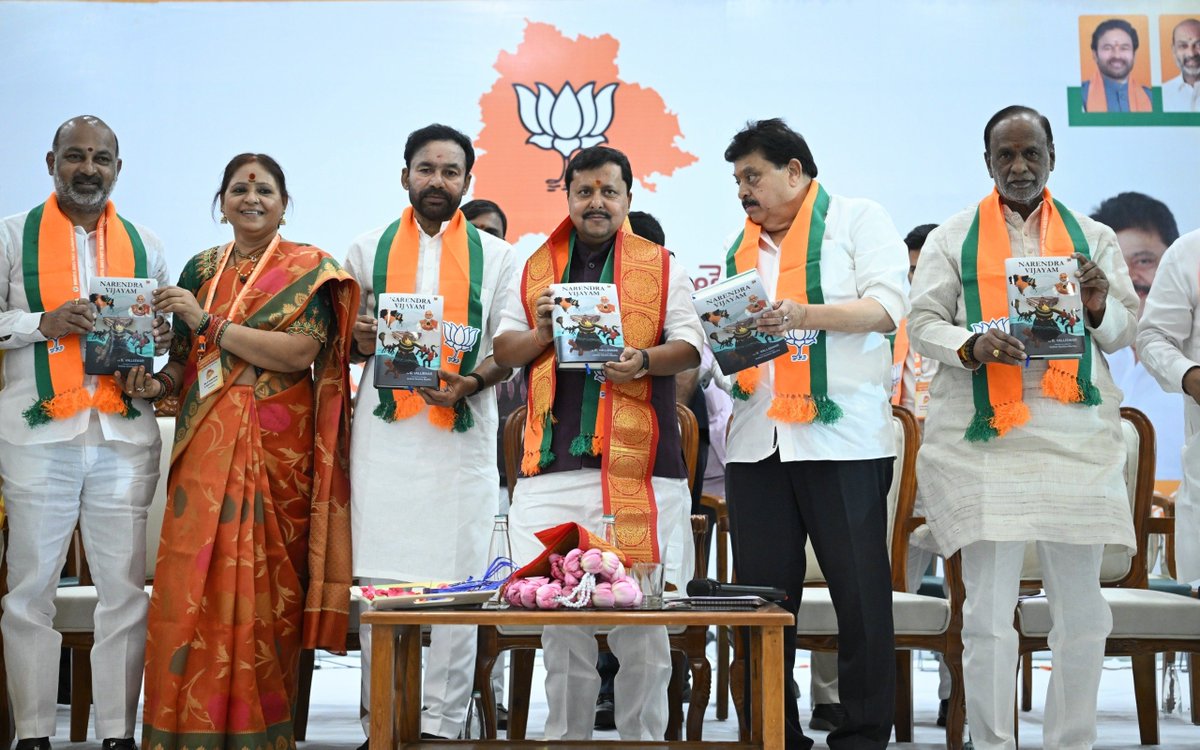
Nitin Nabin seen during the inauguration of the BJP Telangana State Executive Committee meeting. (File | Official photo)

Synopsis: The absence of a Telangana leader from the BJP’s new national executive raises questions about the high command’s confidence in the state unit. Is Delhi pursuing a deeper strategy in Telangana, or struggling to find one? And how much of the party’s failure rests with the central leadership?
Is the BJP central leadership pursuing a “deeper strategy” in Telangana, or simply unsure of what to do? It is difficult to tell. Does the party want to grow on its own and come to power, or should it contain the Congress through alliances? It does not seem to have made up its mind.
Even the heightened anticipation before the constitution of the party’s new national executive did not yield any result, as no Telangana leader found a place in it. Yet senior Telangana leader Dr Laxman says the state will receive greater representation in the Union Council of Ministers. The truth is that, despite several efforts to strengthen the party in the state, the high command does not seem fully convinced. That perhaps explains its hesitation.
The BJP has a familiar formula: if possible, grow on its own and form the government; if that does not appear feasible, join hands with “suitable” forces to contain the Congress. The Maharashtra and Andhra Pradesh models already exist.
After its victory in West Bengal, both Prime Minister Narendra Modi and BJP president Nitin Nabin came to Telangana and said that the state was the party’s “next target”. But the party’s graph in Telangana does not seem to be rising accordingly. If the state leadership is mainly responsible for this failure, the actions and decisions of the central leadership also suggest that it bears some responsibility.
“It is difficult to prove whether we are awake or asleep,” said the Greek philosopher Plato. The BJP central leadership appears to face a similar difficulty in assessing the party’s standing in Telangana. It has repeatedly urged the state leadership to strengthen the party through concrete action, sometimes through persuasion and sometimes through warnings. Yet the expected results have not materialised.
It must be nearly a year since Prime Minister Modi himself told senior Telangana BJP leaders at a meeting: “We do not know how long you will remain in this party. At least while you are here, stay together.” Yet that unity has still not emerged.
Some efforts are now being made, but they have not reached a level that inspires confidence in the central leadership. The high command appears to believe that these leaders are always fighting among themselves and lack the determination to work together and bring the party to power. The fact that eight MPs and seven MLAs have not been able to agree on common decisions or coordinated programmes has become a source of frustration in Delhi. Even at a meeting held after the 2023 Assembly election results, Prime Minister Modi expressed dissatisfaction with the performance of the state leaders. Yet each continues to follow his own course.
In the new composition of the BJP’s national executive, no leader from Telangana has been given a place.
Earlier, DK Aruna served as national vice president and Ponguleti Sudhakar Reddy as national secretary. Bandi Sanjay was a national general secretary until he entered the Union Council of Ministers. Dr Laxman, currently a member of the Parliamentary Board, had earlier headed the national OBC Morcha.
Dr Laxman recently said that it would be incorrect to say Telangana was ignored in the national executive, indicating that the state could receive greater representation in the Union Council of Ministers. Telangana already has Kishan Reddy and Bandi Sanjay as Union ministers. Whether DK Aruna or Dr Laxman will receive an additional opportunity remains to be seen.
There is also speculation that Etela Rajender could be made state BJP president in the election year. Alternatively, he could be given a national position and Bandi Sanjay could be brought back as state president before the elections. Party circles also speculate that the present president, Ramachandra Rao, could receive a position at the national level.
Some leaders are unhappy that Telangana has not received representation in the new national executive. But Delhi circles appear to ask what was achieved when opportunities were given earlier. The high command feels that while several Telangana leaders aspire to become Chief Minister if the BJP wins, they lack the determination and effort required to bring the party to power. Hence the repeated emphasis on unity and hard work, with Haryana, Bengal and the northeastern states cited as examples.
Despite opposition from some leaders within the state unit, the average BJP worker appears to have faith in Bandi Sanjay’s leadership. Before the 2023 elections, the Congress had developed a feeling that power was possible only if Revanth took charge. A similar perception exists about Bandi Sanjay in the BJP. Earlier state presidents were criticised for limiting themselves to their constituencies or districts. That criticism did not apply to Bandi. He undertook three padayatras and acquired a reputation for energising the party. The BJP’s victories in Assembly by-elections and its progress in the Greater Hyderabad Municipal Corporation elections also came during his tenure. Although he lost the Assembly election, he won as an MP.
He also ensured the party’s victory in the Karimnagar corporation. The party won the Graduates’ and Teachers’ MLC seats in his area as well. The BJP high command appears to have a favourable view of Bandi. He prefers serving through a party position rather than government office, something the leadership may consider. The BJP central leadership wants to establish unity within the Telangana unit and give the party a chance to win on its own. If the state leadership fails to inspire that confidence, the central leadership may consider alliances for 2028.
Two scenarios could then emerge. As in Andhra Pradesh, the BJP, TDP and Jana Sena could ally in Telangana. Alternatively, to contain the Congress, the BJP could join hands with the BRS as a strong non-Congress force.
The Prime Minister recently visited Telangana. Though he did not give time to the state BJP leaders, he spent nearly an hour each with Andhra Pradesh Chief Minister Chandrababu Naidu and Jana Sena chief Pawan Kalyan. Does this indicate that the BJP has some “deeper strategy” for Telangana? Pawan Kalyan declared soon afterwards that Jana Sena would also enter the electoral fray in Telangana. Whether this is a signal or coincidence is unclear.
The absence of Telangana leaders from the national executive and BRS working president KT Rama Rao’s frequent visits to Delhi have also fuelled speculation. Is the BJP leadership deliberately keeping a narrow door open for a future alliance? The doubt remains.
The BJP’s failure to grow sufficiently to come to power in Telangana cannot be attributed only to the state leadership. The central leadership’s actions and omissions have also played a role. There have been several occasions, including in 2014, when the central leadership pursued alliance strategies despite opposition from state leaders.
The high command feels that some leaders in Telangana are willing to compromise for alliances to protect their positions, but do not show the unity, hard work and commitment required to bring the party to power. Sunil Bansal had earlier remarked that elections in Telangana had become completely money-driven. This time, the alleged misuse of money is being investigated by a committee.
State party circles believe that the Munugode by-election defeat, which damaged the BJP’s prospects, was the result of an impulsive decision by the central leadership. They also point to decisions such as announcing a Backward Classes (BC) Chief Minister while removing a BC president, appointing upper-caste presidents, and not even giving the legislature party leadership to a BC leader.
They question why, after alleging that Kaleshwaram was used like an ATM, the party did not take stronger action through the CBI against BRS leaders. There has also been a failure to reconcile the interests of leaders who rose within the party with those brought in from outside and make them work together. In these circumstances, is the BJP high command confused about how to strengthen the party as an alternative political force in Telangana? Or is there some deeper strategy at work? That is the million-rupee question.
Also Read:
A new political mood is taking shape in India
(Edited by R Rajesh Kumar.)



