

Published Aug 17, 2026 | 11:00 AM ⚊ Updated Aug 17, 2026 | 11:00 AM

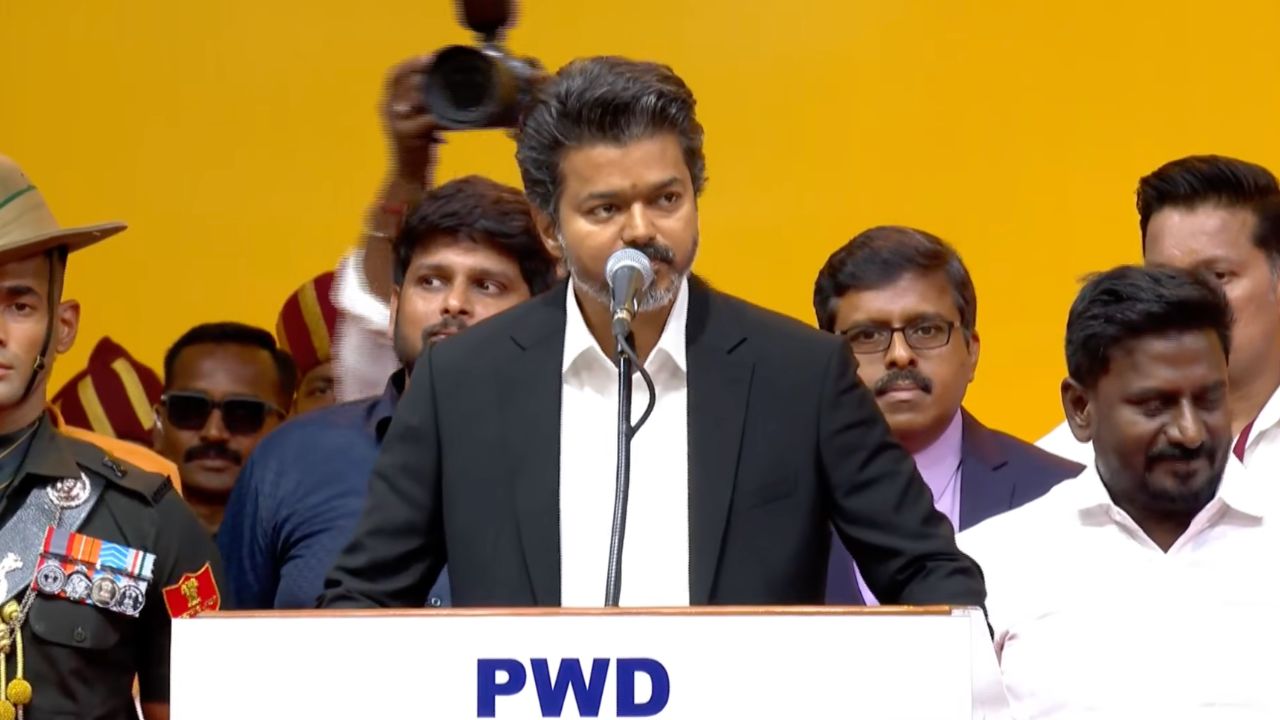
Vijay seen taking oath as the Chief Minister of Tamil Nadu on 10 May 2026. (File Image)

Synopsis: Over three months after Vijay’s first three signatures, the schemes have moved at different speeds, from immediate implementation of free power to the rollout of Singappen and the anti-narcotics force. But questions remain over their impact, with concerns over rising power bills, visible policing and the continuing drug challenge.
The Tamilaga Vettri Kazhagam (TVK) government, headed by Chief Minister C Joseph Vijay, has completed 100 days in office.
Immediately after taking charge on May 10, Vijay signed three major files providing 200 units of free electricity to eligible domestic consumers, creating the Singappen Special Task Force for women’s safety, and establishing a statewide Anti-Narcotics Task Force.
Three months on, have the announcements been translated into actual impact on ordinary people’s lives?
200 units of free electricity
Vijay’s first official action after assuming office was to approve 200 units of free electricity every two months for domestic consumers whose bimonthly consumption does not exceed 500 units. The scheme came into effect from May 10.
The government sanctioned an additional annual tariff subsidy of ₹1,730 crore to compensate the Tamil Nadu Power Distribution Corporation Limited (TNPDCL) for the revenue loss arising from the scheme.
The implementation was subsequently incorporated into TNPDCL’s billing system. By May 22, the utility had updated its billing software to identify eligible consumers, calculate the subsidy and generate bills under the new system.
Around 1.46 crore domestic consumers were expected to benefit from the enhanced concession.
The Tamil Nadu Electricity Regulatory Commission later approved a provisional subsidy of ₹1,545.14 crore for the period from May 10, 2026, to March 31, 2027.
This is not a revision of the ₹1,730-crore annual allocation; rather, it is the provisional amount calculated for the 326-day period covered in the current financial year. The final amount will be reconciled based on actual electricity consumption.
However, while the scheme has been implemented, several electricity consumers have been complaining on social media that their bills are higher than before. Opposition parties have also criticised the TVK government over issues in the power sector.
Central Organisation of Tamil Nadu Electricity Employees general secretary D. Jayasankar said the 200-unit free-power provision has been implemented as announced, but consumption has increased considerably during the summer, particularly because of greater use of air-conditioners and other appliances at night.
“There has been an increase in electricity consumption because of the heat. Particularly at night, the use of air-conditioners and other appliances has increased, which is also resulting in higher electricity bills,” he said.
Tamil Nadu recorded unusually high electricity demand in July. The state’s peak demand touched a record 21,724 MW on July 14, with officials attributing it partly to heatwave conditions, below-normal rainfall and increased use of air-conditioners, coolers and other electrical appliances.
Jayasankar also pointed out that there is a widespread perception that 200 units of electricity are now free for every household. That is not the case. The new 200-unit benefit applies to domestic consumers whose total consumption in a two-month billing cycle is up to 500 units. If consumption crosses 500 units, the consumer does not lose all free electricity; instead, the consumer continues to receive the existing benefit of 100 free units every two months under the earlier tariff structure.
Therefore, the amount payable ultimately depends not only on the government’s new subsidy but also on how much electricity a household actually consumes.
Also Read: The politics of obscenity: When misogyny becomes a weapon
Singappen Special Task Force
Vijay’s second first-day decision was the creation of the Singappen Special Force, a dedicated police mechanism aimed at improving the safety of women and children.
The government approved the force on May 10, with the Chief Minister’s office directly overseeing the initiative. Before the formal launch, 18 Sub-Inspectors, including two from the Cyber Crime Wing, were deputed to the force in late May. The force was formally launched by Vijay at Rajarathinam Stadium in Egmore, Chennai, on June 9.
At the launch, the government announced an allocation of around ₹354 crore for the first phase. The force’s sanctioned strength is to be increased to 2,545 personnel in phases. The statewide structure includes patrol units, vehicles, surveillance equipment, body-worn cameras and drones. The first operational deployment consisted of around 70 patrol units with 280 personnel, with the larger sanctioned strength to be built up subsequently.
The force is intended to work on preventive policing and rapid response, particularly in places where women and children may be vulnerable, including public transport locations, schools, colleges, workplaces, parks and other public spaces.
However, the Singappen Special Task Force has also drawn criticism from policing researchers who question whether increased visibility alone can significantly reduce crimes against women.
Social and behavioural science researcher Shankar Prakash argued that the force risks becoming a form of “visible policing” rather than a crime-reduction mechanism.
He pointed out that the 270 field units sanctioned under the GO would each have two women Sub-Inspectors and six constables. This means that a unit covering an entire police subdivision, which can include several police stations and a large geographical area, would have only a small number of personnel available for patrols, awareness programmes, hotspot monitoring and responding to distress calls.
Prakash also raised concerns about the force’s role after a crime occurs. According to his reading of the GO, Singappen personnel do not have independent investigative authority or the power to register FIRs, and would have to coordinate with the jurisdictional police station for case registration and investigation.
He argued that this could potentially create an additional layer in the response mechanism rather than strengthening the existing Crime Against Women and Children (CAW&C) policing structure.
He also questioned whether the ₹354-crore allocation could have produced a greater impact if directed towards investigative capacity, forensic infrastructure, survivor-sensitive investigation, witness protection, POCSO-related training and prosecution support.
Also Read: TVK govt appoints film producer Archana Kalpathi to Tamil Nadu panel for temple trustee appointments
Anti-Narcotics Task Force
The third decision was the creation of a statewide mechanism to tackle drug trafficking and consumption. On May 10, Vijay announced the establishment of 65 Anti-Narcotics Task Force units across Tamil Nadu.
However, the anti-narcotics initiative took longer to reach its detailed administrative form.
The government initially began expanding the existing anti-narcotics policing mechanism, while the broader “Drug-Free Tamil Nadu” campaign was also taken forward through awareness programmes and enforcement measures.
The major development came in August. The Tamil Nadu government issued a detailed Government Order dated August 8, subsequently reported publicly on August 10, sanctioning 65 dedicated Anti-Narcotics Task Force units with an allocation of ₹264.14 crore.
The order provides for 454 posts specifically for these 65 units: 65 Inspectors, 130 Sub-Inspectors and 325 police personnel. There will be one unit in each of Tamil Nadu’s 37 districts, except Chennai which will have 12 units and Avadi, Tambaram, Salem, Coimbatore, Tiruppur, Tiruchirappalli, Madurai and Tirunelveli will have two units.
The ₹264.14-crore allocation includes recurring and non-recurring expenditure for establishing and operating the units.
However, questions are being raised over whether the drug problem is being addressed at the grassroots level.
Recently in Coimbatore, the family of a 19-year-old engineering student who was killed by his schoolmates, has alleged that he was targeted after he informed his college hostel management about drug use and peddling among students. Police have detained five students in connection with the murder, while the exact motive remains under investigation.
Against this backdrop, opposition parties have accused the TVK government of failing to contain the growing “drug culture” in the state.
Meanwhile, enforcement data underline the continuing scale of the challenge. In a month-long anti-drug operation between July 8 and August 8, Coimbatore City Police registered 215 cases, arrested 273 people and seized more than 10 kg of ganja.
(Edited by Fayisa CA)



