

Published Aug 14, 2026 | 9:00 AM ⚊ Updated Aug 14, 2026 | 11:54 AM

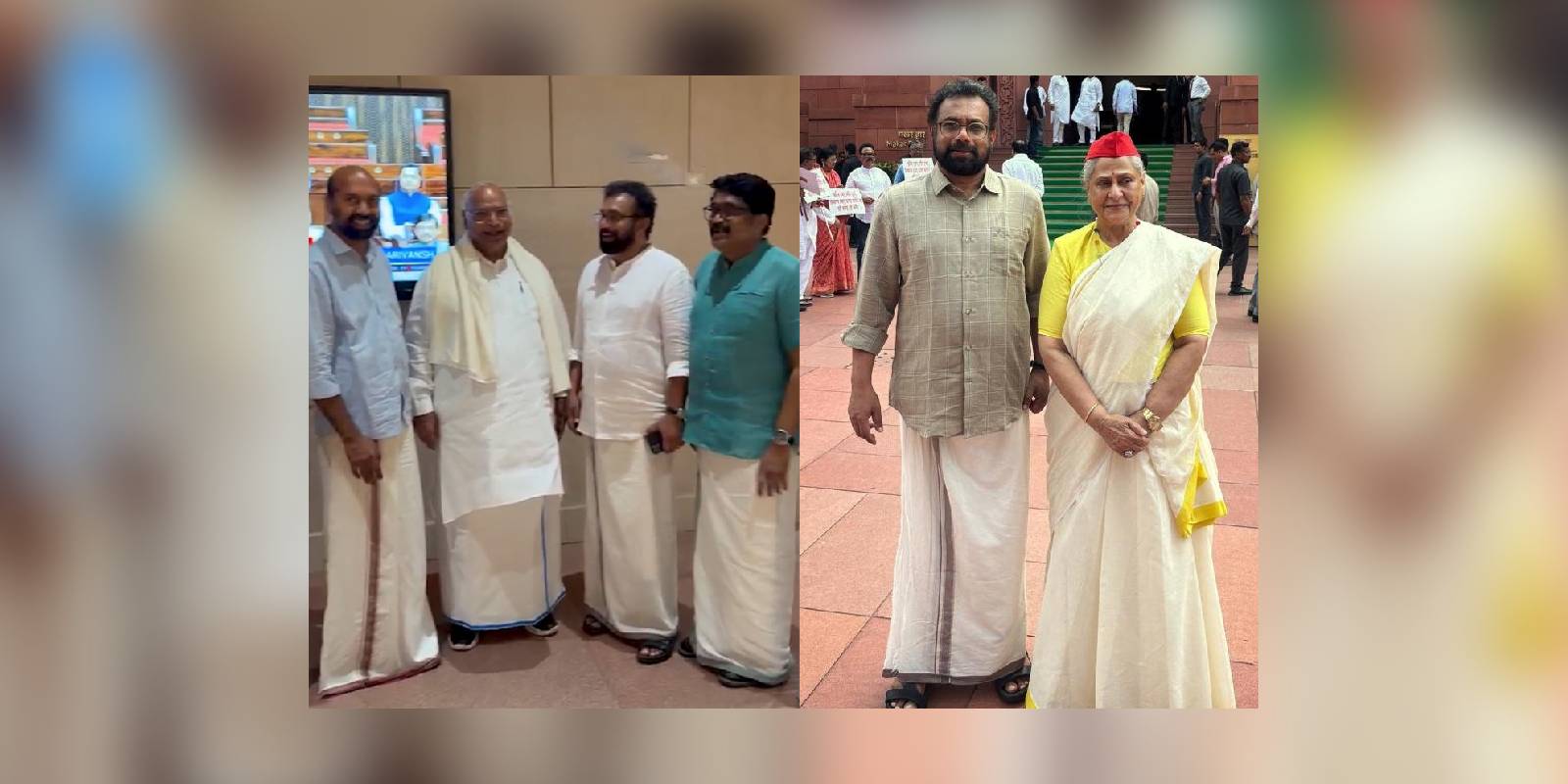
Even Jaya Bachchan arrived in a Kerala attire to express solidarity with Brittas and the South.

Synopsis: The “lungiwala” remark against John Brittas is more than a mere insult. It exposes the cultural hierarchies and regional stereotypes that have shaped how certain Indians see their fellow citizens. It has no place in parliament or in public discourse.
The controversy over BJP MP Sushmita Dev’s use of “lungiwala” against CPI(M) MP John Brittas in the Rajya Sabha may seem like yet another parliamentary spat in an increasingly rancorous political culture. But it is more consequential than that. When a parliamentarian turns an ordinary garment into a term of derision, the issue is no longer parliamentary banter; it is the cultural chauvinism embedded in the insult.
Brittas has pointed out that Dev used the expression disparagingly and subsequently moved a privilege notice, calling it an attempt to stereotype South Indians. Dev has denied intending any insult to the attire or identity of any state. The allegation must, of course, be distinguished from an established finding. The larger question, however, remains: why should a lungi be considered a legitimate shorthand for ridicule in the first place?
A lungi is not a joke. It is worn by millions of Indians, across regions, religions and classes. In Kerala, it exists alongside the mundu; elsewhere, related forms of traditional dress have their own histories and meanings. The garment belongs not to some caricatured “South Indian” type but to the everyday life of India. To weaponise it against a parliamentarian is therefore more than a mere insult. It is an attempt to suggest that the culture associated with the garment is somehow less sophisticated, less respectable or less national.
That is the prejudice that must be strongly confronted. Cultural chauvinism rarely announces itself as a doctrine. It appears in jokes, nicknames, accents, stereotypes and supposedly harmless descriptions. It takes something familiar to one community and presents it as comic or backward to another. The individual disappears behind the stereotype: the Malayali becomes the “lungi-wala”, the migrant becomes the “outsider”, the Northeastern Indian becomes a racial caricature, the person with a regional accent becomes an object of mockery. Such language does not merely recognise difference. It assigns status to difference.
There is a particularly ugly irony in doing this in Parliament. The Rajya Sabha is not a roadside argument or a television shouting match. It is a constitutional institution in which representatives speak in the name of citizens who may themselves wear the garment being mocked. Parliamentary disagreement can be fierce; indeed, it should be. Governments must be challenged, ministers scrutinised and political arguments dismantled. But the legitimate target of parliamentary criticism is a position, a policy or a record: not a person’s region, clothing or cultural identity.
The distinction is fundamental. Calling out an opponent’s failures is politics. Reducing him to a cultural stereotype is prejudice. One strengthens democratic debate; the other cheapens it.
The incident also exposes the persistence of a particular cultural hierarchy in Indian public life. For decades, southern Indians have been caricatured through exaggerated accents, dark-complexion stereotypes, coconut, toddy, and idli-sambar jokes, and the familiar cinematic image of the “lungi-dancing” South Indian. Such representations may be dismissed as comedy, but comedy is not culturally neutral when the joke repeatedly travels in one direction: from a supposedly sophisticated centre towards a supposedly provincial periphery.
The history of the word “Madrasi” offers another example. It was routinely used as a catch-all label for people from southern India despite the enormous linguistic and cultural differences between Kerala, Tamil Nadu, Karnataka, Andhra Pradesh and Telangana. The problem with such labels is precisely their laziness. They spare the speaker the effort of knowing the person. Stereotyping is ignorance made convenient.
And it becomes especially troubling when such instincts surface in the conduct of an elected representative. The words spoken in Parliament are heard not merely by the immediate opponent but by citizens across the country. A regional slur, even when disguised as humour, can make millions of people feel that something integral to their identity is worthy of contempt.
This is why the response cannot be reduced to partisan outrage.
South Indians have indeed faced stereotyping in the North; North Indians have faced hostility in parts of the South; migrants, linguistic minorities and people from the Northeast have all experienced forms of cultural exclusion.
But the answer to one chauvinism cannot be another.
There is no virtue in pretending that the particular incident has no significance because others have committed similar offences. That is the oldest evasion in politics: condemn the insult only when it comes from the other side. A serious democratic culture must reject the instinct itself.
India’s constitutional idea was never based on cultural sameness. It was built on the opposite proposition: that radically different people could share equal citizenship. Article 51A(e) asks citizens to promote harmony and common brotherhood across religious, linguistic, regional and sectional diversities; Article 51A(f) calls upon them to value and preserve the country’s composite cultural heritage. These principles recognise something fundamental: diversity is not an inconvenience to be managed but part of the inheritance to be protected in the Republic.
That is why cultural chauvinism is ultimately more dangerous than an isolated insult. It narrows the meaning of India. It quietly suggests that some accents sound more educated, some clothes are more respectable, some cuisines more refined, some regions more modern and some identities more authentically Indian than others. Once that hierarchy enters public life, constitutional equality begins to lose its cultural foundation.
The lungi, dhoti, sari, kurta, gamcha and countless other forms of Indian dress tell a different story. They represent climate, occupation, community, tradition and adaptation. They are worn by workers and professionals, farmers and politicians, the poor and the affluent.
Mahatma Gandhi himself made clothing a language of political resistance, deliberately rejecting imported conventions of respectability. In India, clothing has long been intertwined with questions of dignity, identity and power. To mock it is therefore not culturally innocent.
Brittas’s response, with the strong solidarity of fellow MPs, that he is proud to be Malayali, South Indian and Indian, captures a healthier understanding of the Republic. These identities do not compete. They accumulate. A person does not become less Indian by being emphatically Malayali, Tamil, Assamese, Manipuri, Bengali or Kashmiri. Indian nationalism at its best has never demanded the erasure of these identities. It has made room for them.
That is the difference between nationalism and chauvinism.
Nationalism enlarges belonging: it says that different people can share a political home. Chauvinism narrows it: it implies that one cultural expression is more authentic than another.
Parliament should know the difference. The expression warrants an apology and an acknowledgement of why such language can carry a discriminatory meaning. Not because politicians must become delicate or humourless, but because democratic disagreement requires citizens to be treated as equals. It doesn’t mean suppressing political debate, but raising its standard.
The deeper lesson is not about the lungi, but who gets to define what looks “Indian” or not. That question has enormous political consequences. A republic as diverse as India cannot survive if its citizens are continually taught to look at one another through hierarchies of region, language, clothing and culture.
The lungi is merely a piece of cloth and turning it into an insult is a choice. When that choice is made by someone sitting in Parliament, it reveals something more troubling than bad manners: the persistence of a chauvinistic imagination that mistakes cultural difference for cultural inferiority. That is precisely the mindset a constitutional democracy must learn to outgrow.
Also Read:
The politics of obscenity: When misogyny becomes a weapon
The politics of forgiveness: Prime Minister Modi and the burden of example
(Amal Chandra is an Indian author, political analyst, and columnist. His debut book, The Essential (2023), was launched by Dr Shashi Tharoor and features a Foreword by India’s former External Affairs Minister Salman Khurshid. His research and commentary regularly appear in scholarly and popular publications. Follow @ens_socialis.)
(Edited by R Rajesh Kumar.)



