

Published Aug 13, 2026 | 7:00 AM ⚊ Updated Aug 13, 2026 | 7:00 AM

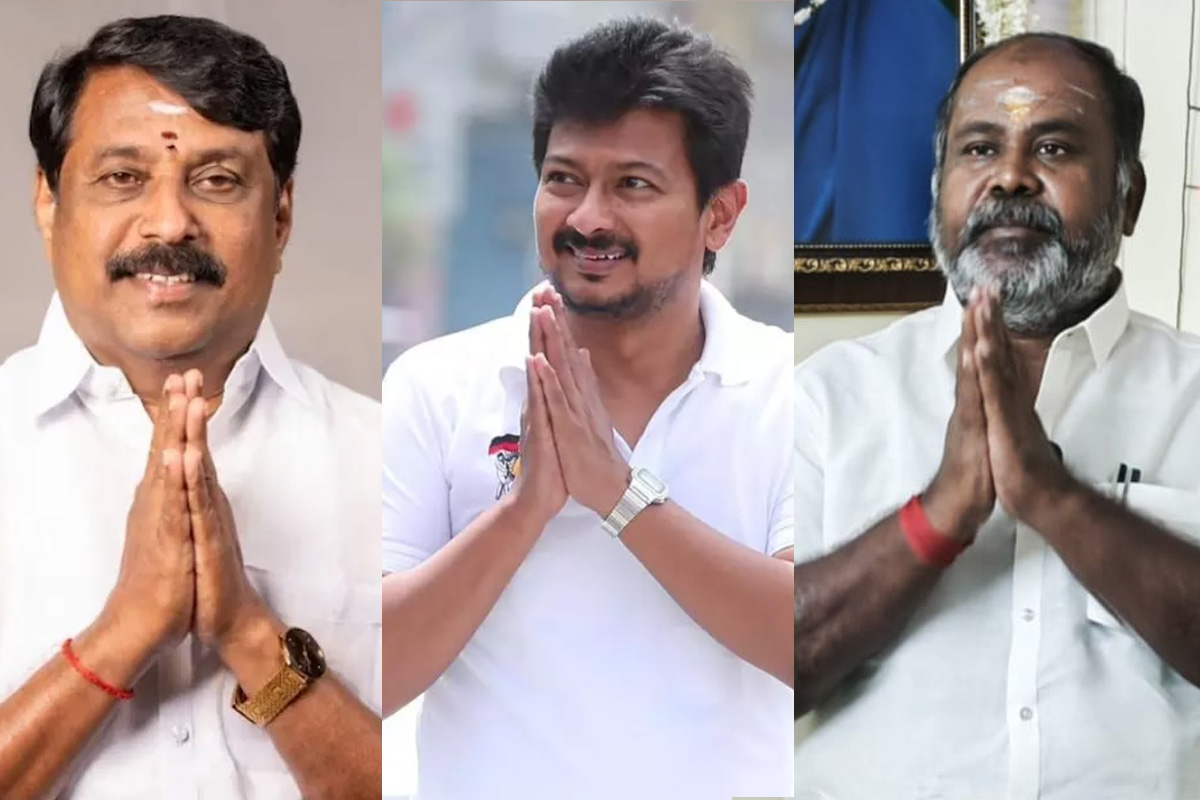
Nainar Nagendran, Udhayanidhi Stalin, and RB Udhayakuma have found themselves in the eye of a storm in recent times.

Synopsis: Making women weapons in political battles underlines how patriarchal our leaders remain. A woman’s dignity is her own; it does not belong to any man in her life or any party. A democracy committed to equality must reject the use of such gendered humiliation.
Recent controversies, including the dispute surrounding allegedly objectionable remarks in Tamil Nadu involving the actress Trisha, have once again drawn attention to the manner in which women’s names, bodies and identities can become instruments of political conflict. They point towards a larger and more persistent question: why does the humiliation or sexualisation of women resurface in political communication?
Political obscenity should not be understood simply as the use of vulgar words. Political language can be aggressive, confrontational and deeply critical without becoming obscene. Political leaders should be able to challenge one another, expose hypocrisy, question competence and oppose policies forcefully.
The character of political speech changes, however, when criticism moves away from political conduct and begins to invoke sexuality, the body, intimate relationships or gendered stereotypes to humiliate. In such instances, language performs a function beyond disagreement. It attempts to diminish the person by mobilising social prejudices surrounding sexuality and gender.
When women are targeted through such language, the problem is not merely that the language is offensive. It is that the language draws upon and reproduces a social order in which women’s bodies, sexuality and personal relationships have historically been treated as legitimate objects of public judgement. This is where the concept of political misogyny becomes important.
Misogyny is often understood simply as hatred or dislike of women, but its political operation is more complex. It can function as a mechanism through which women are disciplined when they enter spaces of public authority. Women in politics are frequently evaluated not only according to their political actions but also according to expectations about femininity, appearance, sexuality and respectability.
A woman who demonstrates authority can be described as arrogant; one who speaks forcefully can be labelled aggressive; one who challenges established power can become the subject of attacks directed at her personal life. Political misogyny therefore does not necessarily announce itself by saying that women are inferior. It can operate by making women’s participation in public life more costly, more humiliating and more vulnerable to gendered forms of attack.
The patriarchal character of such discourse becomes particularly visible when women who are not themselves participants in a political controversy are dragged into it because of their association with a male political actor. A dispute may begin between two men, yet a woman connected to one of them becomes the target of insinuation or ridicule.
Her name becomes political ammunition, her sexuality becomes an instrument of attack and her personal relationship becomes part of a political argument in which she has no substantive role. Such practices reveal a deeply patriarchal conception of women’s identity: the assumption that a woman’s social meaning can be derived from her relationship with a man and that attacking her can consequently injure him. The woman is denied an identity of her own and becomes a political object through which another person’s reputation is contested.
This reduction of women to their relationships is incompatible with the principle of equal citizenship. A woman may be someone’s wife, daughter, mother, friend or associate, but none of these relationships exhausts her identity. She possesses individuality independent of the men around her, even in unequal societies.
When she is dragged into a political dispute merely because of her association with a man, she is not being treated as an autonomous citizen but as an instrument in someone else’s political struggle. The problem, therefore, is not simply that she has been insulted. Her very status as an independent subject is being displaced by a relational identity imposed upon her.
The question of dignity therefore becomes central. Dignity is more than courtesy, reputation or social respectability. It rests upon the recognition that every individual possesses equal human worth and cannot legitimately be reduced to an object of humiliation. Women’s dignity cannot depend upon their conformity to patriarchal expectations of sexuality, respectability or behaviour. Nor can it become a political resource that others are entitled to manipulate.
When the sexual humiliation of a woman is employed to attack a man associated with her, the underlying assumption is that her dignity is somehow connected to his political identity. This reproduces an older patriarchal logic in which women’s bodies and sexuality are connected to male honour. A democratic society must reject that logic.
A woman’s dignity is her own; it does not belong to a husband, father, political leader or political party.
Women entering public life do not demand exemption from criticism. They demand the right to be criticised as political actors, rather than degraded as women. There is an important difference between questioning a woman’s political decision and attacking her sexuality, appearance or personal relationships.
The sexualisation of women also reveals the continuing political significance of the female body. In patriarchal societies, women’s bodies have historically been subjected to social interpretation and regulation through concepts such as honour, purity, morality and respectability. When political discourse turns a woman’s appearance, sexuality or relationships into political material, it carries these older structures into the modern public sphere.
When women repeatedly see female public figures subjected to sexualised insults, comments about their bodies or attacks on their personal lives, political participation itself acquires a gendered cost. Men may be attacked for their political decisions, ideology or leadership, while women can face those same forms of criticism in addition to attacks based upon gender and sexuality. This creates an unequal environment of political participation.
The Indian political landscape provides several illustrations of this wider problem.
In July 2019, objectionable remarks directed at a woman parliamentarian in the Lok Sabha generated widespread condemnation; the remarks were expunged from the parliamentary record and were followed by an apology. The significance of the incident lies not only in the individual remark but in the fact that gendered and inappropriate language can enter even the country’s highest legislative institution.
More recently, in March 2026, derogatory comments concerning the physical appearance of a woman legislator at an election-related event in Kerala triggered public criticism and led to the suspension of the political leader responsible. These incidents are not identical, and they should not be treated as interchangeable. Yet, together with similar controversies elsewhere, they demonstrate a recurring tendency to make women’s bodies, appearance, sexuality and personal characteristics available for political attack.
The Tamil Nadu controversies should similarly be understood with care. The RB Udhayakumar remark was a direct attack. The incident involving Deputy Chief Minister Udhayanidhi Stalin, meanwhile, involved a remark carrying a possible double meaning, an interpretation that the DMK and Udhayanidhi have disputed. The important point for a broader discussion is not to prejudge the legal or factual question surrounding this particular statement. It is that the controversy once again demonstrates how quickly a woman’s name and public identity can become central to a political confrontation.
That pattern deserves scrutiny independently of partisan affiliation. The democratic question should not be whether a particular party or politician is responsible for misogyny, but why political culture repeatedly provides space for gendered humiliation to function as a form of political communication. This is also why condemnation cannot be selective.
Misogyny cannot be condemned when it comes from a political opponent and defended when it comes from an ally. Such selective outrage transforms the dignity of women into a partisan issue and leaves the underlying patriarchal structure untouched. Degrading women through their bodies, sexuality or relationships is not made legitimate by the political identity of the person who uses such language.
The question of dignity can also be placed within Ambedkar’s broader understanding of democracy. Ambedkar’s conception of democracy went beyond elections and institutional arrangements. Democracy, according to him, required a transformation in social relationships and a recognition of equality among human beings.
His emphasis on liberty, equality and fraternity provides an important framework for thinking about contemporary political discourse. Formal political equality cannot be considered sufficient if everyday social relations continue to reproduce hierarchy and humiliation. The question, therefore, is not simply whether women possess the formal right to participate in political life. It is whether political culture recognises them as equal human beings and autonomous political subjects.
Women are not political weapons, extensions of male identity or repositories of someone else’s honour. They are citizens in their own right. Their dignity is not conditional upon political affiliation, their self-respect is not transferable to another person, and their agency cannot be reduced to the relationships through which patriarchal society chooses to define them. A democracy that asks women to surrender their dignity to participate is one that has yet to realise the meaning of equality fully.
Also Read:
Beyond Pradhan’s resignation: CJP and the unfinished struggle for educational justice in India
The politics of forgiveness: Prime Minister Modi and the burden of example
The Supreme Court keeps clarifying obscenity. Nobody is listening
(Edited by R Rajesh Kumar.)



