

Published Jul 17, 2026 | 8:00 AM ⚊ Updated Jul 17, 2026 | 8:00 AM

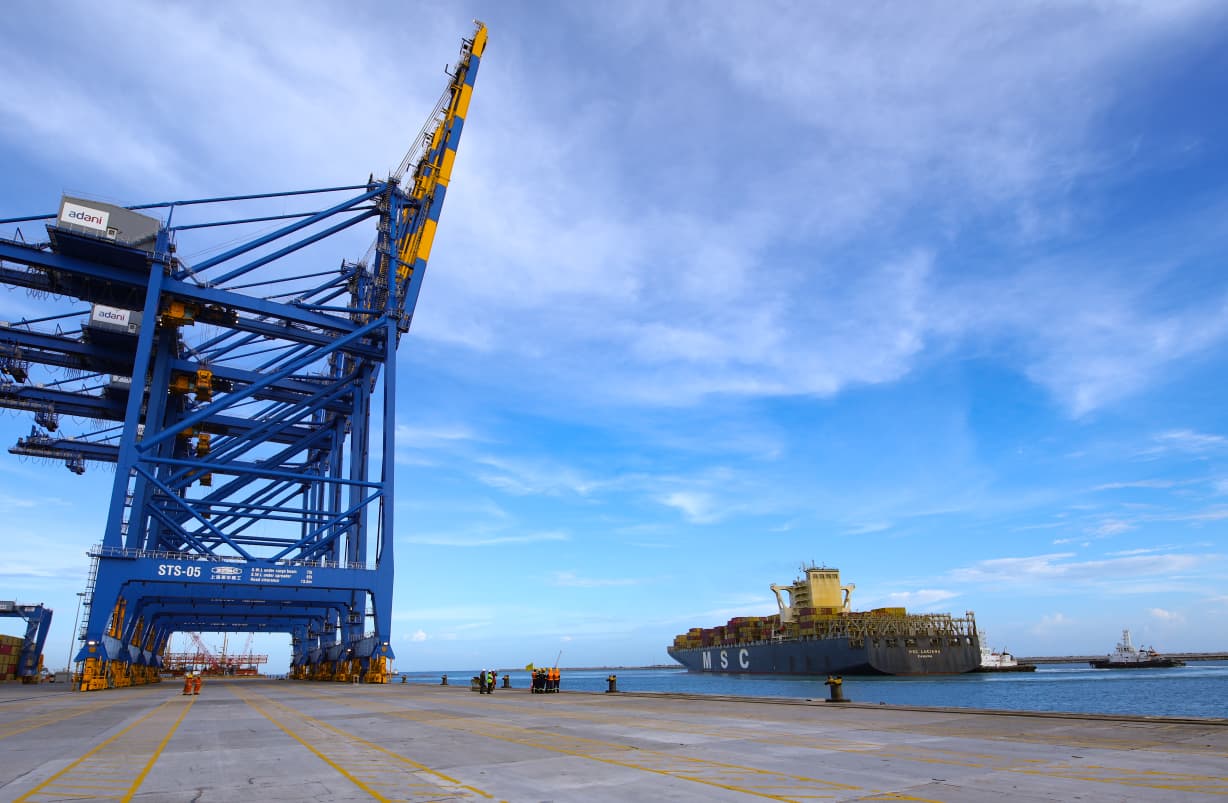
Vizhinjam International Seaport, Thiruvananthapuram

Synopsis: Far from being a straightforward corporate transaction, Adani Group’s proposal to bring in MSC-backed Mundi Limited as a 49% stakeholder in Vizhinjam Port has forced the state government to balance contractual obligations with broader questions of competition, investment policy and strategic security. With the Cabinet opting for an exhaustive review, the politically charged issue will remain open for further examination.
By the time the State Cabinet met on 8 July to consider Adani Group’s proposal to induct a foreign partner into the Vizhinjam International Seaport project, the issue before ministers had already moved far beyond a routine request for approval of a share transfer.
What began with a high-profile corporate announcement on 30 June, by then, had within days blown up into a major political controversy, with questions being raised by the Opposition inside and outside the Assembly.
The Cabinet found itself examining not just a change in ownership, but questions involving competition in the maritime sector, the future investment climate at Vizhinjam, the port’s obligation to function as a neutral common-user facility, and even national security.
Significantly, South First has found that the Cabinet’s deliberations were shaped not only by Adani Ports’ 30 June announcement but also by two separate letters submitted by AVPPL to the state government within days of that announcement—documents that disclosed details absent from the public communication.
The deliberations culminated in the Cabinet deciding to entrust an Empowered Committee headed by the Chief Secretary with examining the proposal in detail before the state takes a final decision.
Also Read: MSC’s TiL acquires 49 percent stake in Adani-operated terminal
On 30 June, Adani Ports and Special Economic Zone Ltd. (APSEZ) announced that it will enter into an agreement with Terminal Investment Limited (TiL), the terminal operations and investment arm of the Mediterranean Shipping Company (MSC) Group, under which TiL would acquire a 49% equity stake in AVPPL, the concessionaire of the Vizhinjam Seaport.
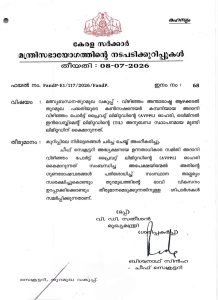
A Cabinet note on the proposed deal connected with Vizhinjam Seaport
Describing it as the largest foreign private investment in Indian port infrastructure, APSEZ said the partnership would strengthen Vizhinjam’s position as a leading transhipment hub in the Indian Ocean region.
The company also announced that the transaction would pave the way for a joint investment of nearly US$1.75 billion for the second phase of Vizhinjam Port.
Ashwani Gupta, Director and CEO of APSEZ, said Vizhinjam had grown rapidly to become one of the country’s major transhipment hubs and that extending APSEZ’s long-standing partnership with MSC to Vizhinjam would improve global supply chain efficiency and strengthen India’s access to key international markets.
The company, however, made it clear that the transaction remained subject to legal and regulatory approvals.
Yet, one important detail did not feature in the 30 June media announcement.
While the release repeatedly referred to TiL and the MSC Group, it did not identify the company that would actually acquire the shares.
Also Read: Kerala footed the bill—the coast is paying the rest
Within days of the public announcement, AVPPL approached the state government seeking approval under Clauses 5.3.1 and 5.3.2 of the Concession Agreement, which mandate prior government approval for a change in ownership.
The first application, Letter No. AVPPL/GoK/2026-27/4064, dated 1 July 2026, briefly outlined the proposed transaction.
It informed the government that Mundi Limited, a subsidiary of TiL, would acquire 49% equity in AVPPL.
The letter also cited TiL’s investments in Adani Ennore Container Terminal and Adani International Container Terminal, Mundra, as examples of similar transactions.
However, that application did not remain under consideration for long.
By Letter No. AVPPL/GoK/2026-27/4067 dated 3 July 2026, AVPPL formally withdrew the 1 July application and submitted a fresh proposal in its place.
It is this 3 July application that is currently before the state government.
Also Read: Adani-MSC deal rekindles questions over who benefits from Vizhinjam
Officials informed the Cabinet that while both letters confirmed the same ownership structure, the second communication was substantially more detailed.
Both letters said Mundi Limited would acquire a 49% stake in AVPPL, while APSEZ would retain the remaining 51%. They also clarified that APSEZ would continue as the controlling shareholder, with the right to appoint the majority of directors and retain management control of the company.
Officials pointed out that while the 30 June media statement spoke about TiL and MSC, the identity of Mundi Limited as the actual acquiring entity became part of the government’s records through these letters.
But unlike the first seven-paragraph letter, the 3 July communication contained detailed corporate information on APSEZ and the MSC Group, explained the strategic rationale behind the investment and provided several assurances to the state government.
Among the assurances highlighted were:
The 3 July submission also elaborated on the commercial benefits expected from the partnership.
According to the proposal, AVPPL and the MSC Group plan to jointly invest approximately US$1.75 billion for the second phase of Vizhinjam Port.
The expansion is expected to increase the port’s annual handling capacity from the present 1.6 million TEUs to 5.7 million TEUs.
The proposal further stated that a substantial share of MSC’s transhipment cargo presently handled at Colombo is expected to shift to Vizhinjam, while cargo volumes from East Africa and Bangladesh are also projected to increase.
Also Read: CM Satheesan reminds Adani Ports of Clause 5.3 in Vizhinjam port agreement
Although the concession agreement permits a change in ownership subject to government approval, ministers were told that the proposal required examination beyond contractual compliance.
The concern stemmed from the nature of MSC itself. The Cabinet noted that MSC is not merely a shipping company.
It operates one of the world’s largest vertically integrated logistics networks, combining shipping services, container terminals, inland logistics and supply chain operations under one ecosystem.
Officials advised that such an ownership structure warranted a closer examination of whether adequate safeguards were necessary to preserve competition at Vizhinjam.
The Cabinet noted that the concessionaire is obligated under Clause 5.8.1 of the Concession Agreement to operate Vizhinjam as a common-user facility, ensuring transparent, fair and non-discriminatory access to every shipping line, ship operator, exporter, importer, freight forwarder and logistics operator.
The agreement specifically prohibits the concessionaire from extending discriminatory or preferential treatment to any existing or prospective user.
Ministers, therefore, felt that the government needed to examine whether the proposed ownership structure could, directly or indirectly, influence the neutrality of the port or affect competition in the maritime and logistics sectors.
Also Read: Vizhinjam’s growth overshadows local concerns
The Cabinet also examined the proposal in the context of Kerala’s long-term maritime strategy.
The Cabinet noted that the state’s vision is to transform Kerala into a major maritime and logistics hub by integrating Vizhinjam Port with the state’s network of minor ports, airports, inland waterways, multimodal transport systems, rail connectivity, warehousing infrastructure, container freight stations (CFSs), inland container depots (ICDs) and allied logistics facilities.
It observed that attracting investments from shipping lines, terminal operators, logistics companies, rail freight operators, manufacturers and supply chain companies would be critical to the success of that vision.
Against that backdrop, as per a note circulated among ministers, the Cabinet felt it necessary to examine whether the proposed ownership structure could influence the confidence of existing investors or future investors and whether additional safeguards were needed to preserve a fair, competitive and investor-friendly ecosystem.
The examination, the note cited, could not remain confined merely to the provisions relating to change in ownership under the concession agreement.
Instead, it had to be viewed through the broader lens of public interest, transparent competition, investment promotion, national security and Vizhinjam’s long-term development as a globally competitive and neutral maritime gateway.
Also Read: Why Kerala can no longer fight the drug trade alone
After considering the proposal, the Cabinet decided that the application should be examined by the 2015-constituted Empowered Committee, under the chairmanship of the Chief Secretary.
The committee has been asked to examine the proposal in accordance with the relevant provisions of the concession agreement and submit its recommendations.
If necessary, the committee may seek further clarification from AVPPL before commencing its detailed examination. Officials indicated that a questionnaire may be prepared covering issues such as ownership rights, governance structure, financial arrangements, security clearances and the safeguards proposed to ensure that Vizhinjam continues to function as a common-user public facility.
The Cabinet also decided that the proposal should be referred to the Union Ministry of Ports, Shipping and Waterways, while security-related clearances should be obtained from the Union Ministry of Home Affairs and other competent central agencies.
The state government said that no final decision on the proposed transfer of 49% equity in AVPPL will be taken until the necessary security clearances are received and the Empowered Committee submits its recommendations.
Also Read: Vizhinjam international seaport makes CPI(M) and BJP strange bedfellows
Though the Cabinet stated the empowered committee will vet the proposed MoU, the controversy is yet to be settled.
On 15 July, Leader of the Opposition Pinarayi Vijayan, in a letter to Chief Minister VD Satheesan, accused the state government of maintaining an ambiguous stand on the proposed transfer of Adani Group’s stake in Vizhinjam Seaport, alleging that the chief minister failed to address the substantive issues he had raised and instead resorted to baseless allegations.
Vijayan urged the government to clearly state that it would protect the port without allowing it to come under the control of corporate interests.
Rejecting the chief minister’s allegation that the previous LDF government had discussed the proposed share transfer during the 2025 Vizhinjam Conclave, Vijayan said the conclave was organised to deliberate on the port’s prospects and industrial development. A review of the Ports Department’s records, he claimed, would show that no discussion on transferring Adani’s stake took place during the LDF administration.
He also questioned the government’s silence over Adani’s communication to SEBI regarding the transaction without prior government approval.
(Edited by Majnu Babu).



