

Published Jul 01, 2026 | 11:25 AM ⚊ Updated Jul 01, 2026 | 12:05 PM

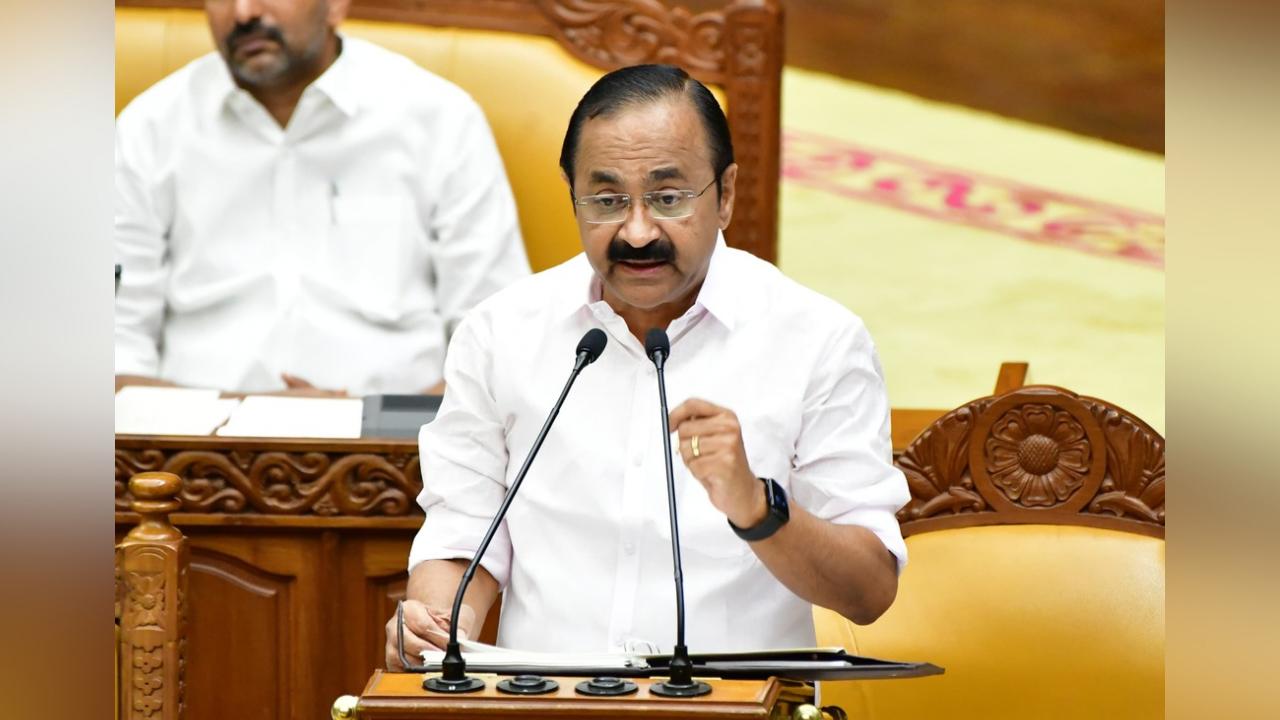
Kerala Chief Minister VD Satheesan presenting the Budget.

Synopsis: Is the Adani Ports-MSC group deal in trouble? The question has arisen after CM VD Satheesan and Thiruvananthapuram MP Shashi Tharoor both questioned the rationale behind the announcement of the MoU.
A day after the high-profile announcement of a strategic partnership between Adani Ports and Special Economic Zone Ltd. (APSEZ) and Mediterranean Shipping Company (MSC) Group’s terminal investment arm, Terminal Investment Limited (TiL), the Kerala Government has made it clear that the proposed equity transaction cannot proceed without its prior approval.
The proposed deal, under which TiL will acquire a 49 per cent stake in Adani Vizhinjam Port Private Limited (AVPPL)—the concessionaire developing and operating the Vizhinjam International Seaport Thiruvananthapuram—has triggered a legal and political debate over compliance with the Concession Agreement signed with the state government.
The deal, announced by Adani Ports, is said to involve a proposed investment of US$1.397 billion (around ₹13,000 crore) by TiL as part of the port’s total project value of $2.85 billion (around ₹27,000 crore).
Replying to a question raised by Xavier Chittilappilly MLA in the Kerala Assembly on Wednesday, Chief Minister VD Satheesan, who also holds the Ports portfolio, said the government was not informed about the Memorandum of Understanding (MoU) before it was announced.
“The concessionaire had not approached the state government seeking permission before entering into such an MoU. As per Clause 5.3 of the Concession Agreement, approval from the state government is mandatory for the transfer of shares. In certain cases, approval from the Union Government may also be required,” the Chief Minister said.
The government’s position is rooted in Clause 5.3 of the Concession Agreement governing change in ownership of the concessionaire. The clause explicitly prohibits the concessionaire from undertaking or permitting any change in ownership without prior approval from the Authority—the Governor of Kerala.
More importantly, it states that any acquisition, directly or indirectly, of 25 per cent or more of the total equity of the concessionaire constitutes a “Change in Ownership” requiring prior approval of the state government. The agreement also empowers the government to examine such proposals from the perspective of national security and public interest, making its decision final and binding.
Also Read: Adani’s pumped storage project in Jawadhu hills faces opposition by Poovulagin Nanbargal
Later, replying to concerns raised by Leader of the Opposition Pinarayi Vijayan, Chief Minister Satheesan sought to allay concerns over the proposed partnership, asserting that the state government would not permit any arrangement that compromises national security, public interest or fair competition.
The CM stated that the Concession Agreement governing the port explicitly states that any change in ownership or transfer of rights cannot be effected without the approval of the Kerala government.
“They have not approached us so far. If and when any proposal comes before the government, it will be examined in accordance with the provisions of the agreement,” he reiterated.
The Chief Minister acknowledged that concerns had been raised over the reported Memorandum of Understanding between Adani Ports and MSC. He said the government would evaluate any proposal on the basis of five key principles — national security, public interest, fair competition, promotion of investment and a long-term vision for Vizhinjam’s development.
“Vizhinjam is a strategic infrastructure. Therefore, any such agreement requires not only the approval of the state government but also the clearances of the Ministry of Home Affairs and the Ministry of Ports, Shipping and Waterways,” he said.
Responding to apprehensions that an Adani-MSC partnership could lead to monopolistic control over port operations, the Chief Minister said the state would ensure that Vizhinjam functions as a common-user facility accessible to all stakeholders.
“There will be no monopoly. Competitiveness will be encouraged and every stakeholder will have equal opportunity. The government has a clear understanding that Vizhinjam must remain a common-user facility,” he said.
The Chief Minister also noted that MSC is not merely a financial investor but one of the world’s largest shipping companies, making it essential for the government to closely examine how the company proposes to utilise the port and the implications for its future growth.
Earlier, the Opposition had questioned the proposed arrangement, pointing out that the Centre had classified Vizhinjam as a highly critical infrastructure during the Pahalgam terror attack and Operation Sindoor. The Opposition also expressed concern that if Adani Ports and MSC jointly controlled operations at the port, it could eventually affect competition, discourage new players and allow a single entity to influence pricing, especially when cargo movement expands beyond transhipment to road-based logistics.
The Chief Minister, however, maintained that the government would not allow any development that undermines competition or the state’s long-term interests, while ensuring that Vizhinjam continues to attract investments without compromising security or public interest.
Also Read: Two investigations in US and India raise fresh Gautam Adani questions; Karnataka deal highlighted
The issue had also drawn the attention of Thiruvananthapuram MP Shashi Tharoor on Tuesday, who, while welcoming the investment’s economic potential, cautioned against overlooking the safeguards built into the concession framework.
“My reaction as MP for this port constituency: more cargo, more capacity, more jobs for Kerala. But a transaction of this scale involving a strategic asset deserves due diligence, not just applause,” Tharoor said in an X post on Tuesday.
He pointed out that any ownership change beyond 25 per cent requires the Kerala Government’s prior approval, a provision that assumes significance as Vizhinjam has been developed largely on state government land and occupies a strategically important position on one of the world’s busiest international shipping routes.
Tharoor also stressed that the approval process should include national security and critical infrastructure scrutiny. He further said Vizhinjam must continue to function as a non-discriminatory common-user port, ensuring fair access and tariff treatment for all shipping lines, even as MSC—potentially its largest customer—becomes a significant shareholder.
Also Read | Negotiate, re-estimate or re-tender: Options before CM DK Shivakumar on Adani tunnel road bid
Meanwhile, AVPPL maintained that the transaction remains subject to all applicable legal and regulatory approvals.
The company said the partnership with TiL is expected to significantly strengthen Vizhinjam’s position as a global transhipment hub. TiL, a part of the MSC Group, operates more than 100 container terminals across five continents with an annual handling capacity exceeding 70 million TEUs.
According to the company, the collaboration will increase Vizhinjam Port’s capacity from the current 1.6 million TEUs to 5.7 million TEUs through future development, making it one of the region’s largest transhipment facilities.
The investment is also substantial, they point out.
Out of the total project cost of US$2.85 billion (around ₹27,000 crore), TiL is expected to invest US$1.397 billion (approximately ₹13,000 crore). The company believes the partnership will ensure stable cargo volumes, attract global shipping traffic and accelerate the port’s long-term growth.
The proposed alliance marks the third collaboration between APSEZ and MSC’s TiL after their partnerships at Mundra Container Terminal No. 3 and Ennore Port.
While the commercial rationale behind the deal has been widely acknowledged, the immediate focus has shifted to whether the mandatory approvals under the concession agreement are obtained before the transaction moves beyond the MoU stage.
From our archives | Ground Report: Is the Vizhinjam seaport transforming lives or sidestepping locals?
(Edited by R Rajesh Kumar.)



