

Published Jul 03, 2026 | 8:00 AM ⚊ Updated Jul 03, 2026 | 8:00 AM

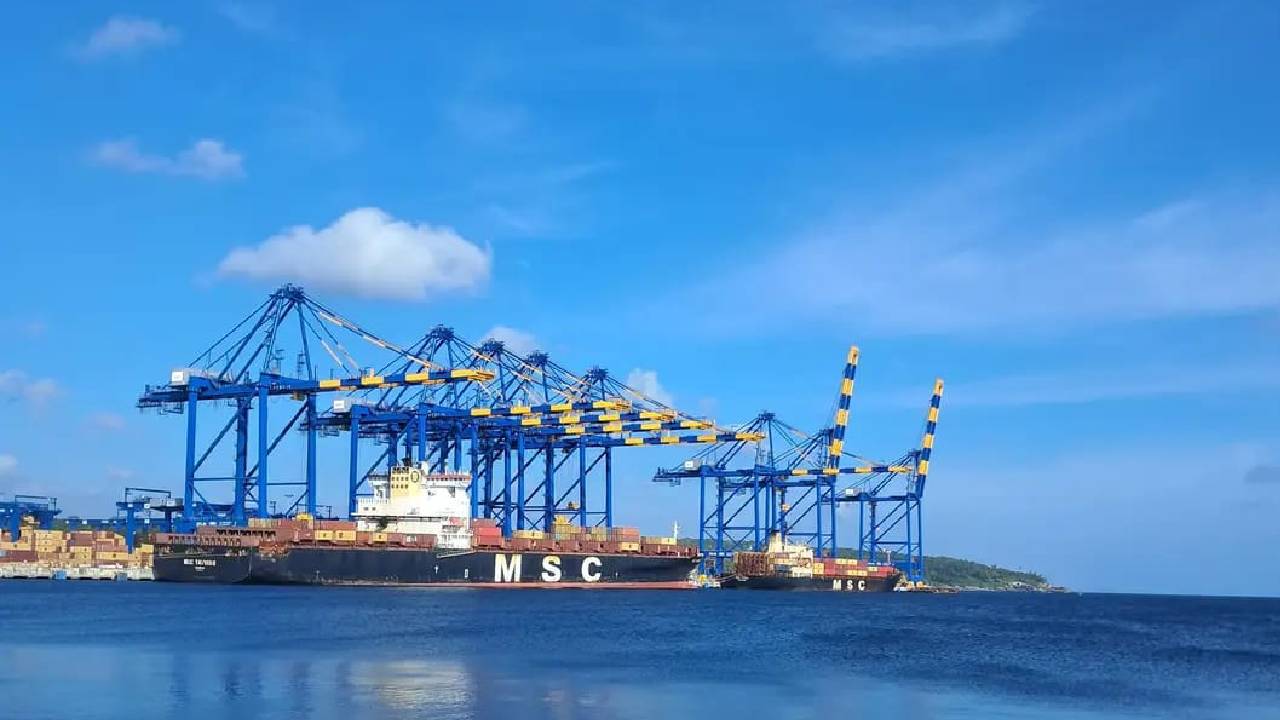
MSC's container vessels at the Vizhinjam port.

Synopsis: A proposed move by Mediterranean Shipping Company to acquire a 49% stake in Adani Vizhinjam Port Private Limited has escalated into a major political battle with the Opposition LDF in Kerala arguing that it exposed deeper concerns over the Vizhinjam concession agreement, public interest and private control of strategic infrastructure. The government insisted that no approval had yet been granted and pledged a legal, security and public-interest review. The controversy has reignited a wider debate on who should ultimately benefit from Kerala’s ambitious port-led development.
The controversy surrounding the proposed transfer of a 49 per cent stake in Adani Vizhinjam Port Private Limited (AVPPL), the concessionaire that operates the Vizhinjam International Seaport Thiruvananthapuram, to Geneva, Switzerland-based Mediterranean Shipping Company (MSC) has rapidly grown beyond a debate over a corporate transaction.
The Opposition Left Democratic Front (LDF) has now projected it as the first major test of the United Democratic Front (UDF) government’s flagship maritime strategy, Mission Samudra. It argued that the episode exposed what it called the dangers of placing Kerala’s port-led development in the hands of large private players.
By linking the proposed share transfer to the budget’s ambitious maritime vision, the CPI(M)-led LDF shifted the political narrative from a dispute over a concession agreement into a larger debate on who would ultimately benefit from Kerala’s next wave of infrastructure growth.
Meanwhile, the state government’s claim that the announcement of MSC’s proposed 49 per cent investment in AVPPL was made without informing or consulting it compounded the controversy. Chief Minister VD Satheesan said the government’s dissatisfaction has been conveyed to Adani Ports management.
Also Read: MSC’s TiL acquires 49% stake in Adani-operated Vizhinjam terminal
The revised Budget that Satheesan presented placed Vizhinjam at the centre of an ambitious plan to transform Kerala into a unified “Port City” by integrating its ports, coastline, inland waterways and logistics network.

An aerial view of containers stacked at Vizhinjam Seaport
Under Mission Samudra, the government proposed to build a maritime economy capable of catapulting Kerala as a major global logistics hub within five years.
For the LDF, however, the reported MSC deal became the peg to question the very foundation of that model.
Former Finance Minister TM Thomas Isaac argued that if Adani Ports monetised its Vizhinjam investment by selling nearly half of its holding to the world’s largest container shipping company, it would only reinforce the criticism that the original concession agreement disproportionately benefited the private concessionaire.
Isaac said the issue was not whether MSC’s entry into Vizhinjam could strengthen the port’s commercial prospects.
His questions were directed elsewhere: whether the Kerala government was aware of the proposed transaction, whether any informal approval had been given, whether discussions had taken place before the announcement, and how the entry of the world’s largest shipping line as both a major customer and shareholder could affect the interests of other shipping companies and public sector agencies involved in the port’s expansion.
Concession Agreement on Vizhinjam
The controversy, he argued, was therefore about governance and public interest rather than merely ownership.
He linked the questions to Satheesan’s visit to Mangaluru shortly after assuming office, asking whether the issue had figured in discussions with Adani Group representatives.
The government expressed ignorance over the transaction. However, Isaac argued that if the concession agreement mandated government approval for such a transfer, it would be difficult to believe that a deal of such a magnitude could progress without any interaction with the state.
The questions, he said, become even more relevant because MSC was not merely a financial investor. As one of the world’s largest shipping companies, it was also among the biggest potential users of the port.
That, according to the Left, created an entirely new dimension.
Also Read: CM Satheesan reminds Adani Ports of Clause 5.3
The latest controversy has also enabled the LDF to reopen its long-standing criticism of the concession agreement signed during the Oommen Chandy government in 2015.
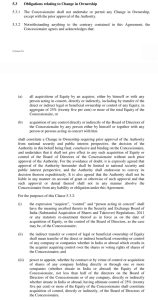
The clause in the Concession Agreement which is now in focus.
The CPI(M) maintained that it had originally proposed developing Vizhinjam under a landlord port model, in which the government would build the infrastructure while a private operator would manage the port on a revenue-sharing basis.
Instead, it argued, the UDF opted for a public-private partnership under which the state bore the bulk of the investment while Adani received operating rights for decades without sharing operational revenue with Kerala during the initial concession period.
The Kerala government, through Vizhinjam International Seaport Limited (VISL), bears 61.5 per cent of the project cost, amounting to around ₹5,370 crore. The Centre contributes viability gap funding of about ₹818 crore, accounting for another 9.6 per cent. Adani’s contribution works out to roughly ₹2,497 crore, or 28.9 per cent.
The LDF said those figures explained why it had opposed the agreement from the beginning.
It argued that Kerala contributed the land, bore nearly 70 per cent of the total project cost and yet surrendered the right to share operating revenues for three decades.
Perhaps, LDF’s sharpest political argument concerned the valuation implied by the proposed transaction.
According to reports, MSC’s investment arm, Terminal Investment Limited (TiL) has expressed willingness to pay around ₹13,000 crore for acquiring a 49 per cent stake in AVPPL.
The LDF argued that if Adani’s investment of around ₹2,500 crore appreciated to such an extent within a few years, it only reinforced its long-standing allegation that the original concession agreement disproportionately favoured the private concessionaire.
Isaac said supporters of Adani presented the proposed valuation as evidence of the company’s business acumen.
His counterargument was that if the value of the concession had increased so dramatically within five years, it demonstrated the lucrativeness of the agreement UDF had signed.
Also Read: Vizhinjam’s growth overshadows local concerns
Interestingly, a Comptroller and Auditor General (CAG) report on Kerala’s Public Sector Undertakings for the financial year that ended on 31 March 2016 delivered a sharp critique of the Vizhinjam Port concession agreement. The report concluded that its provisions overwhelmingly favoured the private concessionaire (AVPPL) at the state’s expense.
The audit highlighted that granting a 40-year concession period, instead of the standard 30 years, along with an option to extend it by another 20 years, could enable the concessionaire to earn an estimated additional revenue of ₹29,217 crore, with the cumulative benefit potentially rising to ₹61,095 crore over the extended tenure.
The CAG also questioned the revenue-sharing mechanism, under which the state would receive its share only after 15 years from the Commercial Operations Date (COD), despite projections indicating that the concessionaire could recover its investment by around the 11th year.
According to the audit, such an arrangement allowed the private operator to secure substantial early returns, while the state, despite contributing the bulk of the project’s funding, was left waiting much longer for financial benefits.
The report further pointed to inflated project cost estimates prepared by consultants, inadequate assessment of the project’s financial implications for the government, and the selective incorporation of provisions from the Model Concession Agreement in ways that disproportionately benefited the concessionaire.
Overall, the CAG argued that the agreement had failed to adequately safeguard the state’s interests.
Following its assumption of office, the LDF government responded by establishing a judicial commission in 2017 under the chairmanship of Justice CN Ramachandran Nair to investigate alleged irregularities in the award and structuring of the concession.
The commission was tasked with identifying whether decisions detrimental to the state’s interests had been taken, fixing responsibility where appropriate, and recommending corrective measures.
However, subsequent revisions to the commission’s terms of reference attracted criticism from opposition groups and civil society. They argued that the scope of the inquiry had been weakened.
In parallel, the LDF government also initiated a vigilance investigation into aspects of the project.
Although such developments happened once the LDF came to power, it later adopted the stance that prolonged litigation could permanently derail the strategically important project, particularly when competing ports were also under development nearby.
Also Read: How a shipwreck sank Pulluvila’s livelihoods
The LDF is now extending the same argument to Mission Samudra.
Isaac contended that the maritime mission reflected the UDF’s broader economic philosophy in which the government would act primarily as a facilitator while large private corporations undertake financing, construction and operation of infrastructure projects.
He contrasted it with the previous LDF government’s approach, which sought to mobilise public finance through institutions such as the Kerala Infrastructure Investment Fund Board (KIIFB) for large infrastructure investments.
The CPI(M) argued that if the government distanced itself from financing major projects, dependence on large private corporations would become inevitable, creating conditions for what it described as the transfer of public assets and future economic gains to private monopolies.
In the LDF’s reading, Vizhinjam is, therefore, not an isolated case but a preview of what could happen across Kerala’s ports, offshore projects and coastal infrastructure under Mission Samudra.
The UDF government’s revised Budget presented the maritime initiative as the government’s long-term strategy to transform Kerala into one of India’s leading logistics and shipping centres. Ports, coastal infrastructure, inland waterways, industrial corridors and logistics parks were expected to become engines of future economic growth.
Also Read: MSC ELSA 3 sinks off Kochi coast
The legal and procedural aspects of the reported share transfer have become another major plank of the Opposition’s campaign.
The LDF pointed to provisions stating that transfer of ownership beyond a specified threshold required prior approval from the Kerala government.
According to its reading of the agreement, a transfer of more than 25 per cent constituted a change in ownership requiring government consent.
Based on this, the CPI(M) demanded that the government clarify whether any approval—formal or otherwise—was granted before the proposed transaction moved forward.
Former Chief Minister and current Leader of the Opposition Pinarayi Vijayan has also questioned the apparent contradiction between statements emerging from the government and the company.
He demanded clarity on whether the government was informed and what legal position it intended to adopt if the concession agreement had been violated. He also questioned whether allowing the world’s largest shipping company to acquire a substantial stake could eventually alter control over a strategically important port.
CPI(M) state secretary MV Govindan has similarly argued that it was difficult to accept the chief minister’s assertion that he learnt of the development only through media reports, particularly in the backdrop of the government’s engagement with Adani on port-related investments.
Also Read: Kerala’s coast wakes up to MSC ELSA-3 nightmare
However, the state government has categorically stated that the proposed transfer of a 49 per cent stake in AVPPL to the MSC Group cannot proceed without its explicit approval, as mandated by the Vizhinjam Port concession agreement.
Replying in the Assembly on Wednesday, 1 July, Chief Minister Satheesan, who also holds the Ports portfolio, said the concession agreement gave the state, as the “Authority”, the power to approve any change in ownership involving 25 per cent or more of the concessionaire’s shareholding, irrespective of the threshold prescribed under the Companies Act.
He pointed out that the government had not received any proposal from the company when the transaction was announced and said it would examine the request only after it was formally submitted.
The chief minister also underlined that the government would assess the proposal against five key considerations:
Amid the controversy, the concessionaire, on the night of 1 July, reportedly submitted a formal proposal for materialising the deal with MSC to the Ports Department and Vizhinjam International Seaport Limited (VISL), a special purpose vehicle formed by the state government for Vizhinjam port management.
The proposal has since been referred to the Law Department for legal examination and will subsequently be placed before a high-level committee headed by the chief secretary.
Its recommendations would form the basis of the state Cabinet’s decision. If the Cabinet grants approval, the transaction will then require clearances from the Central government, including those relating to foreign investment and security, before the parties can execute the final agreement.
(Edited by Majnu Babu).



