

Published Aug 08, 2026 | 8:00 AM ⚊ Updated Aug 08, 2026 | 8:00 AM

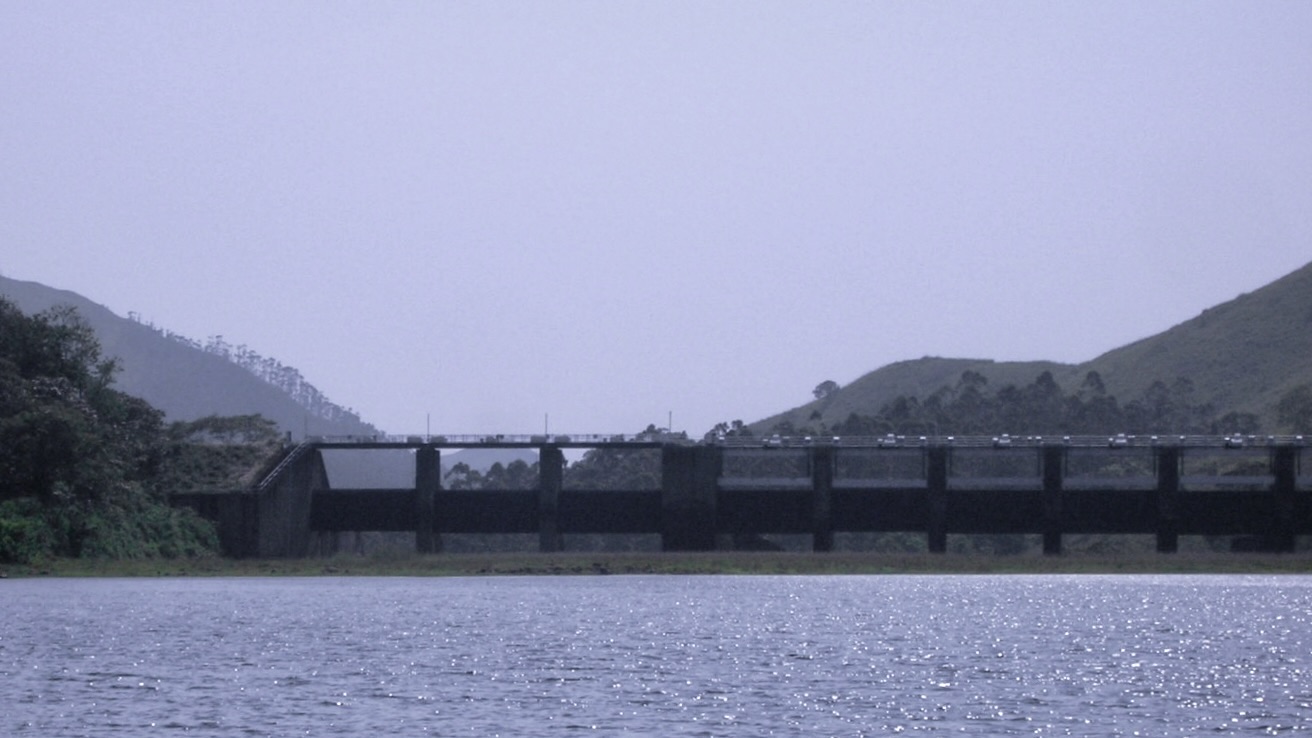
Mullaperiyar dam. (Wikimedia Commons)

Synopsis: Why does the Mullaperiyar dam dispute revolve around 136 feet, 142 feet and 152 feet? Tamil Nadu’s renewed push to raise the Mullaperiyar Dam’s water level has revived a dispute that has lasted for several decades and continues to do so. Beyond the fight over water levels are the legal, technical and political developments that continue to shape the decades-old conflict.
A single line in Tamil Nadu Finance Minister Dr N Marie Wilson’s Revised Budget Estimates speech on 5 August has once again brought one of South India’s longest-running inter-state disputes back into focus.
His announcement that the Tamil Nadu government would continue its efforts to raise the water level of the Mullaperiyar Dam has reopened a debate that has shaped Kerala-Tamil Nadu relations for decades.
More than 130 years after the masonry dam was built across the Periyar in Idukki, the dispute remains as much about safety and ageing infrastructure as it is about water storage.
With both states locked in a legal and political battle, the issue has repeatedly reached the Supreme Court and other forums like the Central Water Commission.
From Kerala’s unsuccessful attempt to cap the reservoir level through legislation to the apex court’s rulings that eventually fixed the permissible storage level at 142 feet against the dam’s full reservoir level of 152 feet, the controversy has taken many twists without finding a lasting resolution.
Also Read: In Kerala’s relief camps, caste proves harder to wash away: Inside flood-hit Pathanamthitta
The origins of the Mullaperiyar dispute date back to the colonial era.
On 29 October 1886, a 999-year lease agreement was signed between the erstwhile Travancore kingdom and the Secretary of State for India, paving the way for the construction of the Mullaperiyar Dam as part of the Periyar irrigation project.
Construction of the masonry dam began in 1887 and was completed in 1895.
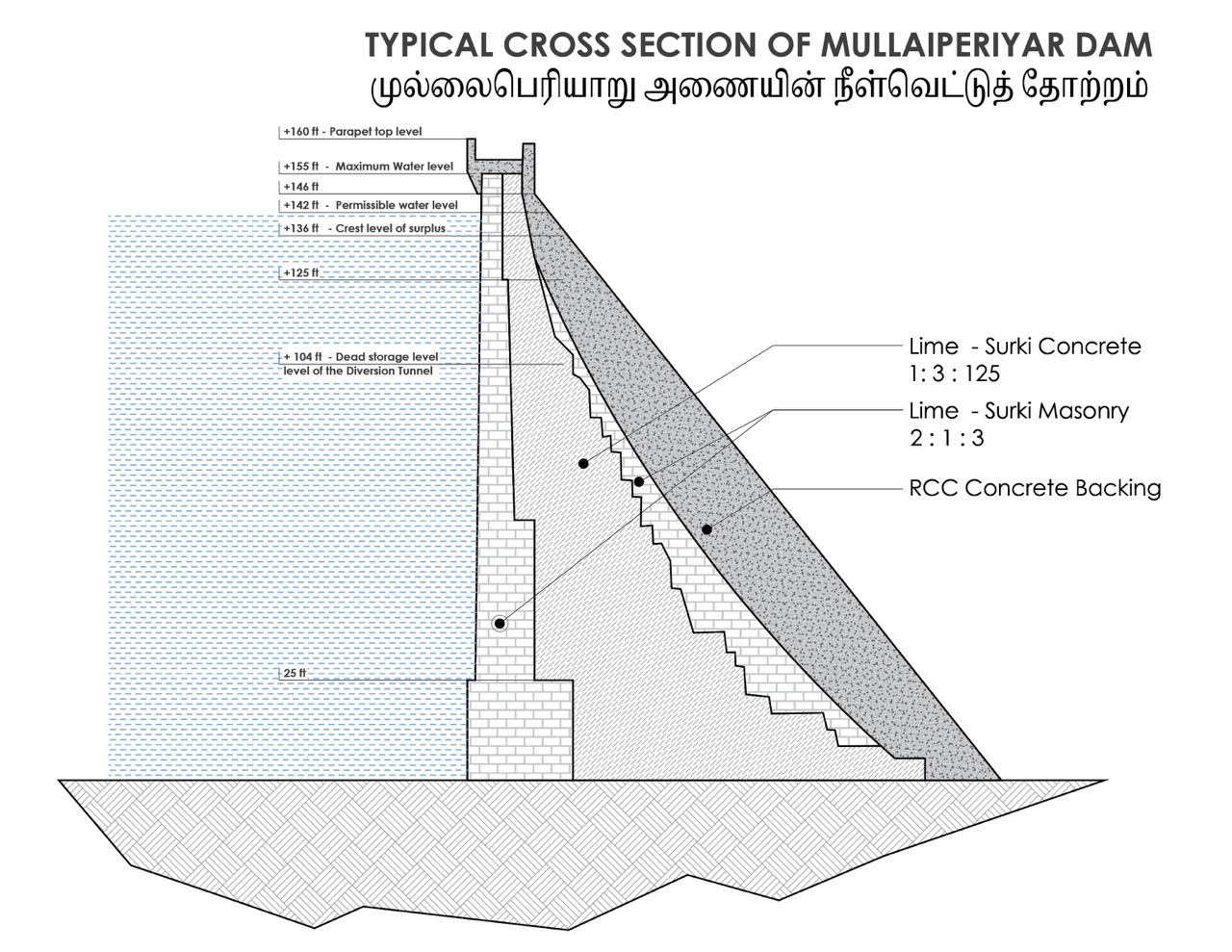
Cross section of Mullaiperiyar dam. (Wikimedia Commons)
Designed with a full reservoir level of 152 feet, the dam became a lifeline for agriculture in Tamil Nadu, supplying water through a tunnel to irrigate nearly 68,558 hectares in the Vaigai basin.
Following Independence, the colonial-era lease was reaffirmed through a fresh agreement in 1970 during the tenure of Kerala Chief Minister C Achutha Menon.
While the revised pact increased the lease rent payable by Tamil Nadu, it also gave the state the right to generate hydroelectric power using the water diverted from the reservoir.
The first major point of contention, however, emerged in 1979, when reports in the Kerala media raised questions over the structural condition of the ageing dam.
The reports trace their origin to an episode of Reservoir Triggered Seismicity (RTS) recorded near the Idukki reservoir in 1977.
Following a mild earthquake in 1979, the Kerala Government expressed concerns over the safety of the Mullaperiyar Dam.

Subsequent inspections identified a few leaks in the structure.
A state agency later assessed that the dam might not withstand an earthquake exceeding magnitude 6 on the Richter scale.
Acting on Kerala’s request, the Tamil Nadu Government reduced the water level from 142.2 feet to 136 feet to facilitate strengthening works.
After the repairs, it was recommended that the reservoir level could eventually be restored to its full capacity.
Parallel to this development was Kerala seeking the intervention of the Central Water Commission (CWC) for a technical assessment.
Responding to the concerns, the Chairperson of the CWC convened a high-level meeting on 25 November 1979, attended by officials from Kerala’s Irrigation and Electricity departments and Tamil Nadu’s Public Works Department.
The meeting identified a series of emergency, medium-term and long-term measures to strengthen the dam.
The issue was reviewed again at another CWC meeting on 29 April 1980.
After assessing the proposed strengthening programme, the Commission concluded that once the emergency and medium-term works were completed, the reservoir level could safely be restored to 145 feet.
Also Read: First budget of the TVK government: Continuity over consolidation
A series of petitions concerning the Mullaperiyar Dam reached the Supreme Court.
Following the apex court’s directive issued on 28 April 2000, the then Union Water Resources Minister convened an inter-state meeting on 19 May 2000. The meeting resulted in the formation of an Expert Committee in June 2000 under the chairmanship of the Member (Design and Research) of the CWC, with representatives from both Kerala and Tamil Nadu.
After examining the dam’s structural condition and the strengthening measures already completed, the committee submitted its report in March 2001.
It concluded that the reservoir level could be safely increased from 136 feet to 142 feet without compromising the dam’s stability.
The panel also recommended that any proposal to restore the level to 152 feet should be considered only after the remaining strengthening works were completed.
Acting on these findings, the Supreme Court, in its judgment dated 27 February 2006, permitted Tamil Nadu to raise the Mullaperiyar Dam’s water level from 136 feet to 142 feet.
The court also allowed the state to undertake the remaining strengthening works required for any future increase in the reservoir level.
Barely a month after the Supreme Court allowed Tamil Nadu to raise the water level from 136 feet to 142 feet, Kerala responded with a decisive legislative move.
On 18 March 2006, the state enacted the Kerala Irrigation and Water Conservation (Amendment) Act, 2006, effectively barring any increase in the reservoir level beyond 136 feet.
The law also included Mullaperiyar in the list of ‘endangered dams’, citing safety concerns.
The Act made its intent unmistakably clear. It stated that, irrespective of any existing law, court order, judgment, treaty or agreement, no government, custodian or agency could take any step to raise the Full Reservoir Level of dams listed in the Second Schedule unless permitted under the provisions of the Act itself.
Kerala identified 22 dams as ‘endangered’ because of age, structural deterioration and other safety-related concerns.
In that schedule, the Full Reservoir Level of the Mullaperiyar Dam was fixed at 136 feet.
Also Read: Everyone wants a piece of Munnar: But can Kerala’s crown jewel carry the weight of its own success?
Unsurprisingly, Tamil Nadu challenged the legislation as it moved the Supreme Court on 31 March 2006.
The state sought to have the legislation declared unconstitutional and requested directions restraining Kerala from preventing it from raising the water level to 142 feet.
In an effort to break the impasse, the Union Water Resources Ministry convened a meeting of the Chief Ministers of Kerala and Tamil Nadu in New Delhi on 29 November 2006.
However, both states reiterated their established positions, and the discussions ended without any consensus.
The issue was revisited a year later after the Tamil Nadu Chief Minister met the Prime Minister on 18 December 2007.
Acting on the Prime Minister’s suggestion, the Chief Ministers of the two states met the following day in the presence of the Union Water Resources Minister.
Tamil Nadu proposed that engineers nominated through the CWC, and not belonging to either state, monitor seepage measurements at the dam.
Although Kerala agreed to examine the suggestion, the two sides could not arrive at a mutually acceptable monitoring mechanism.
The differences widened further after Kerala commissioned a hydrological study by an IIT Delhi professor, which concluded that the dam was unsafe to handle the estimated Probable Maximum Flood. The CWC, however, rejected the findings, saying the report was not well founded.
At an inter-state meeting on 31 July 2009, Kerala maintained that constructing a new dam was the only practical solution and even offered to build it at its own expense. Tamil Nadu, however, rejected the proposal, insisting that the strengthened existing dam was fully capable of serving its purpose.
Also Read: From gold rings to coins: Is TVK’s first budget glittering too much?
And then in 2010, the long-running Mullaperiyar Dam dispute reached a crucial stage when a five-judge Constitution Bench of the Supreme Court took up the matter, focusing on the competing concerns raised by Kerala and Tamil Nadu.
In an order issued on 18 February 2010, the Supreme Court directed the constitution of an Empowered Committee to examine issues surrounding the dam.
The court observed that, apart from the legal and constitutional questions involved, Tamil Nadu’s primary grievance was its inability to raise the reservoir level to 142 feet, while Kerala’s principal concern centred on the safety of the more than century-old structure.
Following the court’s direction, the Union Ministry of Water Resources constituted the Empowered Committee, with former Chief Justice of India Justice (Dr) AS Anand as its chairman.
The committee held 20 meetings, visited the Mullaperiyar Dam site in December 2010 and examined technical, hydrological and safety-related aspects before submitting its report on 23 April 2012. It concluded that the dam was hydrologically safe and said Kerala’s proposal to construct a new dam required reconsideration.
The dispute was later heard in detail by a five-judge Constitution Bench of the Supreme Court during July and August 2013.
Arguments concluded on 21 August 2013, and the court delivered its landmark verdict on 7 May 2014.
In its judgment, the Supreme Court struck down the Kerala Irrigation and Water Conservation (Amendment) Act, 2006, declaring it unconstitutional. The court also restored the full reservoir level of the Mullaperiyar Dam to 142 feet and directed the Union government to constitute a three-member Supervisory Committee to oversee the safety, operation and maintenance of the dam.
The Supervisory Committee, established in compliance with the Supreme Court’s order, functions from its office at Kumily in Kerala and continues to monitor matters relating to the safety and operation of the Mullaperiyar Dam.
Kerala has firmly rejected Tamil Nadu’s renewed bid to raise the water level of the Mullaperiyar Dam beyond 142 feet, with Water Resources Minister Mons Joseph asserting that the state’s position remains unchanged.
Responding to Tamil Nadu’s Budget announcement that it would pursue a higher storage level in the 131-year-old reservoir, the Minister said Kerala would move the Supreme Court if any attempt was made to alter the existing limit.
He maintained that the 142-foot ceiling, accepted by the apex court, cannot be changed unilaterally by either state.
Joseph pointed out that several directions issued by the Supreme Court on dam safety remain pending, including a comprehensive inspection by the National Dam Safety Authority, periodic safety assessments and strengthening of the baby dam.
He said these measures were to have been completed before the end of last year, but even a basic safety audit has not been carried out.
The issue was also reviewed at an emergency meeting convened by Chief Minister VD Satheesan on 5 August.
Reiterating Kerala’s long-standing demand, the Minister said the state continues to press for a new dam that would ensure Tamil Nadu receives its share of water while fully addressing the safety concerns of people living downstream in Kerala.



