

Published Aug 05, 2026 | 3:32 PM ⚊ Updated Aug 05, 2026 | 3:38 PM

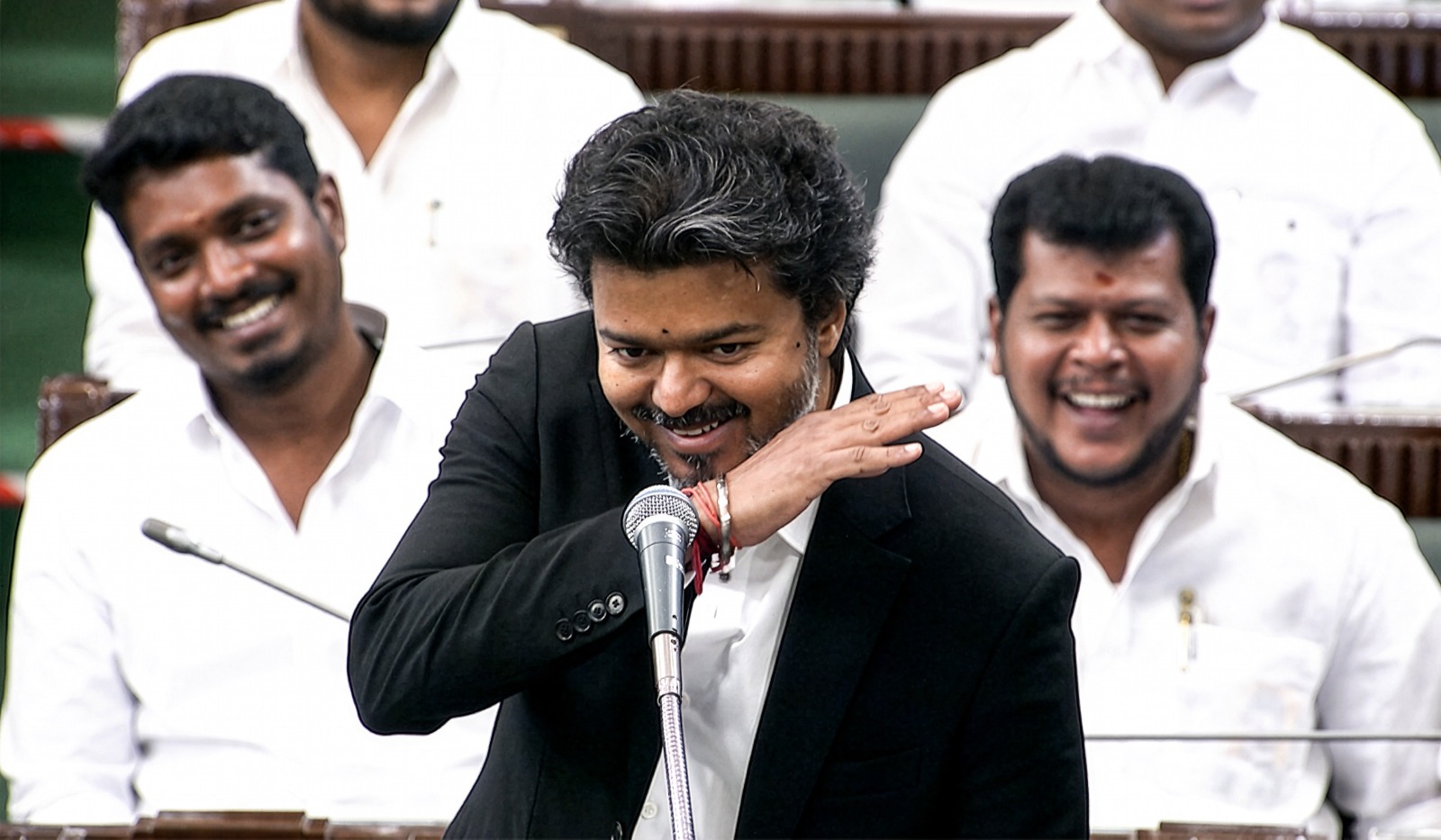
Tamil Nadu Chief Minister C Joseph Vijay.

Synopsis: While the Vijay-led TVK government has unveiled several high-profile welfare schemes featuring gold coins, gold rings and branded bicycles, the announcements have also triggered questions over funding, eligibility and spending priorities amid the State’s claimed fiscal constraints.
The Tamilaga Vettri Kazhagam (TVK) government, led by Chief Minister C. Joseph Vijay, has presented its first full-fledged Budget.
Finance Minister Dr. N. Marie Wilson outlined the government’s financial roadmap for 2026-27 during his Budget speech at the Legislative Assembly that lasted over two-and-a-half hours.
While many expected the Budget to fulfil key election promises, such as increasing the Women’s Rights Assistance Scheme from ₹1,000 to ₹2,500 per month, the government instead unveiled a series of expensive welfare initiatives aimed primarily at women and students.
From 8-gram gold coins for brides to 1-gram gold rings for babies born in government hospitals, the 2026-27 Budget is dominated by gold-based welfare schemes.
One of the most talked-about announcements in the Budget is the “Annan Seer” marriage assistance scheme, under which every bride in Tamil Nadu will receive an 8-gram gold coin along with a silk saree. The government has allocated ₹812 crore for the scheme during the current financial year.
However, the Budget speech states that the benefit will be provided to women getting married in Tamil Nadu. This has prompted many netizens to question whether the allocated amount would be sufficient if the scheme is indeed universal.
With several lakh marriages taking place annually in Tamil Nadu, many are asking how ₹812 crore would be enough to provide every eligible bride with an 8-gram gold coin and a silk saree.
Others have questioned whether the scheme is actually intended only for a specific category of beneficiaries, urging the government to provide clarity on the eligibility criteria.
Questions have also been raised over the State’s financial condition as the Vijay-led government has repeatedly maintained that the previous DMK regime had left the exchequer empty. Critics are asking how the State plans to fund new gold-based welfare schemes while simultaneously citing fiscal constraints.
Also Read: Tamil Nadu budget puts Mullaperiyar back in focus, raises concerns in Kerala
The government had earlier announced the “Thaai Maaman Thanga Mothiram Thittam”, under which every child born in a government hospital will receive a 1-gram gold ring.
The scheme is scheduled to be launched on September 15, the birth anniversary of former Chief Minister C.N. Annadurai.
The Budget allocates ₹560 crore for the programme during the current financial year.
Some have questioned whether this allocation would be adequate if the scheme succeeds in attracting more expectant mothers to government hospitals, thereby increasing the number of beneficiaries beyond current estimates.
Tamil Nadu has long implemented a free bicycle scheme for government school students, benefiting more than five lakh students every year.
The Vijay government has now revamped the programme by announcing that 5.32 lakh students will receive modern branded bicycles equipped with helmets and water bottles, at an estimated cost of ₹277 crore.
Also Read: TN Budget pushes for NEET ban, focuses on Education, Infra and Revenue
The Budget also unveiled the TN-SUDAR (State Upgradation, Development and Advancement of Student Residences) initiative, under which the government plans to construct 200 integrated student hostels across major educational hubs.
The project will be implemented through a Public-Private Partnership (DBFOT) model with an estimated capital outlay of ₹3,200 crore. Of this, the State government will contribute 20 per cent (₹640 crore) as a capital construction grant over the next two financial years, while the remaining investment will come from private partners.
The proposed hostels will feature modern beds, air-conditioned study hubs, 24×7 security, hygienic kitchens, and an automated room allocation system aimed at promoting diversity and social integration.
However, the project has also triggered questions.
Many argue that instead of establishing a new PPP-based hostel network, the government could first upgrade the quality of existing government hostels across Tamil Nadu.
Others point out that since the government is contributing only 20 per cent of the project cost while private players will invest the remaining 80 per cent, there is uncertainty over the fees students may ultimately have to pay.
If hostel charges become expensive, critics ask whether the project would truly benefit economically weaker students, who are expected to be its primary beneficiaries.
(Edited by Fayisa CA)



