

Published Aug 06, 2026 | 6:00 PM ⚊ Updated Aug 06, 2026 | 6:00 PM

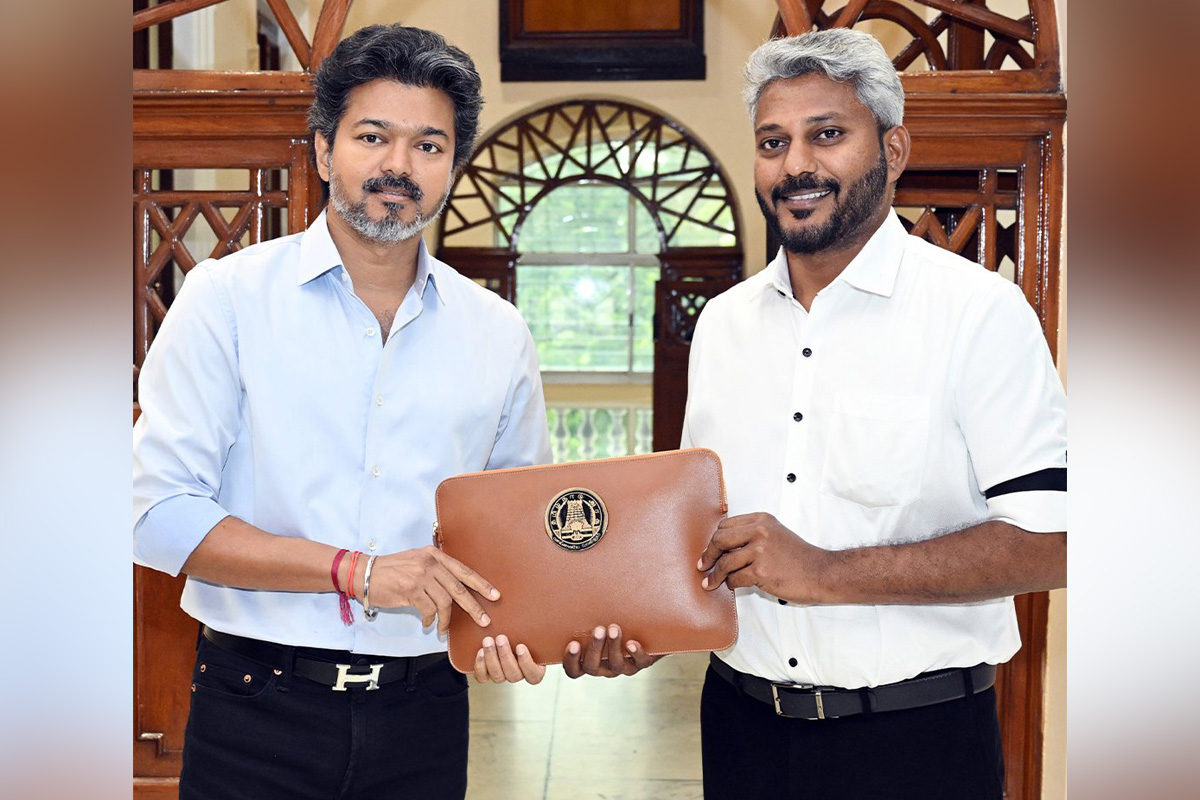
Tamil Nadu CM Vijay and Finance Minister N Marie Wilson with their government's maiden budget. (Special Arrangement)

Synopsis: An analysis of the Revised Budget Estimates for 2026–27 presented by Finance Minister Marie Wilson reveals that it borrows heavily from the interim budget and also from the Dravidian model.
The first budget of the TVK government, presented on August 5 by Finance Minister Marie Wilson, was awaited with considerable expectation. This anticipation arose against the backdrop of Chief Minister Vijay Joseph’s ‘Kajaana Kaali’ (empty treasury) declaration on the first day of his government, followed by the submission of a white paper on state finances.
Both the Tamil Nadu Chief Minister’s concerns and the white paper painted a picture of a serious fiscal crisis—marked by a widening revenue deficit, mounting debt, and rising interest payments—attributed to the mismanagement of public finances during the previous DMK government’s five-year term. The white paper called for corrective measures, leading many to expect the budget to set a clear direction for fiscal consolidation.
Surprisingly, the budget did not do that and instead largely adopted the interim budget version prepared by the former Finance Minister Thangam Thennarasu, with limited modifications: selective tinkering, the renaming of many existing schemes, and a reallocation of expenditure of approximately ₹18,386 crore.
The fiscal and developmental implications of this first TVK budget are inherently limited, as it covers only the remaining half of the current financial year 2026–27. Nevertheless, the political direction of the TVK government for the coming years is already evident: it has preferred fiscal expansion for welfare spending over consolidation.
The total size of the Revised Budget Estimate stands at ₹4,72,864 crore—just 1.35 per cent (₹6,323 crore) higher than the Interim Budget Estimate (IBE) of ₹4,66,541 crore. The opposition may well ask how the TVK government could present a budget of nearly ₹5 lakh crore from what it had described as an empty treasury.
Although the overall budget size has increased only marginally, allocations for subsidies and transfers have been raised by ₹18,386 crore. How the Finance Minister has managed this is instructive:
• Salaries and pension commitments have been reduced by ₹6,823 crore relative to the interim budget estimates.
• Lending support to state public sector undertakings has been cut by ₹4,633 crore.
• Expenditure on education has been reduced by ₹4,108 crore.
• Capital outlay has been trimmed by ₹2,577 crore.
Together, these reductions amount to ₹18,141 crore—almost exactly offsetting the additional ₹18,386 crore allocated largely to the new schemes of the TVK government: Annan Seer, Thai Maaman gold ring, TN SUDAR, Singapengal, and loans for self-help groups.
The fulfilment of major poll promises—such as raising the direct cash transfer to women from the existing ₹1,000 to ₹2,500—would require more than Rs 1 lakh crore. The Finance Minister has therefore indicated that these will be implemented in phases over one-, three-, and five-year horizons. In the interim, many existing schemes have been renamed with the prefix ‘Vetri’.
On the revenue front, instead of increasing the state’s own tax revenue as signalled in the white paper, the estimate has been revised downward by ₹2,839 crore—from ₹2,29,579 crore in the Interim Budget Estimate to ₹2,26,740 crore in the Revised Budget Estimate.
The government has announced the constitution of a Revenue Enhancement Committee. The budget roadmap projects an additional ₹16,000 crore in revenue, but only in the coming years, not in the current fiscal.
Federal transfers constitute only about 23 per cent of the state’s revenue receipts. While the share of central taxes remains unchanged, Union grants, which recorded a negative compound annual growth rate of –6.7 per cent over the last five years, have been increased by a substantial ₹8,160 crore, a rise of 33 per cent over the Interim Budget Estimate.
The Finance Minister clarified that these are expected receipts from the Union government on account of pending arrears under the erstwhile MGNREGA scheme and its successor, the VB–Guarantee for Rozgar and Ajeevika Mission (Gramin). Such grants have been declining for all states, and more sharply for opposition-ruled ones.
The previous DMK government had approached the Supreme Court over the withholding of thousands of crores under Samagra Shiksha after its refusal to sign the PM SHRI scheme and implement the three-language formula. Although the Finance Minister remained silent on this particular issue, it is noteworthy that several opposition-ruled states, including Kerala and earlier West Bengal, have experienced similar pressure on Centrally Sponsored Scheme funds.
The actual release of these ‘expected’ funds will therefore depend on whether the TVK government aligns with the ruling coalition at the Centre or remains in opposition. In the latter case, a shortfall of ₹8,160 crore—or more—could open a further hole on the revenue side. This risk is heightened by the recommendations of the 16th Finance Commission, which propose doing away with state-specific grants and revenue-deficit grants under Article 275.
Most debt and deficit indicators remain broadly the same as in the interim budget, with one notable exception: the revenue deficit has increased by ₹7,078 crore—from ₹48,697 crore in the Interim Budget Estimate to ₹55,775 crore in the Revised Budget Estimate.
The primary deficit, fiscal deficit, public debt levels, and interest payments are virtually unchanged.
The opposition DMK may take comfort in the fact that the first budget of the TVK government demonstrates a clear dependency on the Dravidian model of development, which set benchmarks in the late 1960s and early 1970s by prioritising social-sector expenditure. Successive alternate governments—whether AIADMK or now TVK—have found it difficult to deviate from this trajectory. Instead, they have tended to expand it (as seen with the morning breakfast scheme) and strengthen it (renaming existing schemes signals continued commitment).
In short, the first TVK budget reveals continuity more than rupture: welfare expansion financed by internal reallocations, cautious revenue projections, and reliance on expected central grants whose realisation remains politically contingent.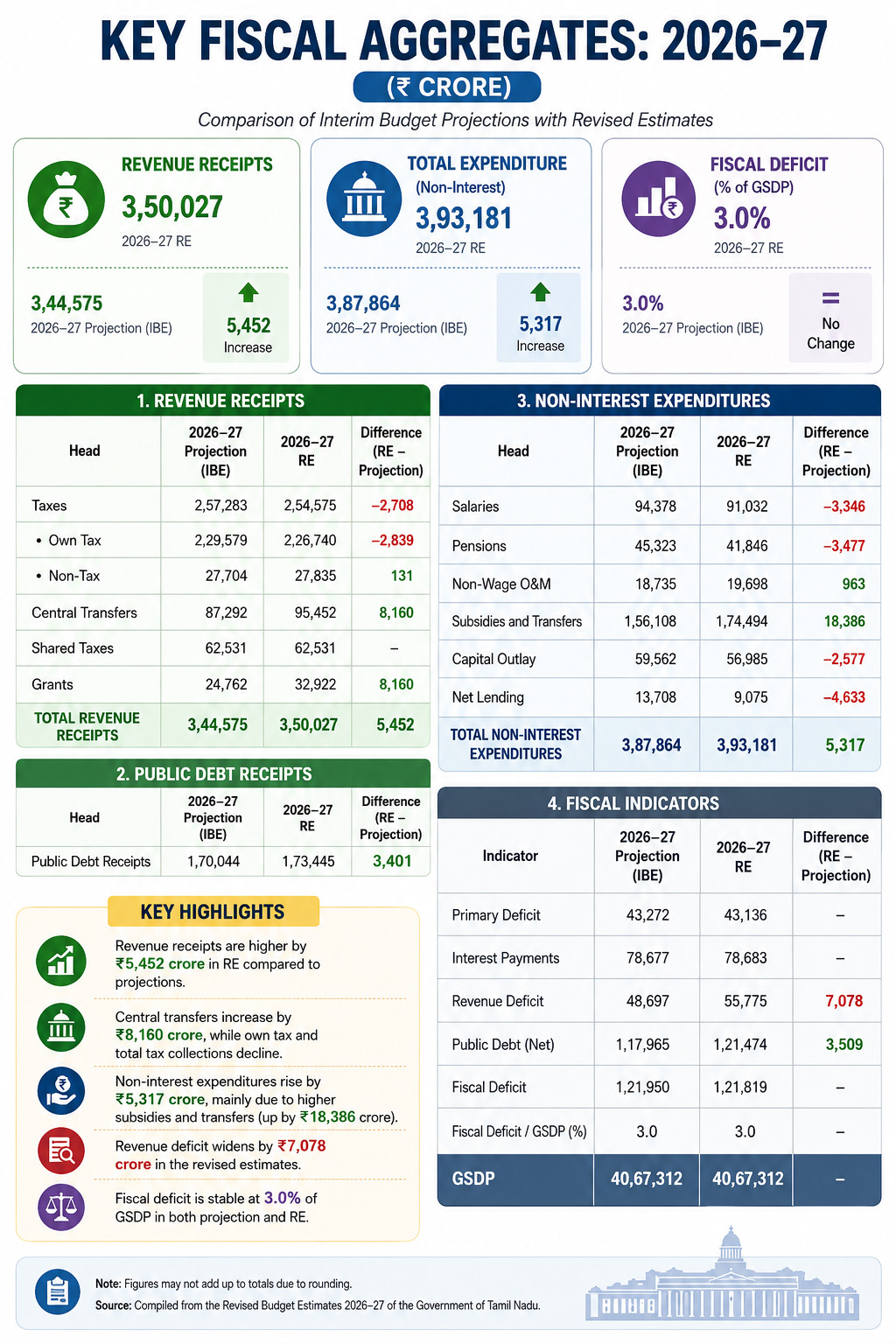
The first budget of the TVK government is more an exercise in continuity than a decisive break. It reallocates resources within a largely inherited framework to launch a few signature welfare schemes, while postponing the full delivery of major electoral promises. The revenue assumptions rest, in part, on expected central grants whose realisation is politically contingent. For the remainder of 2026–27, the fiscal space for transformation remains constrained; the true test of the government’s fiscal philosophy will come in the full-year budgets that follow.
Also Read:
From gold rings to coins: Is TVK’s first budget glittering too much?
Vijay’s June 23 Assembly speech: When performance trumped governance
(K Jothi Sivagnanam is a former professor of economics, University of Madras, and former Member (Full Time), Tamil Nadu State Planning Commission.)
(Edited by R Rajesh Kumar.)



