

Published Aug 20, 2026 | 3:31 PM ⚊ Updated Aug 20, 2026 | 3:31 PM

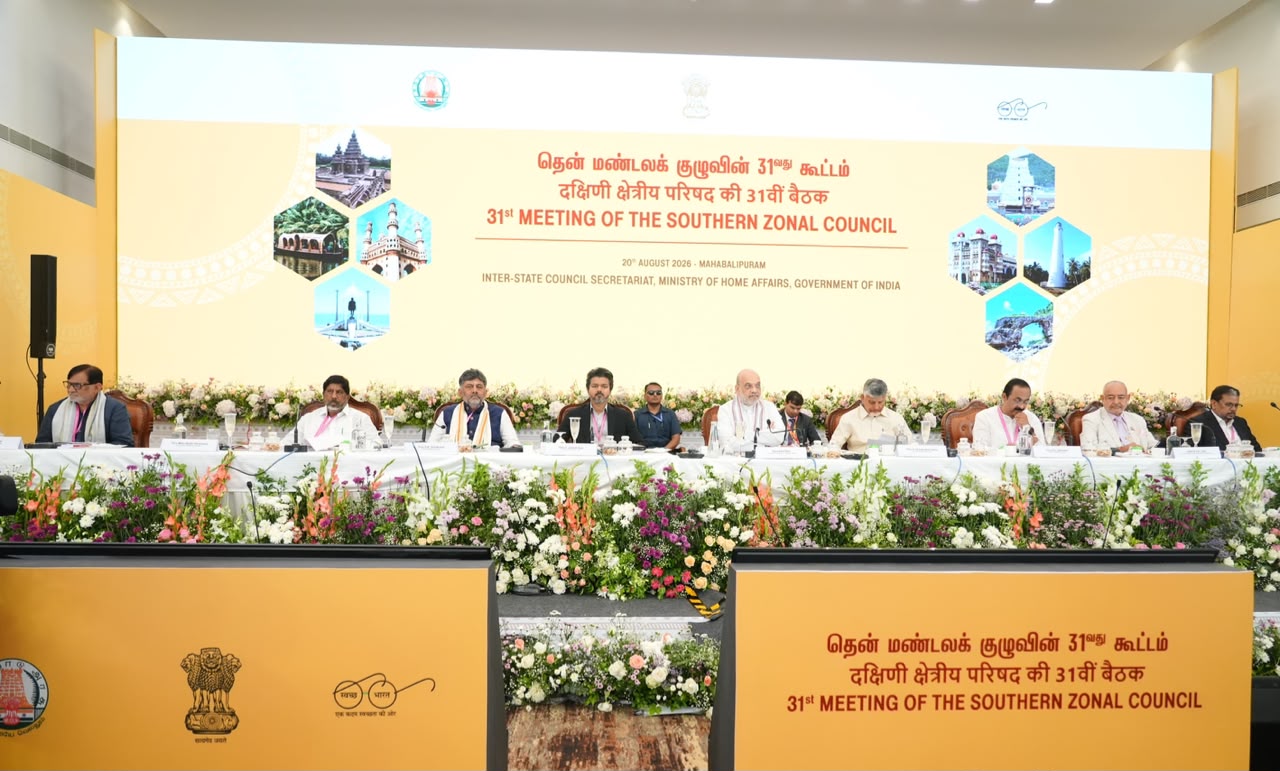
Union Home Minister Amit Shah chairs the 31st Southern Zonal Council meeting in Mahabalipuram, Tamil Nadu.

Synopsis: The 31st Southern Zonal Council meeting saw Tamil Nadu, Karnataka, Keralam, Andhra Pradesh, Telangana and Puducherry raise concerns over fiscal fairness, political representation, inter-state water sharing and regional development. The states also highlighted issues including delimitation, Cauvery and Godavari water projects, healthcare funding, infrastructure, security, bifurcation-related matters and stronger Centre-state cooperation.
The 31st meeting of the Southern Zonal Council, chaired by Union Home Minister Amit Shah, was held at Mahabalipuram in Tamil Nadu on Thursday, 20 August, bringing together the Chief Ministers and senior representatives of the southern states and Union Territories to deliberate on inter-state disputes, Centre-state relations, security, infrastructure, water resources and regional development.
Tamil Nadu Chief Minister C Joseph Vijay, who is the Vice-Chairman of the Council, hosted the meeting.
Andhra Pradesh Chief Minister N Chandrababu Naidu, Karnataka Chief Minister DK Shivakumar and Keralam Chief Minister VD Satheesan attended, while Telangana was represented by Deputy Chief Minister Mallu Bhatti Vikramarka. Puducherry was represented by Lieutenant Governor K Kailashnathan.
Karnataka Chief Minister DK Shivakumar made a strong case for greater fiscal fairness, beginning by highlighting the state’s contribution to India’s economy.
He said Karnataka accounts for 42 percent of India’s software exports, hosts around 1,100 Global Capability Centres, and attracted more than 21 percent of India’s FDI equity inflows between 2019 and 2025. Karnataka has 5.5 percent of India’s population but contributes around 9 percent of its GDP, he said.
Shivakumar also highlighted Karnataka’s position as the country’s largest aerospace hub, accounting for around 60 percent of India’s aerospace industry, as well as its production of nearly 70 percent of India’s coffee and 90 percent of India’s processed gherkin exports. He said Bengaluru is now among the world’s top five AI cities.
He said Karnataka’s share in the divisible pool under the 15th Finance Commission fell from 4.7 percent to 3.6 percent, resulting in an estimated loss of ₹65,000 crore over six years. He also pointed out that the 15th Finance Commission had recommended a special grant of ₹5,495 crore and state-specific grants of ₹6,000 crore, neither of which was released.
While the 16th Finance Commission partly restored Karnataka’s share to 4.131 percent, Shivakumar demanded that it be fully restored to 4.7 percent. He noted that Karnataka is the second-largest contributor to GST and income tax, arguing that states that perform well in growth and revenue generation should be incentivised rather than penalised.
He sought additional Central projects including the Bengaluru-Mumbai high-speed rail project, STRR South, AIIMS in Raichur and a special package for Kalyana Karnataka.
The Karnataka Chief Minister made a strong intervention on parliamentary delimitation, saying the South’s success in population stabilisation should not become a reason for reducing its political voice.
He called for the 1971 population basis to be honoured and demanded that the number of Lok Sabha seats be frozen at the existing 543. He also called for women’s reservation to be accommodated within the existing strength rather than reducing the South’s representation.
The issue has emerged as a shared concern among southern states, with Tamil Nadu and Karnataka both calling for safeguards against a reduction in their parliamentary weight.
Also Read: Hanur firing: Row between Karnataka and Tamil Nadu deepens as victim’s kin appeal to CM Vijay
Shivakumar said the Cauvery, Krishna, Tungabhadra, Pennar and Palar rivers should unite the southern states rather than divide them.
He called for a shift from water sharing to water cooperation, based on three principles: equity, transparency and cooperation.
Referring to a joint public meeting held with Andhra Pradesh Chief Minister N Chandrababu Naidu and Telangana Chief Minister A Revanth Reddy, he said Karnataka’s approach was to treat neighbouring states as partners rather than competitors.
At the same time, he stressed that cooperation must work both ways and Karnataka’s lawful share under tribunal awards must be respected. He said he would place the state’s specific positions on the Krishna, Upper Bhadra and river-linking projects before the Council.
Shivakumar also raised concerns over healthcare financing, education and nutrition, housing for poorer families, coastal erosion and disaster support, mining and the fiscal rights of mineral-bearing states, land given by states to Central institutions, justice delivery and digital infrastructure, banking and financial inclusion in villages, and support for farmers.
He opposed the proposed Mines and Minerals (Development and Regulation) Bill, 2026, arguing that it takes away the states’ right to tax major minerals, which he said had been recognised by a nine-judge Bench of the Supreme Court.
He also called for stronger laws and enforcement against drug trafficking, including swift and stringent prosecution of those involved in the trade.
Also Read: Three months in power, KPCC reorganisation held up by factional claims and political equations
Keralam Chief Minister VD Satheesan focused on healthcare financing, transport, climate change, rail connectivity, mining, women and children, and inter-state security.
He said Keralam spent around ₹1,493 crore under Ayushman Bharat Pradhan Mantri Jan Arogya Yojana in the last policy year, while the assistance received from the National Health Authority was only about ₹151 crore, leaving the state to bear nearly 90 percent of the burden.
Satheesan sought state-specific premiums instead of a uniform national premium, alignment of eligibility with the National Food Security Act database and revision of the Central share based on actual expenditure incurred on centrally sponsored families. He also said the expansion of benefits to senior citizens under the Vay Vandana scheme needed adequate funding.
Satheesan sought either a complete toll exemption or substantially concessional toll rates for state road transport undertakings.
He said the Keralam State Road Transport Corporation paid more than ₹2.16 crore in tolls in June 2026 despite providing an essential public service. He pointed out that buses are sometimes required to use national highways only for short stretches to cross toll plazas, but are still charged the full toll.
Keralam’s coastal vulnerability was another major issue raised by Satheesan. He said the state has a coastline of around 586 km, with nearly 63 percent classified as eroding, while around 30 percent of the state’s population lives along the coast.
He sought permission to use the National and State Disaster Response and Mitigation Funds for coastal protection works and the resettlement of families displaced by erosion. He also called for the speedy finalisation of a national policy on coastal erosion.
Satheesan reiterated Keralam’s demand for the Thalassery-Mysore and Nilambur-Nanjangud railway lines, seeking cooperation from Karnataka and the Railways to finalise alignments and DPRs.
He also raised night traffic restrictions on forest stretches connecting Keralam with Karnataka and Tamil Nadu. Instead of blanket restrictions, he sought scientifically determined least-sensitive time windows and regulated convoy movement to balance wildlife protection with the movement of people and goods.
Also Read: Elanthoor human sacrifice case accused held with suspected hash oil
While stating that Keralam was cooperating with the Geological Survey of India and the Ministry of Mines in bringing bauxite, beach sand and critical mineral blocks to auction, Satheesan raised strong objections to offshore sand mining off the Keralam coast.
He sought a rigorous scientific assessment and a robust Standard Operating Procedure before offshore mineral blocks are auctioned, citing environmental concerns and the impact on fishing communities.
Satheesan said Keralam has operationalised 54 of the 56 sanctioned Fast Track Special Courts, including 14 e-POCSO courts, for speedy trials in rape and child-abuse cases. He said compliance with the investigation timeline monitored through the ITSSO portal had improved to more than 78 percent.
He sought an extension of the Fast Track Special Courts scheme and assured funding beyond the current period, along with stronger inter-state cooperation in forensic reports and witness production.
He also highlighted Keralam’s child nutrition and education initiatives, including Poshaka Balyam, take-home rations, the First Thousand Days programme and the VIVA Keralam anaemia campaign. He said a mass anti-dropout campaign had helped keep the state’s school dropout rate among the lowest in the country.
On security, Satheesan proposed that every southern state designate a senior Police Headquarters-level officer as an Inter-State Police Nodal Officer. He called for real-time intelligence sharing, prisoner-information sharing, joint operations and coordinated patrolling to tackle narcotics trafficking, organised crime, illegal migration and emerging cyber threats.
Tamil Nadu Chief Minister C Joseph Vijay said the Southern states together contribute more than 30 percent of India’s GDP, making the region one of the principal engines of the national economy.
He called for the states to function as an integrated economic region, arguing that their interconnected manufacturing and service sectors could be developed into globally competitive value chains.
Vijay proposed common economic and logistics clusters consisting of integrated manufacturing zones, shared multimodal logistics parks and seamless freight and industrial corridors connecting production centres to ports and global markets.
He said the approach could reduce the cost of doing business, improve export competitiveness, attract foreign investment and spread industrial growth to smaller towns.
Vijay highlighted the proposed extension of the Bengaluru Metro from Bommasandra to Hosur as an immediate example of interstate infrastructure cooperation.
He described the project as a potential model for connecting Bengaluru’s Electronic City corridor with the industrial hub of Hosur and urged the Union government and the governments of Karnataka and Tamil Nadu to expedite its implementation.
Vijay also called for the Blue Economy to be placed at the centre of the Southern regional agenda.
He proposed an integrated approach covering ports, coastal shipping, fisheries, marine industries, maritime services and coastal tourism. He said expanding coastal shipping would reduce logistics costs and ease pressure on roads and railways.
He also called for stronger port-hinterland connectivity, dedicated coastal economic zones and coordinated maritime infrastructure to attract investment and create jobs. With Tamil Nadu’s 1,076-km coastline, he said the state was ready to work with its neighbouring states on a shared maritime vision.
Also Read: DVAC searches 51 locations across Tamil Nadu in aluminium conductor procurement case
Vijay said cooperative federalism must be supported by a predictable and equitable system of fiscal federalism.
He argued that states that have invested in human development, maintained fiscal discipline and successfully stabilised their populations should not be disadvantaged in the fiscal devolution process.
“The Southern States seek not preferential treatment, but a fair and equitable treatment,” he said, stressing the need to respect fiscal autonomy and reward performance alongside equity.
Vijay also pointed out that after the introduction of GST, states have very limited flexible revenue sources outside petroleum and alcohol. Citing Article 279A(4)(e) of the Constitution, he called on states to work together to regain flexibility in determining GST rates.
Vijay said no agenda for Southern cooperation could be complete without addressing inter-state rivers.
He stressed that the legitimate rights of lower-riparian states and the livelihoods dependent on assured river flows must be protected. He also insisted that Supreme Court judgments, tribunal awards and statutory mechanisms for river management must be implemented in letter and spirit.
On the Cauvery, he called for timely implementation of the Supreme Court judgment and decisions of the Cauvery Water Management Authority.
On Mullaperiyar, he said safety must continue to be guided by judicial decisions concerning the increase of the water level to 152 feet.
He also said any upstream intervention that could affect another state’s rightful share must take place only within the established legal and institutional framework.
Also Read: Village of widows: Women pay the price for Puducherry’s alcohol-dependent economy
Vijay reiterated Tamil Nadu’s opposition to NEET, arguing that the examination places rural students and those from socially and economically disadvantaged communities at a disadvantage.
He urged the Union government to allow Tamil Nadu to fill all seats under the state quota in MBBS, BDS and AYUSH courses solely on the basis of Class XII marks, arguing that this would preserve the state’s school-education-based model of inclusive medical admissions.
Vijay also raised the issue of parliamentary delimitation, describing it as a matter of “profound constitutional importance”.
He warned that delimitation based predominantly on population could reduce the collective voice of the southern states in Parliament. He argued that the South’s success in population stabilisation, human development and economic growth should not become a reason for reducing its political representation.
Vijay called for a clear legislative assurance that no state would suffer a reduction in its percentage of parliamentary representation because of its success in population stabilisation.
The demand comes days after the Tamil Nadu Assembly adopted a resolution opposing the proposed delimitation exercise, with the state government urging that the existing level of parliamentary representation be protected and that southern states should not be penalised for successfully implementing population control measures. Tamil Nadu has also called for retaining the existing 543 Lok Sabha seats and accommodating women’s reservation within the existing strength.
Andhra Pradesh Chief Minister N Chandrababu Naidu called for stronger cooperation among the southern states, arguing that Centre-State coordination and mutual trust were essential to resolving long-pending issues and accelerating regional development.
Naidu said the southern states together contribute around 31 percent of India’s GDP and have the potential to build a $10 trillion economy by 2047. He called for the South to emerge as a major economic force in the effort to build a Viksit Bharat.
He proposed a bullet train corridor connecting Andhra Pradesh, Karnataka and Tamil Nadu, with a route linking Amaravati, Bengaluru and Chennai through Kuppam. He also called for a common logistics network and the development of dry ports across the southern states to strengthen trade and industrial connectivity.
Naidu proposed linking the Southern power grid with the national grid and suggested creating a consortium of southern universities and skilling institutions to improve higher education, research and workforce development. He also proposed a Mutual Aid Force among the southern states to coordinate disaster-management efforts.
Calling for greater cooperation in tourism, Naidu suggested a spiritual tourism circuit connecting Tirupati with Kashi, Ayodhya and the Char Dham.
Naidu urged the Centre to expedite the resolution of pending issues arising from the bifurcation of Andhra Pradesh. He said institutions listed under Schedules IX and X of the Andhra Pradesh Reorganisation Act remain undivided even 12 years after bifurcation.
He also sought resolution of issues relating to the state’s resource deficit and Section 56 of the Reorganisation Act.
Naidu highlighted the progress of major projects including Polavaram, the South Coast Railway Zone and Amaravati, with support from the Union government. He said Amaravati has secured statutory capital status.
He sought speedy approvals for the Dugarajapatnam port and refinery proposals, as well as the proposed Visakhapatnam and Vijayawada Metro Rail projects. He also sought approval for the Kadapa–JSW railway link.
Water was another major component of Naidu’s address. He proposed the diversion of more than 500 TMC of water through the Godavari-Cauvery river-linking project, arguing that the project could provide a permanent solution to Tamil Nadu’s water requirements.
He called for coordination among Andhra Pradesh, Telangana, Karnataka and Tamil Nadu on inter-state river-water management and urged the Centre to formulate a long-term national plan for Ganga-Cauvery river linking.
Naidu also called for time-bound preparation of Detailed Project Reports and clearances for river-linking projects, stressing that cooperation and coordination among the southern states would be crucial for the region’s long-term development.
His proposals received appreciation from other leaders at the meeting. Karnataka Deputy Chief Minister DK Shivakumar praised Naidu as a senior leader with a broad vision for the development of all states, while other Chief Ministers also appreciated his vision for comprehensive development of the southern region.
Also Read: A year after quitting YSRCP, Vijayasai Reddy announces new political party in Andhra Pradesh
Puducherry Lieutenant Governor K Kailashnathan represented the Union Territory at the meeting, as Chief Minister N Rangasamy boycotted the conference despite being invited.
Sources in the Chief Minister’s Office said Rangasamy was unhappy that the Lieutenant Governor, rather than the elected Chief Minister, was given the opportunity to speak on behalf of Puducherry before Union Home Minister Amit Shah.
Kailashnathan highlighted Puducherry’s dependence on neighbouring states and called for greater cooperation on water and infrastructure. He said Mahe depends on Keralam for drinking water, while Puducherry and Karaikal depend on Tamil Nadu for essential commodities.
He said Puducherry has no surface-water resources and relies entirely on groundwater, with high TDS, iron and nitrate levels in some areas. He sought an additional 5.55 TMC for drinking water and irrigation under Phase I of the Godavari link, besides proposing a dedicated pipeline from Sathanur Dam to Puducherry.
For Karaikal, which is entitled to 7 TMC of Cauvery water annually, he sought support for storing excess monsoon water and groundwater recharge. He also proposed linking the Pennaiyar and Sankarabarani rivers to utilise excess water for drinking, irrigation and groundwater recharge.



