

Published Aug 19, 2026 | 9:00 AM ⚊ Updated Sep 15, 2026 | 11:36 AM

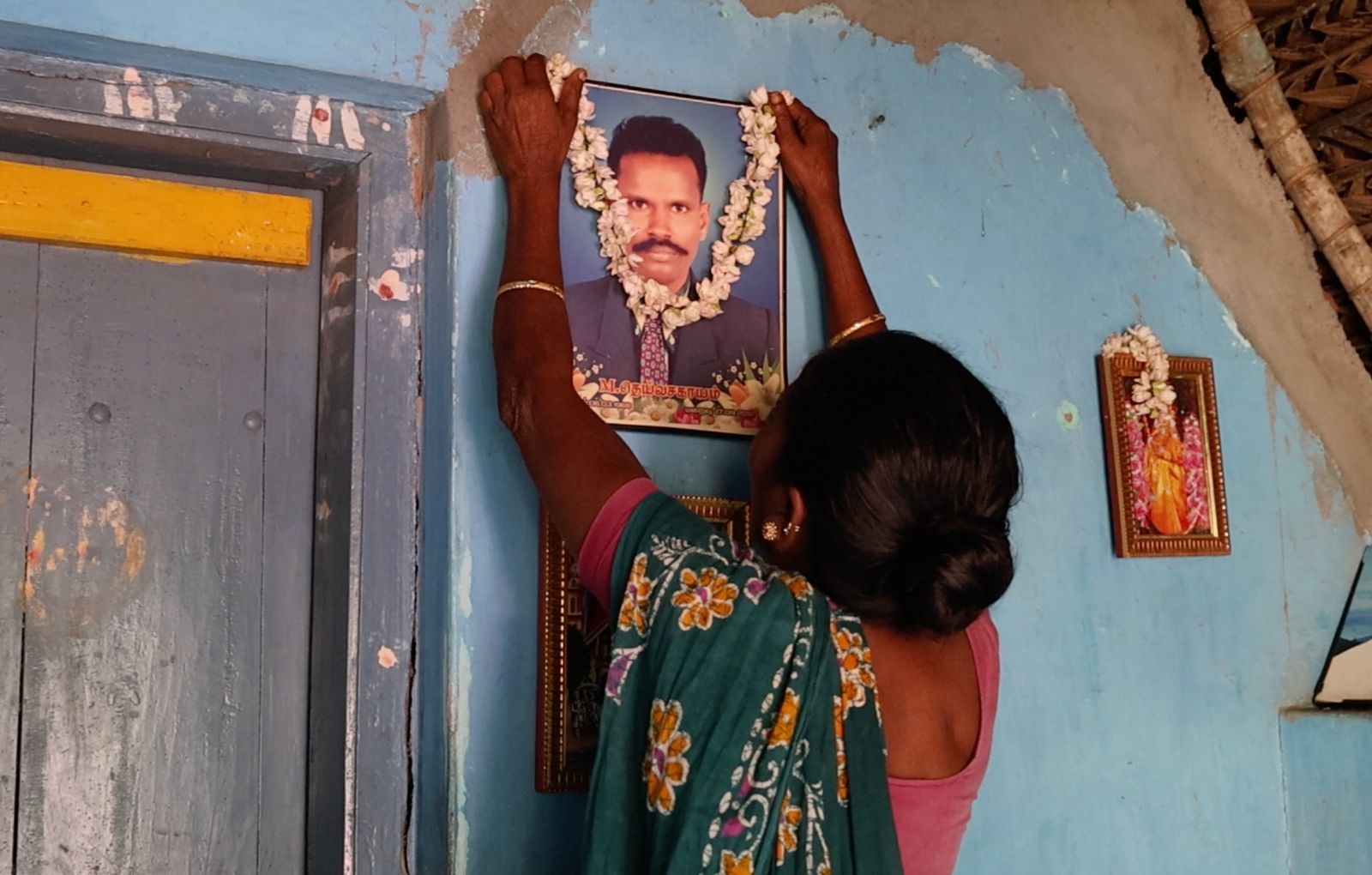
Rani garlanding a photograph of her late husband Deiva Sagayam.

Synopsis: In Melayur, a Dalit village in Karaikal with around 150 families, more than 70 households have young women, widowed by their husbands’ heavy alcohol use. The women struggle to raise children and earn a living in Puducherry, which has a growing alcohol economy that generated ₹1,733.5 crore in excise revenue in 2025–26.
The sea is still dark even as a few fishing boats returned with their catch. The cawing of crows that announces the arrival of each boat is missing from the early morning stillness of Karaikal.
A few shops had opened for early-morning business. As time ticked towards 5 am, business was brisk in some shops, where men—mostly daily-wage workers—with droopy eyelids sat under colourful lights with clear bottles and glasses on the table.
Most of them moved slowly. Some others seemed in a hurry, emptying the bottles, wiping their lips with the backs of their palms, and slipping into the darkness.
Arrack shops doing brisk pre-dawn business are a common sight in this coastal enclave in Puducherry, once a French colony. Outside, by the roads, men lying in drunken stupor, too, are not rare. Those who manage to work take the same route back home. Pit stops at the liquor shop have become their routine — on their way to work and back.
Many of them seldom complete their natural life journey. They drown in alcohol.
Also Read: Women struggling to stay afloat in a sea of alcohol
Several women at the Melayur village in the Neravy-Tirumalairayanpattinam (TR Pattinam) Assembly constituency haven’t slept properly for years. Tucked away in the backyard of Karaikal, the village doesn’t even have a proper board announcing its name. An asphalted road runs towards the village, but it turns into a potholed dirt track as it nears Melayur.
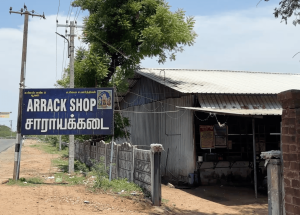
An arrack shop in Karaikal.
Around 150 Dalit families, most belonging to the Paraiyar community, live in this nondescript village. Some families have converted to Christianity, but the problem dogging the village remains the same.
The women here are not concerned about the road or the absence of facilities. Each one of them lives in the constant fear of losing a male family member to alcohol. They worry whether those leaving for work will return alive.
More than 70 households have widows—women who lost their husbands who had generously contributed to Puducherry’s booming alcohol economy and bought death in return. Several women were widowed when they were only in their 20s, 30s or early 40s.
One among them is T Rani.
Also Read: Soliga tribal youth are taking to sports to keep the bottle at bay
Deiva Sagayam made statues of Mother Mary and sold them in Velankanni. He took care of his family, comprising his wife Rani and two daughters. However, he forgot — or ignored — to take care of himself.
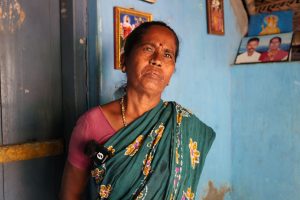
Rani lost her husband before she turned 30.
He drowned himself in alcohol, and Rani was widowed in 2012. Deiva Sagayam’s demise left Rani shattered and terrified since she had never stepped out of home for work. Life looked like an insurmountable challenge for Rani. The religious figures that Deiva Sagayam had created did not help the family; nor did the people around,
“I had no problems when he was alive. We were happy. But after his death, I started working at construction sites to raise our daughters. There was no one to help us. Even when I went to ask someone for help, people would mock me, saying, ‘Look at her, going around asking for help with two girls,” Rani said.
She didn’t buckle. She fought and is bringing up her two children. Still, deep inside her, memories often hurt her.
Rani’s relatives said Deiva Sagayam would take an advance payment for his sculptures and spend the money drinking until it ran out.
His drinking severely damaged his internal organs, including the intestines. The relatives tried the best they could afford to bring him back to life. He was taken to several hospitals, but all efforts went in vain.
Deiva Sagayam was not even 35 when he died.
Also Read: Fatty liver may soon be the next endemic
People with a substance use disorder, it seems, justify themselves that they are not at risk. The deaths of several men around them seldom deter them from taking the same path to self-destruction and breaking families.
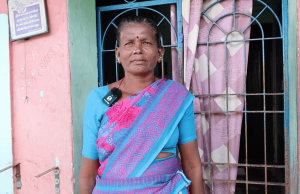
Prema Mary lost three members of her family to alcohol.
Prema Mary, who works under the rural employment guarantee scheme, has seen men close to her ignoring the dance of death. She lost her husband, A Peter John, her father-in-law and her husband’s younger brother to alcohol.
“My husband would drink four or five times a day. Eventually, his health deteriorated. He was admitted to the Government General Hospital in Puducherry. But he died despite treatment. Life became very difficult after he was gone. I am now working as a daily-wage labourer to take care of my three children,” she said.
Thilagavathy was around 30 when her husband Rajendran died of drinking-associated complications.
“He was hospitalised multiple times, and each time he returned home, he would start drinking the same day itself. His health deteriorated, and he died. After that, I have been working as a construction labourer to raise my two children.”
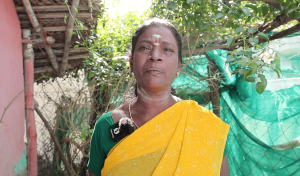
Thilagavathi’s husband died of alcohol-related complications.
Rani, Prema Mary, Thilagavathy… the list goes on.
Walking through Melayur, the scale of the loss becomes visible in a way that statistics cannot capture. One house has a widow. The neighbouring house has another. And the house beside that one, another. They are the living victims of alcoholism.
It feels as though loss and grief are constants in Melayur, the village of widows.
Also Read: Unheard sobs tell the tale of Kerala’s rising adult suicides
Melayur drew attention more than a decade ago.
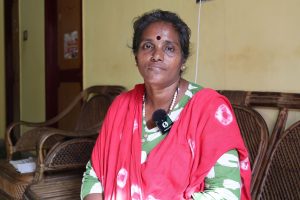
AIDWA’s E Sathya says the number of widows at Melayur has increased.
In 2014, the Puducherry unit of the All India Democratic Women’s Association conducted a study after learning about the unusually high number of young widows in several villages. E Sathya, who was then the organisation’s Puducherry Pradesh secretary, said they found a similar situation in Paduthar Kollai, a remote village a few kilometres from Melayur.
“We conducted a study in 2014 after learning that deaths were occurring continuously in this area. When we surveyed the village, we found around 70 to 80 widows. What shocked us most was that almost all of them had become widows at a very young age,” Sathya said.
She added that Melayur had little infrastructure when the survey was conducted. Children walked more than two kilometres to school, and the village lacked proper road facilities.
Despite such drawbacks, the village had a wine shop.
Poor daily-wage workers would return from work, drink and, according to the organisation’s findings, many eventually died after years of alcohol use. Sathya said they even encountered women who had lost their father, husband and son from the same family.
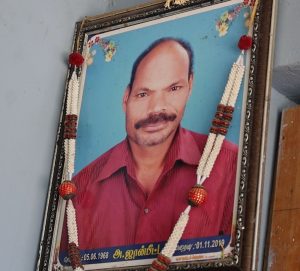
John Peter died in 2012.
She recalled the case of one woman, Victoria.
“We met Victoria during the survey. She was between 20 and 30, and had two small children. Her husband had died, and she told us she was doing domestic work to take care of them. That was extremely disturbing,” Sathya said.
More than a decade later, Sathya said, little has changed.
When she recently returned to the village, she found that the number of widows had increased rather than declined.
Also Read: Why Telangana women are more open about alcohol consumption
Alcohol is not merely part of Puducherry’s tourism economy; it is also a significant source of government revenue.
According to the latest data from the Puducherry Excise Department, obtained through an RTI by social activist Ashok Raja, excise revenue rose from ₹1,096 crore in 2021–22 to ₹1,733.5 crore in 2025–26, an increase of nearly 58% in five years. Revenue stood at ₹1,402.61 crore in 2022–23, ₹1,487.66 crore in 2023–24 and ₹1,538.81 crore in 2024–25. The figures cover the Union Territory’s excise administration, including Puducherry and Karaikal, as well as Mahe and Yanam.
The expansion of alcohol-serving establishments has accompanied this growth. Between 2021 and 2026, the Excise Department issued 194 new FL-2 licences to hotels and restaurants under the tourism category. These establishments are permitted to serve liquor from 8 am to midnight.
Yet, the women and residents South First spoke to described a drinking culture that often extended beyond the official working hours. Several liquor-shop sellers in Karaikal said that workers sometimes arrive at night and knock on the doors, asking for alcohol.
“The workers come at night and knock on the door. We feel sorry for them, so we take their money and give them a bottle,” a seller said.
Chief Minister N Rangasamy has acknowledged the role of excise revenue in government spending.
Speaking in the Puducherry Assembly in August 2024, he said revenue generated through the Excise Department, including from liquor and arrack shops, was being used for developing roads, public amenities and other infrastructure across the Union Territory.
In March 2025, while defending a proposal for a new liquor factory, Rangasamy said it could generate ₹500 crore in revenue for the government and create 10,000 jobs. Yet, he also said: “If everyone supports complete prohibition in Puducherry, I am also ready.”
For the government, the bottle brings revenue, jobs and tourism.
In Melayur, however, women describe another side of that economy, one measured not in crores, but in husbands lost, children raised alone, and families left to cope with the consequences of alcohol.
Also Read: Alcohol, ‘disappearing’ girls and more
The women of Melayur are not simply being left widowed. They are being left to face the world alone.
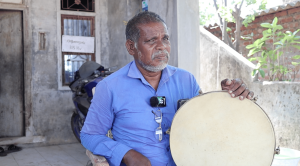
Rajendran said the prevalence of alcohol dependence has also affected marriage prospects.
The village has limited transport facilities, making it difficult for women to travel outside the area for work and return home safely. Several women, as widows, face harassment and unwanted sexual attention from men.
Rajendran is regarded as an important leader in Melayur. A member of the Karaikal district committee of the Communist Party of India (Marxist), he has also worked with several social organisations.
He has repeatedly campaigned against liquor shops operating in the area. In 2014, he led a major successful protest demanding the closure of a liquor shop in the village.
“I am 57 years old, and I am the oldest person in my village. Many people younger than me have already died,” he said.
Rajendran said the presence of liquor shops close to homes made alcohol easily accessible.
“Because the liquor shop is right near their homes, many of them drink heavily and die at a very young age, leaving their wives and children behind. The suffering of these women is terrible. Because they are women without husbands, they face harassment from men everywhere, from their workplaces to anywhere else they go.”
He said the prevalence of alcohol dependence has also affected marriage prospects. Families from outside the area are reluctant to marry their daughters into the village, while women from Melayur who marry outside often leave the village permanently.
Sathya said many widows work as domestic workers in apartment complexes or as construction and other daily-wage labourers. Their days revolve around getting their children to school, travelling to work, returning on time to pick them up, and then managing household chores.
“They have to leave their children at school, go to work and then return on time to pick them up and take them home. For them, managing this routine every day is a huge achievement. Imagine the mental state of a woman who has to live like this alone, without a single day off, 365 days a year.”
The women we spoke to described a life that had changed completely after their husbands died.
They said that while their husbands were alive, they did not have to work or even travel far from home. They lived with their children without carrying the burden of earning the family’s income alone. Now, they survive through the 100-day employment scheme, construction work and other daily-wage jobs.
Their words were strikingly similar: “Alcohol destroyed our lives.”
Sathya said the government has been exploiting women.
“The Puducherry government is happy that the Excise Department brings in a large amount of tax revenue. But that profit comes at the cost of a woman’s marriage; it comes from breaking a woman’s thali and exploiting the labour of a woman who will spend the rest of her life struggling after losing her husband.”
She wanted the government to gradually reduce the number of liquor shops, particularly those located near schools, bus stands and places of worship, and not permit new liquor shops. She also called for identifying women who have lost their husbands to alcohol, providing them with housing and strengthening their rehabilitation and livelihood support.
For these women, the loss is not limited to a single life.
They lose a husband. Then they lose the security his income once provided. They lose the freedom to remain at home with their children. They lose time, dignity, happiness and, in many cases, the ability to imagine a life beyond survival.
In Melayur, the cost of alcohol is not counted only in bottles sold or crores earned. It is counted in the lives women are left to live after the men are gone.
Deaths have ceased to be news. People now hear about it with a numbness. Still, before daybreak, men with drooping eyelids sit under colourful lights, having their morning drink.
(Edited by Majnu Babu).



