

Published Aug 30, 2026 | 8:00 AM ⚊ Updated Aug 30, 2026 | 8:00 AM

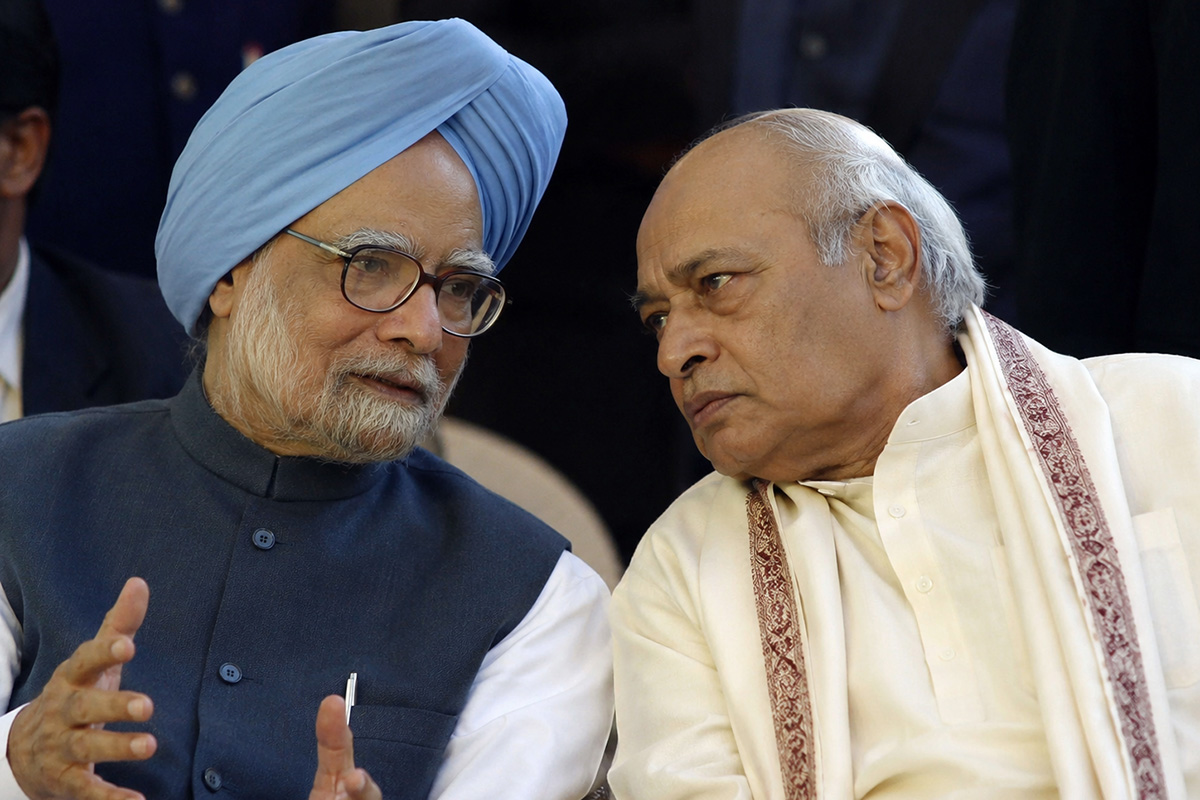
Manmohan Singh and Narasimha Rao. (AI generated image)

Synopsis: NGEF did not die due to globalisation. Its state government ownership, concentrated market and the rising value of its Bengaluru land sealed its fate long before foreign giants entered the picture.
Every existing account of NGEF’s collapse—including the tacit-knowledge, ecosystem and reputation-economics narratives—treats the story as a battle between domestic manufacturing and private multinational entry (also, the story of mismanagement and corruption, although to a lesser degree).
That framing is not wrong. But it is incomplete in a specific and correctable way: it never asks why New Government Electrical Factory (NGEF) died while its closest institutional twin, Bharat Heavy Electricals Limited (BHEL), did not.
Both were state-promoted heavy electrical manufacturers born of the same developmental philosophy. Both faced identical shocks: trade liberalisation after 1991, the same private multinational entrants, the same shift in procurement logic, the same migration of engineering talent toward foreign brands.
If globalisation alone explains NGEF’s death, it should have killed BHEL too. It did not. BHEL restructured, diversified, exported, and survives today as a Maharatna public enterprise. NGEF ceased operations in 2002 and was formally closed following a High Court order in 2004. Soon after, the liquidation process started.
The comparison is the argument this article wants to make: NGEF’s death was not primarily a story of private/foreign competition. It was a story of three structural asymmetries that had nothing to do with Siemens, ABB or Schneider Electric at all: asymmetries in ownership tier, product architecture, and, most originally, the economics of urban land. None of these has been seriously examined in the popular retellings of NGEF’s collapse, and each changes the moral of the story.
NGEF was a Government of Karnataka undertaking. BHEL was a Government of India undertaking. This distinction sounds bureaucratic. It was actually decisive.
Central public sector enterprises after 1991 were folded into a reform program that included partial disinvestment, listing on stock exchanges, “Navratna” autonomy status (BHEL, now a MAHARATNA), and direct access to the central government’s much deeper balance sheet for restructuring loans, technology tie-ups, and export credit guarantees. BHEL benefited precisely from this treatment: greater operational autonomy, permission to enter joint ventures, and continued preferential treatment in central power-sector procurement (NTPC, state electricity boards buying under central-government-influenced tenders) even as tariffs fell.
State-level PSUs like NGEF had no equivalent lifeline. Karnataka’s own fiscal capacity was a fraction of the Union government’s, and state finance commissions in the 1990s were themselves under pressure from the same liberalisation that was squeezing NGEF’s order book.
A sick state PSU competed for bailout rupees against midday meal schemes, irrigation subsidies, and state salary bills, an entirely different political economy of triage than a sick central PSU competed against. NGEF’s crisis was never purely industrial; it was a crisis of which treasury was responsible for saving it, and that treasury was structurally the weaker one.
This is a federalism problem, not a globalisation problem. It suggests that India did not simply “lose” a manufacturer to foreign competition; it lost a manufacturer because Indian fiscal federalism never built an equivalent of central-government industrial triage for state-owned heavy industry. The lesson generalises: any state-run manufacturer in a capital-intensive, long-cycle sector is inherently more fragile than its central counterpart, independent of the quality of its engineering.
BHEL made turbines, boilers, generators, and a wide catalogue of power-plant equipment sold across every state in India and, increasingly, abroad. NGEF’s core strength was transformers, motors, and switchgear sold disproportionately within Karnataka and to a handful of state electricity boards and metro projects.
BHEL’s diversification meant that a downturn in one product line or one regional market could be absorbed elsewhere in the portfolio. NGEF had no such internal hedge.
This is a portfolio-theory point that the ecosystem narrative misses entirely: industrial survival under trade shock depends not only on tacit knowledge and network embeddedness but on the breadth of the revenue base absorbing that shock. A geographically concentrated single-state supplier is playing an undiversified bet against a diversified global entrant almost by construction, regardless of engineering quality.
NGEF was, in portfolio terms, a single stock; ABB and Siemens were index funds of global demand. No amount of shop-floor excellence changes the arithmetic of concentration risk.
The least examined dimension of NGEF’s collapse, and the one this essay treats as its central original contribution, is the economics of the land beneath the factory.
NGEF’s main works sat on a large, increasingly valuable industrial estate in Bengaluru, a city whose land values were rising through the same decades that NGEF’s order book was shrinking. This is not a coincidence to be waved away; it is a structural incentive problem.
For a state government managing a chronically loss-making unit, two very different paths exist: (a) invest patient capital, modernise plant, retrain the workforce, and hope for a competitive turnaround measured in decades, or (b) allow the unit to remain sick long enough to justify winding it down, and realise the land’s appreciated value through sale, lease, or redevelopment, a payoff realisable in years, not decades, and one that shows up as revenue on a state budget under fiscal stress.
Once a PSU’s underlying real estate is worth more as vacant, rezoned, or commercially redeveloped land than the enterprise is worth as a going industrial concern, the political economy of “reviving’ that enterprise changes completely. Ministers, bureaucrats, and even boards no longer face a binary choice between saving jobs and accepting closure; they face a third, quietly dominant option – managed decline followed by monetisation.
This dynamic has recurred across Indian urban PSU real estate (old textile mill lands in Mumbai are the best-known parallel), and it deserves to be named as a distinct causal channel in the NGEF story rather than folded silently into “government indifference.” Indifference is a symptom. Land arbitrage is a motive.
This does not require any conspiracy, exactly as the ecosystem narrative correctly observes about procurement drift, but it does require naming an incentive that the ecosystem narrative never mentions: a bankrupt factory sitting on appreciating urban land is not merely a policy failure to be regretted. For the entity that owns both the failing factory and the valuable land beneath it, protracted industrial sickness can be the economically rational outcome, quite apart from whatever happens in the transformer market.
Put together, these three asymmetries suggest a causal chain different from, and prior to, the multinational-entry story:
ABB, Schneider Electric, and Siemens entered a market that these three domestic asymmetries had already made structurally vulnerable. Private multinational competition did not need to defeat NGEF; NGEF was already positioned to lose regardless of who its competitor happened to be.
This inverts the usual moral of the story. The customary telling treats private/foreign entrants as the active agent of destruction and the Indian state as a passive, if negligent, bystander. The federalism-plus-land argument treats the Indian state as an active agent whose institutional structure and asset base gave it reasons, never publicly stated, rarely even privately articulated, to prefer NGEF’s death to its survival.
If this reading is right, the policy implication of NGEF’s collapse is not primarily about protecting domestic manufacturers from private/foreign competition, industrial ecosystems, or procurement standards, however important those dimensions remain. It is about two much more specific and actionable problems.
First, capital-intensive state-owned manufacturing needs a federal restructuring mechanism analogous to what central PSUs already receive. This can be in the form of cross-subsidised turnaround financing insulated from the annual state budget cycle. Or else, state governments will always be structurally tempted to let such enterprises die slowly rather than fund their revival.
Second, and more unusually, any policy aiming to preserve industrial capability inside publicly owned firms must explicitly separate the enterprise’s operating fate from the fate of its underlying land. As long as a sick PSU’s land is worth more than its business, the incentive to keep it sick, rather than heal it, will persist no matter how the transformer market evolves, no matter which multinational enters, and no matter how many committees are formed to study industrial revival.
NGEF’s ruins in Bengaluru are not simply, as is often said, the archaeological remains of a discarded developmental philosophy. They are also, more precisely, the visible residue of an unstated but entirely rational calculation: that a piece of Bengaluru real estate had become worth more to its owner than the company standing on it. That calculation, not the arrival of ABB, may have been the truer beginning of NGEF’s end, and it is the part of the story India has not yet told itself.
Also Read:
Saying Wai Wai to the world: Nepal’s sole billionaire on building a global business empire
No, India’s ‘great’ Global Capability Centres aren’t transformational yet
‘It’s the economy, stupid’: The making of India’s Gen Z discontent
From Dharwad Pedha tales to a ₹300-crore bet: Big Mishra eyes 50-plus new cities
Manipal IPO reveals India’s new hospital economics; occupied bed matters more than patients
(Edited by R Rajesh Kumar.)



