

Published Aug 23, 2026 | 9:37 AM ⚊ Updated Aug 23, 2026 | 9:37 AM

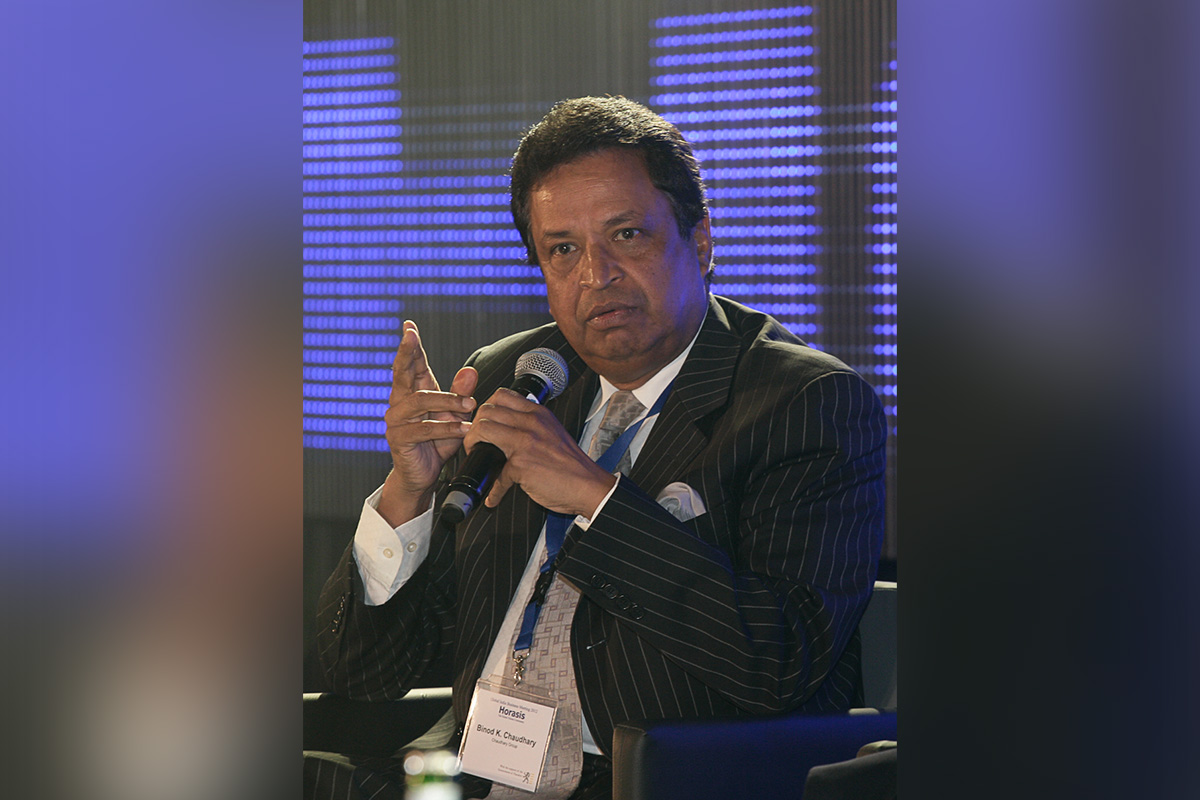
Binod Chaudhary, Nepal's most successful businessman and politician.

Synopsis: How do you build a global business from a small economy? Binod Chaudhary, who has taken Nepal’s Wai Wai noodles to more than 100 countries, reflects on five decades of entrepreneurship, his India ambitions, his political journey, and why he believes now is the best time to be an entrepreneur.
For Binod Chaudhary, taking a business from Nepal to the world required more than access to capital or a large domestic market. It required what he calls “passion, priority, strategy and hunger”.
In an interview with South First at the Book Brahma Lit Fest in Bengaluru, the chairman of CG Corp Global (Chaudhary Group), who is Nepal’s sole billionaire, reflected on a business journey spanning five decades, the international expansion of Wai Wai, his investments in India and his move into politics.
Chaudhary, whose net worth, according to Forbes, is currently $2.1 billion, traces his business roots to enterprises established by his grandfather and later carried forward by his father.
“My grandfather started in his own modest way, and then my father continued,” Chaudhary said, reflecting on how the family business evolved over successive generations.
His own journey in business now spans around 50 years, while the next generation of the family has been involved for roughly two decades. “It has been a very fulfilling journey,” he said.
What began as a business rooted in Nepal gradually expanded internationally, with the group building interests mainly across the food and hospitality sectors. It is best known for its globally recognised “Wai Wai” noodles.
Asked why more businesses from Nepal have not managed to build a similar international presence, Chaudhary said a lot depends on the ambition and priorities of the entrepreneur.
“It is about passion, it is about priority, it is about strategy, and it is about hunger,” he said.
That ambition is perhaps most visible in Wai Wai, which grew from a noodle brand associated with Nepal into a product sold in more than 100 countries. Wai Wai’s overseas factories are based in India, Serbia and Bangladesh, with a new one coming up in Egypt.
Part of Wai Wai’s success, Chaudhary believes, comes from the flexibility of the product.
“You can eat it as a snack, you can eat it as a soup, and you can eat it as a meal,” he said.
He said the brand has managed to connect with three generations of consumers and, in some markets, has become comparable to a staple food.
At points during its international expansion, he said, demand moved faster than the company’s ability to establish the factories and supply chains required to meet it. India has become one of CG Corp Global’s most important markets, with its interests here ranging from food and FMCG to hospitality and real estate.
The group has expanded its hospitality business through partnerships with international and Indian hotel brands, including Taj and Marriott. They currently run 106 hotels, with 92 of them in India.
For Chaudhary, India’s size, proximity and economic growth make it a critical part of the group’s international footprint.
Chaudhary’s journey has also taken him from corporate boardrooms into Nepalese politics, where he has served three terms as a Member of Parliament representing the Nepali Congress party.
He acknowledges that the entry of wealthy businesspeople into politics can attract suspicion, particularly in South Asia. “There is a negative perception about wealth,” he said, linking some of that to the region’s history of socialist and communist politics.
But Chaudhary said his decision to enter politics was driven by an interest in whether the government itself could function more professionally.
“Why can’t the state be run as a professionally managed organisation?” he asked, pointing to countries such as Singapore and South Korea as examples of states that successfully pursued economic transformation.
He also said his having established his presence in business meant he had little reason to enter politics for personal financial gain or recognition. Instead, he argued, political office offered him an opportunity to use his experience for the betterment of society.
Having begun his entrepreneurial journey decades before smartphones, social media and today’s interconnected global economy came into being, Chaudhary believes young founders now have opportunities his generation could scarcely have imagined.
“This is the best time ever to be an entrepreneur,” he said.
Asked what he would do if he were 25 years old today, Chaudhary’s answer was ambitious.
“I would aspire to be one of the best,” he said.
Technology and global connectivity, he argued, have reduced many of the barriers that once separated entrepreneurs in smaller economies from international markets.
More importantly, he believes entrepreneurship today is increasingly driven by ideas rather than simply by access to money. “It is the power of ideas that dominates,” Chaudhary said.
A founder with a compelling idea, passion and the commitment to execute it can attract the other elements required to build a company, he argued.
“If the idea has power, if you have the passion and commitment, management and capital will follow,” he said.
After five decades in business, Chaudhary’s message to the next generation is ultimately the philosophy that shaped his own expansion beyond Nepal: the country or market where an entrepreneur begins need not determine how far the business can go.
Also Read:
From Dharwad Pedha tales to a ₹300-crore bet: Big Mishra eyes 50-plus new cities
In cold numbers: What brought the youth to Jantar Mantar and the streets of India
No, India’s ‘great’ Global Capability Centres aren’t transformational yet
(Edited by R Rajesh Kumar.)



