

Published Jul 28, 2026 | 8:00 AM ⚊ Updated Jul 28, 2026 | 8:00 AM


Synopsis: What we saw play out on the streets of Delhi’s Jantar Mantar and across India was not just resentment over exam failures. It runs much deeper than that. A society with big aspirations, fuelled by a smartphone-empowered world, is increasingly finding fewer jobs on offer. Inequality is also rising. These are warning signs that no government can choose to ignore.
A few months ago, a senior officer of the security apparatus and family friend called on me on a private visit and asked whether I had been following the concerns and aspirations of India’s Generation Z. The conversation stayed with me. The recent agitation unfolded in a context in which few expected such a sustained mobilisation or the emergence of demands that challenged prevailing assumptions.
The more important question now is whether this Gen Z resentment has subsided or whether it marks the beginning of more such struggles. The answer is far from straightforward, but understanding the broader context is essential.
Before I proceed further, let me state that my own knowledge of economics is foundational rather than expert, and economists are better placed to analyse the structural weaknesses of the Indian economy. But with my professional experience and interest in international affairs, a broader trend is becoming increasingly visible—one from which India is by no means insulated.
India’s manufacturing sector has long underperformed relative to its potential, limiting the creation of large-scale employment of the kind witnessed in Vietnam and several other Southeast Asian economies. Manufacturing contributes about 16–17 per cent of India’s GDP, but its employment footprint is considerably narrower. By the government’s own Periodic Labour Force Survey, the share of manufacturing workers in India’s total workforce was just 11.7 per cent in 2022-23, which has barely changed from 12.6 per cent in 2011-12, and by some measures is lower than it was a decade earlier. India’s manufacturing sector currently employs somewhere between 18 and 20 million workers, out of a total workforce of well over 500 million, meaning the sector absorbs only a small fraction of new labour-market entrants each year.
The contrast with Southeast Asia is instructive.
In Vietnam, manufacturing accounted for roughly 21 per cent of total employment in 2022, nearly double India’s share, even though Vietnam’s population is a fraction of India’s size. Indonesia and Bangladesh both, though their industry figures include construction and utilities alongside manufacturing, post employment shares in the low-to-mid twenties, again comfortably ahead of India.
During their own periods of rapid industrialisation, East Asian economies such as South Korea and Taiwan pushed manufacturing employment shares considerably higher still, absorbing tens of millions of workers out of agriculture and into factories within a generation.
India, by comparison, has industrialised without correspondingly absorbing labour, which is a pattern economists have described as “premature deindustrialisation.”
Let us not forget that demonetisation dealt a severe blow to many small and medium enterprises in India, and the COVID-19 pandemic compounded those disruptions. At the same time, a traditional pathway of upward mobility for sections of the urban middle class, employment in the information technology sector followed by opportunities in the United States, has become considerably narrower as immigration policies have become more restrictive and the global technology industry has slowed hiring.
For decades, the United States offered an economic safety valve for India’s skilled workforce. Hundreds of thousands of Indians have travelled to the United States every year as students, professionals or immigrants, and Indian nationals have consistently accounted for the overwhelming majority of H-1B visas issued annually. That avenue, however, no longer appears as certain as it once did.
Simultaneously, artificial intelligence is beginning to reshape the global technology industry, with routine software and back-office functions increasingly automated. Whether India can successfully position itself as a global leader in the AI economy remains an open question, but there is little doubt that the transition will be disruptive for many young professionals.
The economic context extends beyond employment. Wealth in India has become increasingly concentrated, with a small number of large business groups expanding across multiple sectors from infrastructure and energy to telecommunications, retail and digital services.
While large corporations have undoubtedly contributed to economic growth and infrastructure development, concerns over market concentration, regulatory capacity and the ability of smaller firms to compete have also grown. Unlike jurisdictions where competition authorities have historically intervened more aggressively to curb monopolistic behaviour, India’s regulatory institutions continue to face questions about their autonomy and effectiveness.
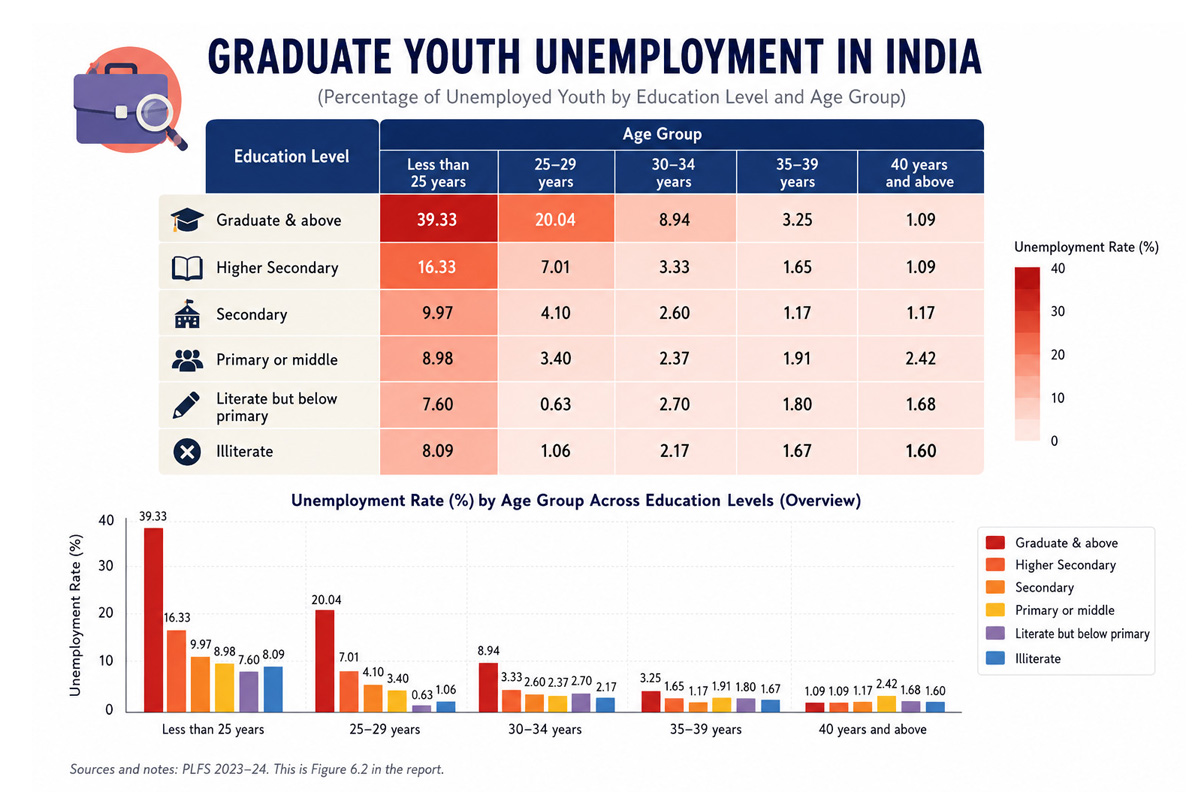
The result is a widening gap between aspiration and opportunity. India’s median age is only around 29 years, making it one of the world’s youngest major economies, and roughly half of its 1.4 billion people are below the age of 30. Every year, nearly 10–12 million young Indians enter the labour market, which is a cohort that manufacturing, at its current pace of job creation, is structurally unable to absorb.
They are exposed to a world of unprecedented consumerism through smartphones and social media, where luxury lifestyles, expensive cars and global consumption patterns are constantly on display. Yet stable, well-paying jobs have not expanded at the same pace as aspirations. This generation has grown up in a connected world and is far less inclined to accept traditional explanations that attribute economic hardship to fate or destiny.
It is in this broader context that recent protests should be understood. This is India’s own ‘It’s the economy, stupid’ moment. And as Bill Clinton’s team realised, economic woes are powerful enough to roil the masses.
The controversy surrounding the NEET examination may have acted as a trigger for a particular group of students, but it cannot by itself explain the deeper undercurrents of frustration visible among many young Indians. Focusing solely on examination reforms risks mistaking the symptom for the disease.
The challenge before India is therefore not merely administrative but strategic. Electoral success and political messaging cannot substitute for governance.
A country of 1.4 billion people, with one of the world’s youngest populations, requires sustained attention to job creation, education, technological competitiveness, institutional credibility and regulatory reform. The parties in governments inevitably devote considerable energy to winning elections, but governing requires an equally relentless commitment to evidence-based policymaking and the inclusion of domain experts in economic and institutional decision-making.
If today’s youth increasingly conclude that the economic system offers diminishing opportunities for advancement, periodic eruptions of resentment should not come as a surprise. They will become recurring features of the political landscape, puzzling those who view each protest in isolation while ignoring the structural forces that bind them together.
The security establishment’s own instincts, evident in that conversation which prompted this piece, reflect a dawning recognition: Nepal and Bangladesh have already demonstrated how swiftly a restive Gen Z can upend entrenched political orders, often catching seasoned analysts and governments off guard. But recognising this potential is not the same as knowing how to respond to it, and the temptation to treat youth discontent primarily as a law-and-order or intelligence problem would be a serious misreading of the moment. Securitising a generation’s frustration does nothing to address its source; if anything, it deepens the alienation that produces it.
What is required instead is an honest reckoning with what is actually manufacturing this sense of hopelessness, stalled mobility, jobless growth, concentrated wealth, and foreclosed avenues abroad, rather than a search for triggers, provocateurs or external hands. This requires governing elites to first tolerate, and then actively seek out, unfiltered feedback from those outside their circles of comfort and consensus.
Speaking truth to power is not a courtesy owed to the powerful; it is the single most important corrective mechanism available to them. Without it, India risks mistaking the symptoms of a generational crisis for its causes, again and again, until the pattern becomes impossible to ignore.
Also Read:
Beyond Pradhan’s resignation: CJP and the unfinished struggle for educational justice in India
Jantar Mantar protests mark the birth of fear among Modi and his men
(Edited by R Rajesh Kumar.)



