

Published Aug 13, 2026 | 8:55 PM ⚊ Updated Aug 13, 2026 | 10:29 PM

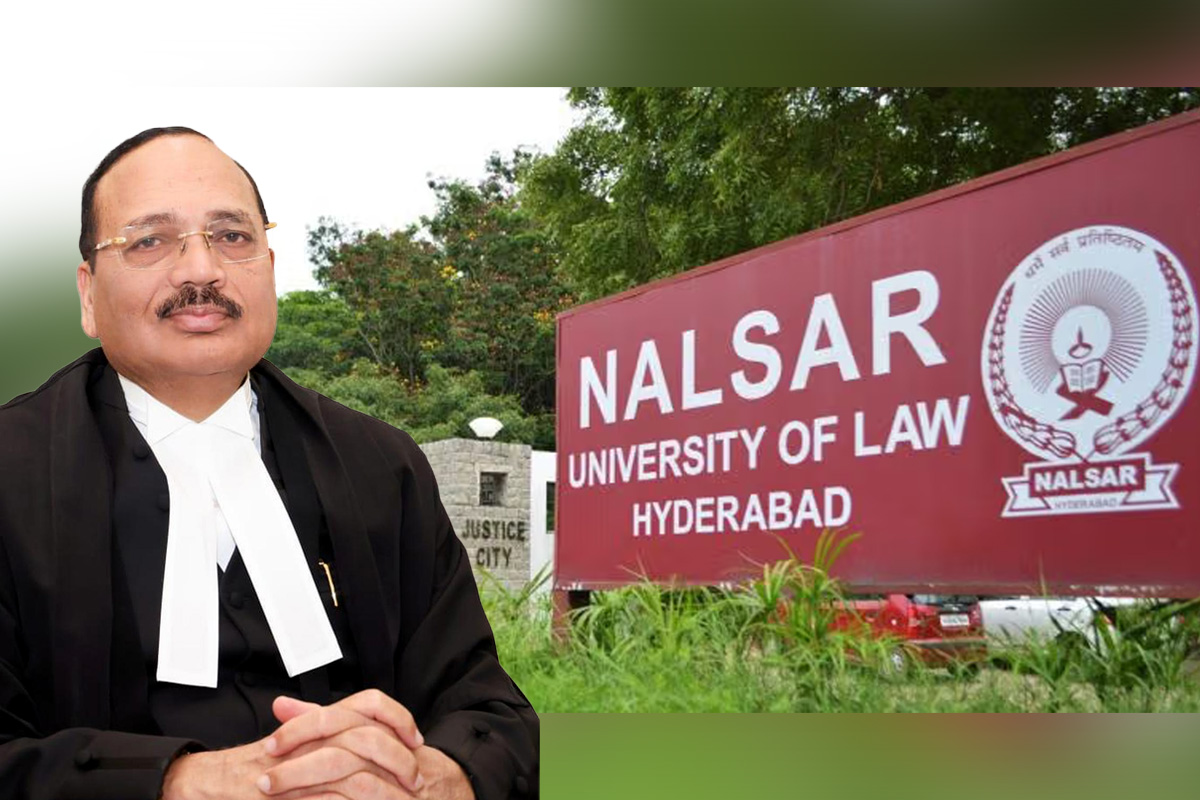
NALSAR’s 2026 graduating batch opposes CJI Surya Kant as convocation chief guest.

Synopsis: The NALSAR students must be congratulated for their refusal to let Chief Justice Surya Kant confer their degrees. Theirs is not an act of disrespect, but an assertion of principled dissent that reflects a growing unease over the judiciary’s recent conduct.
Congratulations, and thanks and good wishes to the students of NALSAR University of Law, Hyderabad, for the statement they issued and the conviction they displayed. Wherever they come from, these are young people studying or having studied in Telangana, and we owe them our thanks for expressing a dissent that is urgently needed today.
The Bar Council of India’s direction, subsequently “modified” and reversed, to State Bar Councils not to enrol any NALSAR graduates from the 2026 batch as advocates following this was reprehensible and has to be condemned.
At a time when sycophancy, servility, calculated diplomacy, obsequiousness, compromising one’s values for personal gain, flattery and participation in the courtier culture have come to be treated as signs of competence and cleverness, and when the entire framework of social values seems to have been turned upside down, the NALSAR students deserve applause for having the courage to speak plainly and without hesitation.
Perhaps most of them are still youngsters in their early twenties. They are students of law. Unlike many who study law, grow older and become lawyers or judges only to uphold injustice, these young people, with the impatience and idealism of youth, have chosen to use their legal education to uphold the idea of justice. They have said what many elders, educated and self-proclaimed wise men could not say, and done what they could not do.
We all know the story of the little child who pointed out what the entire royal court, surrounded by flatterers and panegyrists, could not: the king had no clothes. Like that innocent child, the NALSAR students have exposed the truth about the Chief Justice of India, moving around in what were presumed to be the robes of constitutional authority.
Every university holds a convocation at the end of the academic year to confer degrees on graduating students. It is an important and joyous occasion in their lives. A distinguished person is invited as chief guest to award the degrees and deliver the convocation address. At NALSAR, it has been customary to invite the Chief Justice of India, who is also the Chancellor of the university, as the chief guest.
This year, just days before the convocation, an email letter signed by 450 students and addressed to the Vice-Chancellor, Registrar and faculty became public on July 23. The initiative was reportedly begun by 70 students, with another 380 signing within hours. The students made it clear that they opposed the proposal to invite Chief Justice of India Surya Kant as chief guest at the convocation.
“As law students, our interest is limited. As students of the graduating class, our concerns are specific. In our view, the convocation is a special occasion—a moment when the university’s own values, including its commitment to constitutional rights, access to justice for all and a reasoned approach to problems, should be reflected in its choices,” they wrote. They added that accepting their degrees from a person who, according to media reports, had recently dismissed allegations of police brutality against protesting citizens would be inconsistent with the values they had learned at NALSAR.
The language was restrained and courteous, but the meaning was unmistakable: we do not believe that those hands are worthy of conferring our degrees.
The letter appeared on July 23, evidently following remarks made by the Chief Justice in the Supreme Court on July 21 that he did not have the time to watch videos of alleged police brutality.
On July 20, the Cockroach Janata Party had called for a “Chalo Sansad” march from Jantar Mantar to Parliament in Delhi. Lakhs of students and young people reportedly took part. Delhi Police used batons and water cannons and fired pellet guns, subjecting the protesters to severe violence. Hundreds were injured and many were bleeding. The police action violated the legal norms governing the handling of peaceful protests.
Even if sections of the mainstream media, derisively known as “Godi media”, did not show the brutality—or played it down—the violence and the allegedly unlawful and inhuman conduct of the police were widely visible on social media.
When petitions were brought before the Supreme Court seeking an immediate inquiry into the violence and action against those responsible, the Chief Justice reportedly said that he had neither the time to hear the matter nor to watch the videos. Justice Surya Kant advised lawyers not to waste their time and the court’s time by showing those videos.
Anyone with even a little sensitivity would find such a response disturbing. What the NALSAR students expressed in their letter was simply that legitimate anger.
The Chief Justice subsequently clarified that he had not said what the media had reported, and an inquiry into the alleged police excesses at Jantar Mantar was initiated. Yet, whether made thoughtlessly or deliberately, his earlier remarks had already entered public memory, particularly that of students and young people. Even if the technical explanation was that no properly constituted petition had been filed and that the matter had merely been mentioned orally by a lawyer, his response had revealed what many perceived as his attitude towards protesting students and police excesses.
In fact, it was this very Supreme Court that, in the late 1970s and 1980s, developed a new and highly necessary tradition of public interest litigation. Recognising that the judicial system was inaccessible and unaffordable to large sections of the public, it allowed even a postcard, telegram, ordinary letter or newspaper report to be treated as a basis for taking up a matter in the public interest.
In recent years, however, judges themselves have increasingly undermined that tradition. Several judges, including the Chief Justice, have made disparaging observations about public interest litigation. But when students are being chased through the streets barely a stone’s throw from the Supreme Court, beaten until they bleed and allegedly fired upon with pellet guns, it is the judiciary’s responsibility to examine the evidence. The judges should watch those videos not merely to condemn the police, but at the very least to determine whether the police acted lawfully.
To say irresponsibly that there is no time to watch them is indefensible, whatever the circumstances in which the remark was made.
The students were, however, careful not to turn their disagreement into a confrontation with the university authorities. “We are bringing this issue to your attention now, well before the convocation and before any decision is made to invite the Chief Justice. We hope that our views will be taken into consideration when you make your decision,” they wrote.
That shows both their respect for the university authorities and their effort to resolve the matter through dialogue. Their suggestion that the university reconsider the proposal seriously before issuing a formal invitation was equally measured.
This may be the first time in the country’s history that a person holding the office of Chief Justice of India has faced such a rejection from students of a premier law university. It is unfortunate that, with only about eight months left before his retirement, Justice Surya Kant should have to face such rejection and embarrassment.
Some may see the students’ action as a personal insult to Justice Surya Kant, or as disrespect to the office of the Chief Justice of India. But responsibility for the circumstances that have produced this reaction lies with the conduct of the person occupying that office—or, more broadly, with the judiciary’s increasing willingness to bend before those in power at the cost of its independence.
Even leaving aside controversial aspects of Justice Surya Kant’s earlier record, and his conduct as Chief Justice in cases where critics have accused him of favouring the government at the expense of legal principles, his remarks in a case that came before him in the second week of May about the country’s youth—describing them in derogatory terms and suggesting that they are parasites, cockroaches, media persons or agitators—had already generated widespread resentment among students and young people.
The NALSAR students’ protest is part of that larger national anger.
Nor was NALSAR the first institution to distance itself from the Chief Justice. He was scheduled to be the chief guest at the July 26 convocation of OP Jindal Global University’s Jindal Global Law School in Ahmedabad. At the last minute, his visit was cancelled and senior Supreme Court advocate and Rajya Sabha member Abhishek Manu Singhvi attended instead.
Two days later, he was to deliver the HR Khanna Memorial Lecture at the India International Centre in New Delhi. That programme was postponed without any reason being given. On August 2, he was scheduled to attend the convocation of the Tata Institute of Social Sciences (TISS) in Mumbai as chief guest. TISS announced that the convocation was being cancelled due to unforeseen circumstances.
In other words, within two weeks, the Chief Justice of India had faced four such rejections or cancellations.
Under a Sangh Parivar regime that has systematically eroded the neutrality, prestige and dignity of constitutional institutions, seeking to destroy them and thereby fragment society, the NALSAR students’ rejection is hardly an unnatural development.
It is not disrespect towards anyone. It is a necessary assertion of principle in a system where values are steadily being degraded.
Also Read:
People as ‘ants’ no more: SC judge Ujjal Bhuyan demands transparency in judicial appointments
Can any committee fairly identify Telangana movement’s real activists?



