

Published Aug 13, 2026 | 8:08 PM ⚊ Updated Aug 13, 2026 | 9:37 PM

Bar Council of India

Synopsis: Hours after issuing an extraordinary direction to State Bar Councils not to enrol NALSAR University of Law’s 2026 law graduates as advocates over their opposition to having CJI Surya Kant as the chief guest at their convocation, the Bar Council of India has reversed its order, allowing all students from the batch to seek enrolment with the State Bar Council of their choice.
Hours after the Bar Council of India (BCI) issued an extraordinary direction to all State Bar Councils not to enrol as advocates any student of NALSAR University of Law, Hyderabad, who obtained a law degree in 2026, until further orders, its chairman Manan Kumar Mishra announced that the council had “modified” its earlier direction, effectively reversing the blanket restriction.
The contentious direction, issued earlier on Thursday, 13 August followed opposition from students of NALSAR’s 2026 graduating batch to the university’s decision to invite the Chief Justice of India Surya Kant’s participation in the university’s convocation as the chief guest. In a letter to the university administration dated 23 July, the students asked it to reconsider the invitation.
“After detailed deliberation, the Bar Council of India has modified its earlier directions concerning NALSAR. All 2026 passed-out students of NALSAR will now be entitled to seek enrolment with the State Bar Council of their choice. The factual inquiry will continue, and further action will follow on the basis of the report,” Mishra said in a post on X.
After detailed deliberation, the @barcouncilindia has modified its earlier directions concerning @NALSAR_Official.
All 2026 passed-out students of NALSAR will now be entitled to seek enrolment with the State Bar Council of their choice. The factual inquiry will continue, and… pic.twitter.com/uJPkpHaOXj
— Manan Kumar Mishra (@MishraManan01) August 13, 2026
Also Read: Explained: Mines and Minerals Amendment Bill and how it threatens states’ fiscal autonomy
In it’s direction to state bar council, the BCI said the deferment was intended “solely to preserve the integrity and efficacy of the statutory enrolment process”. Entry on a State Roll gives a person the statutory status of an advocate and brings into operation the rights, privileges, duties and professional obligations attached to membership of the legal profession.
“Till further orders, no student of NALSAR University of Law, who has obtained the Law Degree in the year 2026, shall be enrolled by any State Bar Council as an Advocate,” the direction said.
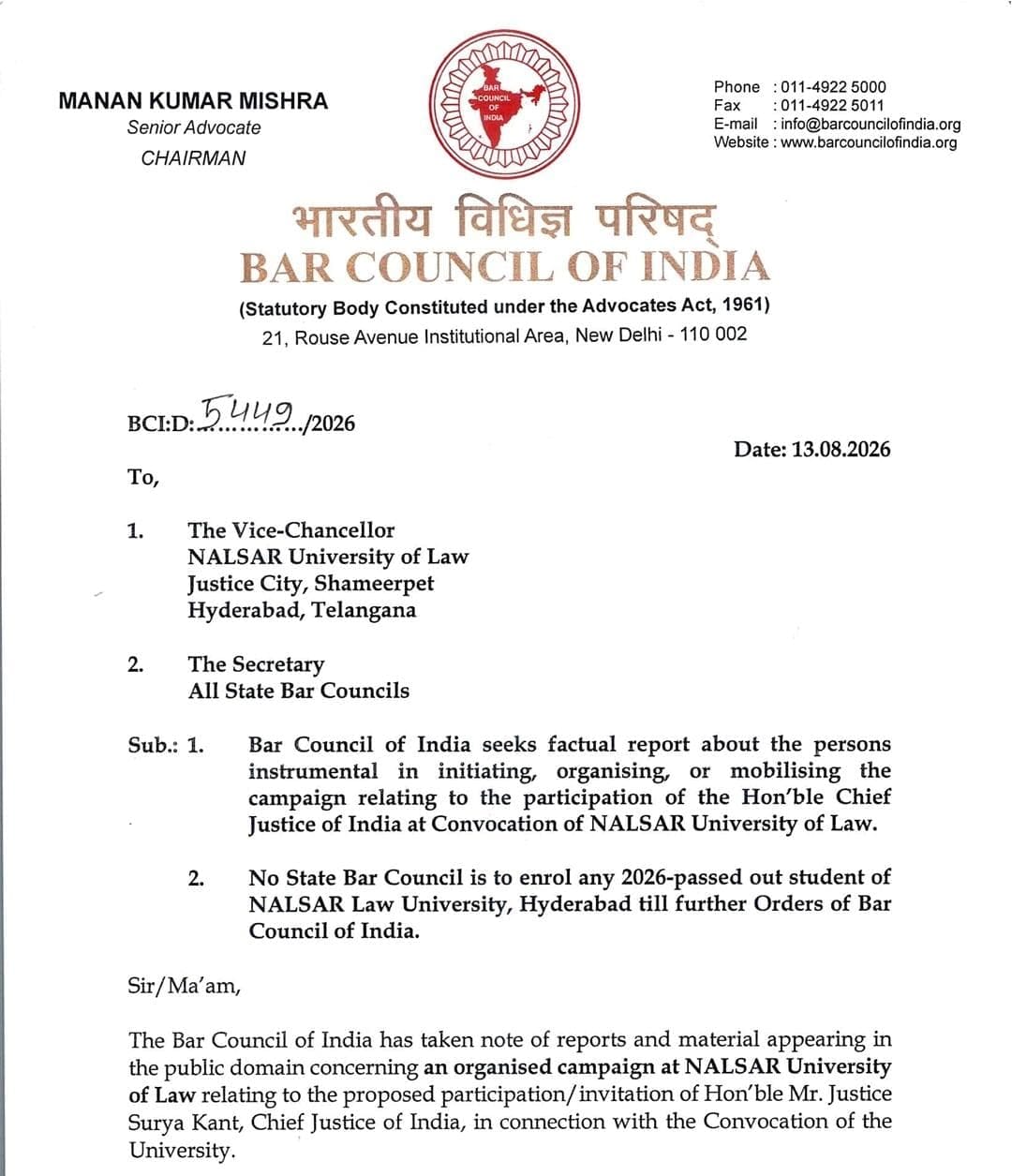
A copy of the direction.
The BCI had also sought a report identifying the students behind the campaign. It will take a final decision on the matter on 19 August.
The BCI said legal education encourages critical reasoning, debate and analysis of judicial decisions, “but, at the same time, those seeking entry into a regulated profession intrinsically connected with the administration of justice are expected to appreciate the distinction between reasoned criticism and conduct which, if established upon due examination, may involve intimidation, obstruction, organised disruption or disregard of the institutional responsibilities attached to the profession.”
“It is also necessary to reiterate that legal education necessarily encourages critical reasoning, debate and analysis of judicial decisions. But, at the same time, those seeking entry into a regulated profession intrinsically connected with the administration of justice are expected to appreciate the distinction between reasoned criticism and conduct which, if established upon due examination, may involve intimidation, obstruction, organised disruption or disregard of the institutional responsibilities attached to the profession,” it said in the direction.
Also Read: Modi, Shah finally turn up in Lok Sabha only for Speaker to adjourn sine die in under four minutes
Senior Advocate B.T. Venkatesh said the direction had no basis under the law governing enrolment of advocates.
“That is illegal. The Bar Council of India has no rule to do that. It cannot pass such an order. It is impermissible under law and amounts to an abuse of the process of law. Under the Advocates Act, institutions and universities have to be recognised by the Bar Council of India. Once that recognition is granted, if a student graduates from that institution, they are entitled to enrol themselves with the Bar Council. The enrolment is based on the recognition of the institution,” he told South First.
“If I have joined a recognised law college, completed my graduation and obtained my degree, the matter ends there. The Bar Council has no right to deny me enrolment. My enrolment cannot be denied. Even if a person is a convict who has completed their sentence and has subsequently been released, they are entitled to enrolment. The mere fact that a person has a pending criminal case does not necessarily disentitle them from becoming a member of the Bar Council.”
On the students’ decision to oppose the invitation to the CJI, he said choosing not to receive a degree from a particular person at a convocation was a right of the students.
“If the students decide that they do not want to receive their degrees at a convocation from a particular person, that is their right. It is a fundamental right. Who is the Bar Council to say that they should not be enrolled? They have no business to make such a rule. No college comes under the Bar Council. The Bar Council is an agency for advocates. Its role in relation to law colleges is only one of recognition. It is an accreditation agency. It says that an institution can conduct a law programme, and beyond that, it has no role,” he said.
“The syllabus and curriculum are decided by the university. The examinations are conducted by the university and the degree is awarded by the university. Everything is done by the university. The Bar Council’s role is only accreditation.”
Venkatesh said that if the BCI wanted to prevent NALSAR graduates from entering the legal profession, it would have to act against the university’s recognition, not against students who had already completed their degrees.
“If they have to take action, they cannot do it against the students. They must say that NALSAR is derecognised. They have to act against the university, not the students. To make the students ineligible for enrolment, they would have to derecognise the university. But they cannot derecognise a university retrospectively once recognition has been accorded and the students have completed their course. Any such derecognition would operate prospectively, not retrospectively,” he said.
“You can certainly say that students who have not completed their law course will not be enrolled as lawyers. But for students who have already completed their law course, you cannot do that.”
Investigative journalist and Cockroach Janta Party spokesperson Saurav Das, in a post on X, questioned the grounds on which the Bar Council had issued the direction.
“Students of NALSAR have displayed democratic dissent against a person they, in their own wisdom, thought was unfit to give them their hard-earned degrees. Who are you to intervene? Your accountability needs to be talked about too. Tell us why, as the statutory regulator (BCI) responsible for supervising State Bar Councils, you permitted elected bodies to continue BEYOND their terms until the Supreme Court intervened? Who were these people that were favoured as a result of this? Tell us now,” he wrote in a post on X.
“And why and how have you been holding the post of Chairman since 2012 to now till 2030? Do tell us about your track record. Tell us why did you illegally intervene in the 2026 Chhattisgarh State Bar Council, as stated by the High Court there? Law students and advocates in Delhi and across the country will rise up in protest against you and in support of the students of NALSAR if you don’t WITHDRAW this disgusting notification IMMEDIATELY and apologise for your conduct. Your conduct and tenure as the BCI Chairman (while being BJP RS MP) needs to be accounted for.”
Also Read: FCRA Amendment Bill referred to 31 member JPC for detailed scrutiny; Opposition seeks withdrawal
‘Infringement of fundamental rights’
Karam Komireddy, a lawyer practising in the Telangana High Court, said the BCI had no legal basis to prevent the 2026 NALSAR graduates from enrolling as advocates.
“It is not permissible at all. How can you deny these students enrolment? People go to NALSAR or any other educational institution to study a particular course with the expectation that, on completing it, they will be able to enrol themselves as lawyers or practise their profession. I don’t think any statutory authority, whether it is the Bar Council of India or any equivalent regulatory body, has the right to pre-emptively prevent them from enrolling. This is an absolute joke,” he said.
Komireddy said the students had only registered their protest against the invitation to the CJI and had exercised their right to decide whether to attend the convocation.
“The students have only registered their protest. They have written to the dean and registrar saying that, for certain reasons, they do not wish to attend the convocation. The Chief Justice is traditionally invited to NALSAR’s convocation every year and addresses the students and awards degrees. The students have exercised their democratic right to protest. What is wrong with that?” he said.
“You and I may disagree with their protest. We may say that the Chief Justice should attend the convocation. But you cannot say that merely because students have spoken out, they should face consequences. Are you trying to pass some kind of diktat or send shivers down people’s spines so that they do not speak out in the future? This is an absolute joke and a mockery.”
On the BCI’s role and the impact of the order on students, Komireddy said the regulator could not act to the detriment of students to please the judiciary.
“If the Bar Council wants to be in the good books of the judges, that is its choice, but it cannot do so at the expense of students. If you want to please the judiciary, good luck to you, but not at the expense of students,” he said.
He said the BCI chairman’s political affiliation was not itself an issue, but that the head of a statutory body had to act neutrally while discharging official duties.
“I have no objection to the BCI president being affiliated with any political party, but while discharging the duties of the president of a statutory body, he has to play a neutral role. At the very least, he should come across as being neutral. This is such an arbitrary order that I don’t think even the courts will approve of it,” he said.
On the blanket restriction covering the entire 2026 graduating batch, he said the order affected about 100 to 120 students who had completed a five-year law course at NALSAR.
“You are talking about around 100 or 120 students who have slogged for five years and earned admission to a highly reputed university on merit. You are now passing a blanket order directing the State Bar Council not to enrol them. Under what authority? This is an infringement of their constitutional and fundamental rights,” he said.
“Lawyers are meant to be guardians of constitutional rights. If a statutory body representing lawyers passes this kind of order, it is deeply troubling. I really don’t know what else to say.”
(With inputs from Sumit Jha)



