

Published Oct 13, 2026 | 1:15 PM ⚊ Updated Oct 13, 2026 | 1:15 PM

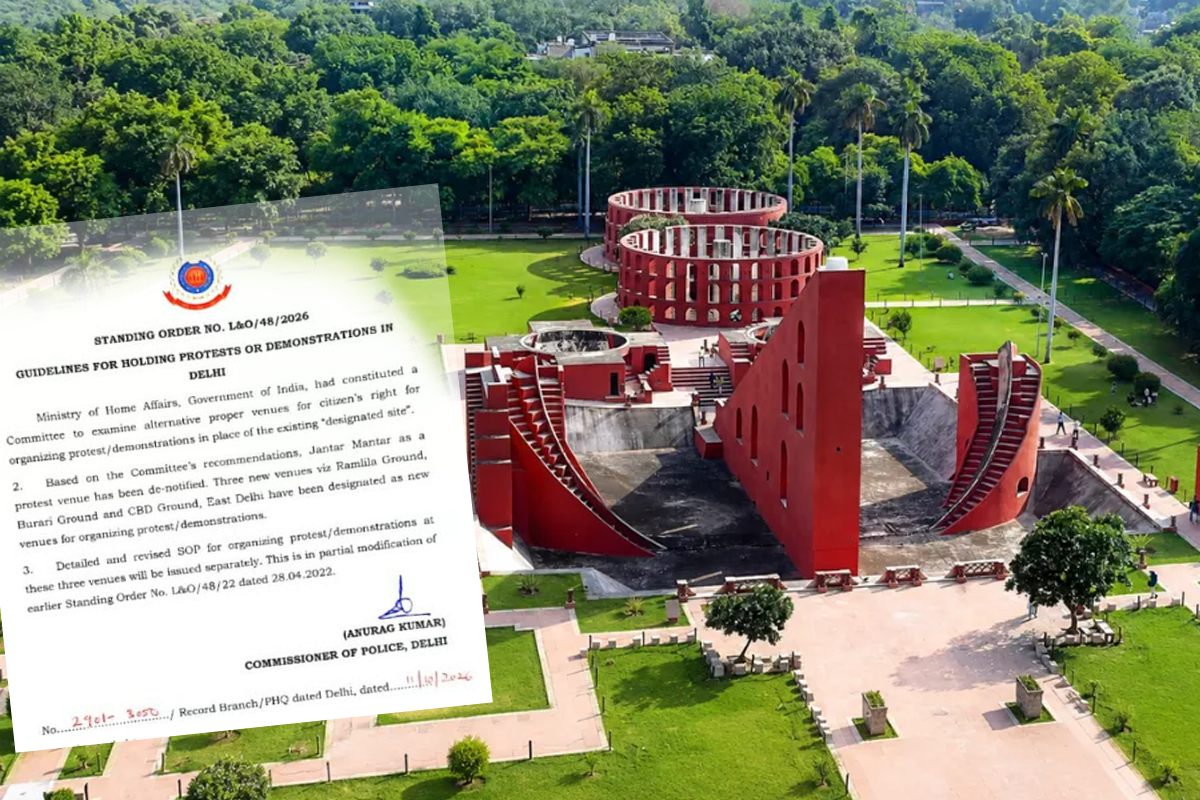
A petition has been filed in the Supreme Court challenging restrictions on protests at Delhi’s Jantar Mantar and the designation of alternative sites.

Synopsis: The denotified Jantar Mantar long served as a familiar destination for citizens demanding justice, accountability and political change. Removing it from the official protest has implications for the accessibility, visibility and effectiveness of democratic dissent.
The right to protest loses much of its meaning when authorities decide not only whether citizens may demonstrate, but also where their voices can be heard. The Delhi Police’s decision to remove Jantar Mantar from the list of designated protest venues raises a fundamental question for Indian democracy: are protest sites meant to facilitate dissent or to keep it at a convenient distance from power?
Jantar Mantar, in the heart of the national capital, has long served as a familiar destination for citizens demanding justice, accountability and political change. From aggrieved workers and farmers to students, women and civil society groups, people have gathered there because it offers more than open ground. Its proximity to Parliament and central government institutions gives public demonstrations political visibility. Removing it from the official protest map is therefore not merely an administrative rearrangement. It has implications for the accessibility, visibility and effectiveness of democratic dissent.
There is, of course, a legitimate case for regulating public demonstrations.
Delhi is a densely populated capital with sensitive government establishments, heavy traffic and genuine security concerns. Authorities cannot ignore the rights of commuters, residents and other citizens. Peaceful assembly does not mean an unrestricted licence to block every road or disrupt essential services indefinitely. The police have a responsibility to maintain public order, and reasonable restrictions may sometimes be necessary.
But a legitimate administrative responsibility does not automatically validate every restriction imposed in its name. The crucial distinction is between regulating a protest and rendering it politically ineffective. A democracy must ask whether a restriction is necessary, proportionate and supported by transparent reasons, rather than treating administrative convenience as the overriding consideration.
The location of a protest is not a trivial matter. A demonstration in a remote or poorly connected area may technically satisfy the requirement of permitting assembly, yet deny protesters the public attention that gives collective action its strength. For people travelling from distant states, many with limited financial resources, accessibility is essential. Relocating a gathering can increase travel costs, reduce participation and make it harder for journalists, supporters and the public to engage with the cause.
The alternative venues designated by the authorities must therefore be assessed not merely by their capacity to accommodate crowds, but also by their distance from the political centre, public transport access, basic facilities and the practical ability of citizens to assemble. A large ground on the outskirts cannot automatically replace a centrally located space with an established democratic significance.
The timing of such a decision also matters. When citizens mobilise over electoral roll revisions, alleged irregularities or demands for accountability from constitutional institutions, restricting access to a familiar protest venue inevitably raises questions about the space available for political dissent. Security considerations deserve scrutiny, but they should not become a convenient justification for reducing the visibility of uncomfortable questions.
A change of venue cannot settle the substance of a political grievance. If citizens suspect that eligible voters are being excluded from electoral rolls, directing them to a different ground does not answer their questions. If farmers protest against policies or students demand accountability over an examination scandal, their concerns do not disappear because the gathering has been moved beyond the immediate sight of those in authority. Governments may regulate where demonstrations take place, but they cannot reasonably expect to regulate the public debate that follows.
India’s democratic history offers an important lesson. The freedom struggle, movements for social justice and agitations such as the one that eventually led to the formation of Telangana were not exercises in administrative convenience. They were collective assertions that established institutions had failed to address public demands adequately. Such movements gathered momentum because people could assemble, communicate their grievances and attract wider public attention. A democratic government must recognise that protest is not necessarily a symptom of disorder; it can be a means of correcting institutional indifference.
The answer is not to abolish designated protest sites altogether. Clearly identified venues can help the police plan security, organisers manage gatherings, and citizens exercise their rights without unnecessary conflict. But designation must not become confinement. If peaceful demonstrators are restricted to inaccessible locations disconnected from the institutions they wish to address, as Burari ground and CBD ground are said to be, the government risks turning a constitutional freedom into a permission-based exercise with little practical value.
Delhi Police should explain the criteria behind the decision, publish the reasons supporting it and demonstrate why Jantar Mantar cannot continue to serve as a protest venue with appropriate safeguards. Alternative sites must have adequate transport links, drinking water, sanitation, medical assistance and facilities for journalists. Ramlila Maidan, while offering space and a history as the ground from which Jayaprakash Narayan issued a famous challenge to Indira Gandhi, is said to lack even proper toilets and to be situated on swampy ground.
A transparent permission process, clear timelines and a mechanism to challenge arbitrary refusals are equally necessary. Restrictions should be based on demonstrable risks, applied consistently and remain open to review.
Ultimately, the question is not whether protests require designated places. It is whether the state can narrow the boundaries of dissent until the right itself becomes meaningless. Public order and democratic freedom are not mutually exclusive; responsible governance requires protecting both.
Jantar Mantar has represented the meeting point between the ordinary citizen and the machinery of the Indian state. Moving protests elsewhere may change the geography of dissent, but it cannot extinguish the reasons people protest. A government confident in its democratic legitimacy should not fear citizens demanding answers near the seat of power. In a democracy, the purpose of a protest site must be to give the people’s voice a place to be heard, not to put that voice out of sight.
Also Read:
In groups of four, through back lanes: How students tried to reach a sealed Jantar Mantar
Indira Gandhi, Narendra Modi and the march of folly: The same mistake, fifty years apart
Lest we forget, India resisted Modi and his men long before the Gen-Z agitation
Fortress Delhi: An ‘undeclared Emer-Gen Z’ and the threat to democracy
(Edited by R Rajesh Kumar.)



