
Published Oct 09, 2026 | 9:10 PM ⚊ Updated Oct 09, 2026 | 9:10 PM

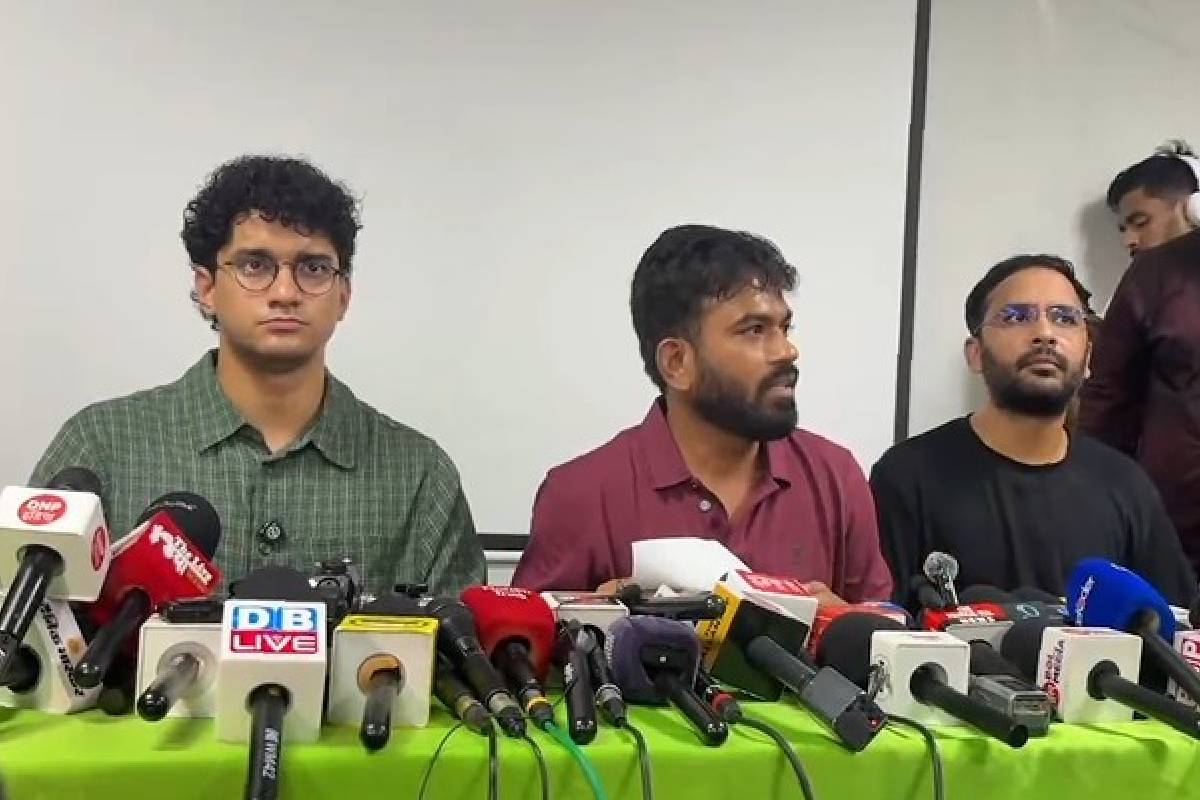
CJP leaders Abhijeet Dipke, Sourav Das and Asutosh Ranka addressing a press conference. (File Photo)

Synopsis: It is true that our youngsters came out and showed remarkable spirit in Jantar Mantar 1.0. But why indulge in hyperbole? It would be unfortunate if this loud admiration goes into the heads of some of the leaders of this movement. It will do them good if they don’t mistakenly believe that they, indeed, are the only saviours of our Republic, anointed by history.
The Cockroach Janta Party’s agenda and demands are not yet deep and broad enough to irreversibly unsettle the current regime. Their agitation is yet to venture beyond shallow waters.
The demands articulated during the latest protests might give the regime an easy escape route: offering a sacrificial lamb in the form of Gyanesh Kumar today, as they did with Dharmendra Pradhan yesterday.
The June-July agitation by our youngsters held out a huge promise. Those who said that students and youth were exclusively focused only on the examinations issue did not realise that we should not burden them with carrying the entire weight of the country’s political agenda.
That they had come out and decided to fight was in itself a significant development. At that initial stage of their agitation, they could widen and deepen their agenda through the dynamics of their involvement in the struggle during these fraught days.
But surprisingly, many leaders of the agitation have shown remarkable and disappointing resistance to any pulls and pushes to widen and deepen the agitation. Moreover, they have also learnt to market Pradhan’s resignation as a massive victory.
It would be unhelpful to both the youngsters and the larger movement to rescue the Republic from the clutches of the present autocratic regime if ‘elders’ continued to celebrate the Gen-Z movement uncritically.
Some elders are going overboard. They even say: “We failed and these kids did something that none of us could.” “They told the country one need not fear.”
It is true that the youngsters came out and showed remarkable spirit. But why indulge in hyperbole?
Farmers stayed the course for over a year. They suffered unimaginable repression. They lost about 650 lives. Yet they dug in. They forced the government to withdraw the three farm laws. They did not merely demand the resignation of the agriculture minister. They did not give the government an escape route to offer a sacrificial lamb.
They wanted the three laws to be withdrawn. Nothing less.
The government buckled under pressure. It had to withdraw the farm laws. The regime had no alternative. The Prime Minister tendered a public apology, had to go on television and admit his mistake. Farmers proved that he was neither mighty nor invincible.
But in its enthusiasm to celebrate the victory of Pradhan’s resignation, our discourse seems to have forgotten to recall the Kisan movement. Did that not teach the country not to be afraid of this regime?
A lot of people have put up a valiant fight against majoritarianism since as early as the Godhra carnage. They braved every kind of repression. One may recall the names of scores of people who resigned their IAS jobs, who lost lives, who had their careers ruined, who worked and are still working among the marginalised and the ‘othered’, and who are rotting in jail for over six years without even a charge sheet. Their courage and fearlessness suddenly seem of no significance.
The Aravali agitation forced the government as well as the Supreme Court to rescind their decisions. But that too seems invisible to this present celebratory discourse. The fight and victory of people of Devenahalli go unnoticed.
The resistance put up and the turmoil in Manipur, and the miseries of people there, are not a part of the current political imagination. The fight that is going on in dozens of Adivasi villages against the coercive state apparatus is, alas, not Instagrammable. And is, therefore, invisible.
Ken-Betwa River Interlinking protests, the Pathalgadi movement, Adivasi Ulugulan Morcha and the Long Marches, ST status and identity protests in Assam, the ongoing Niyamgiri and Kondha anti-mining agitations, ITDA Paderu agitation to protest against the dilution of land transfer provisions – are these not symbols of courage and fearlessness?
Are the scores of people who work with these movements no heroes? Is it because television cameras and YouTubers do not chase them?
Thousands of underpaid factory labourers and gig workers fought and were brutalised by the regime recently, not far from Delhi. None of our celebrities walked with them, holding their hands.
These and many other agitations are invisible to the ‘elders’ who simply say, ‘our generation has failed’! That is how hopelessly disconnected these self-appointed representatives of ‘our’ generation are. There were no cameras there.
Hewers of wood and drawers of water are not screen-friendly and, therefore, are not visible. The heavy-handedness of the State in evacuating the agitating women wrestlers did not prick the consciences of these ‘elders’ to make them say, “our generation has failed”!
It’s necessary that we take stock of the Jantar Mantar 1.0 as we embark on JM 2.0. What did the JM 1.0 movement achieve?
First, it achieved the resignation of Pradhan. But another equally clueless and insincere minister replaced him.
The second outcome was the setting up of the Nilekani Task Force, ostensibly to look into the issue of the conduct of entrance exams. God only knows what exactly the committee and Nilekani are doing. Apparently, they are reviewing the recommendations of an earlier committee headed by K Radhakrishnan!
Stripped of the hype, it hardly looks like an achievement, and it gives little reason for celebration.
Now, if the current agitation wants Gyanesh Kumar to go, what would that result in? That would only bring a Vigyanesh Kumar in his place. Like exit Pradhan and enter Joshi.
Because the youngsters at JM look like our own children, they speak like our own kids, are on Instagram like them, create memes like them, are comfortable with ordering food from Swiggy and Zomato like them, hail a cab like them, and can effortlessly say ‘what the f**k?’ — they became model daredevils of our middle classes and are their darlings who can instruct the nation how to be fearless.
One more thing of significance for our middle classes: the JM children also turned protest sites into places of fun with dance, music, and skits with their creativity. True, our farmers, Adivasis, Dalits, gig workers, and other protesters and fighters right from the days of Godhra somehow did not know how to turn their side of the battle lines into carnival sites.
The JM youngsters’ visibility on social media and their presence in our mind space are disproportionately larger than their numbers. For every single ‘Gen-Z’ who came to JM or resonated with the agitation from anywhere in the country, there are at least 10 Gen-Zs (if one defines that category as a specific demographic cohort) who are wielding Trishuls, gyrating to H-pop, urinating on the heads of Dalits, lynching suspected beef sellers, participating in Kanwar Yatras, demanding the real names of food vendors along the route of the Yatra to ascertain their religion, enforcing economic boycotts of minorities, wearing saffron headbands, shouting Jai Shri Ram slogans and playing loud music in front of mosques from DJ speaker sets, vandalising churches and shopping malls that displayed Santa Claus on Christmas Eve! They belong to a different NEET — Not in Education, Employment or Training.
But the favourite Gen-Z of the current dominant discourse is the cosy slice of the full Gen-Z, not the entire chunk. This slice alone suddenly began to look like the country’s saviours because that trope can absolve middle classes from the crime of not treading the path of those people who staked their everything, are suffering untold hardships and putting up valiant resistance to this brutal and illegitimate regime for over ten years. That fight actually started way back in 2002. The objective of those fighters was to defend the core values of our nation’s collective life that are enshrined in our Constitution.
But the current discourse stubbornly sticks to the trope that ‘our generation failed, and the Gen-Z deliverers came along’.
Why? Because these sections’ criminal indifference, irresponsibility and laziness so far can be masked by their declaration of admiration for agitation by our own cosy slice of Gen-Z. They redeem themselves by indulging in lazy praise.
It would be unfortunate if this loud admiration goes into the heads of some of the leaders of this slice of the ‘Gen-Z movement’. It will do them good if they don’t mistakenly believe that they, indeed, are the only saviours of our Republic, anointed by history. They should guard against the dizzying hyperbolic endorsements by the comfortably ensconced middle-class keyboard warriors.
These ‘Gen-Z’ leaders should endeavour to connect with every other mass movement in the country, listen to them, and try to learn from them. Fawning elders who are already in their charmed circle are no substitute for a real connect with the real India. The ‘elders’ who bend over backwards and compete with each other in their public praise of this cosy slice of Gen-Z will only be walls between them and the real India.
Harnessing the youth energies to the larger united movement of all sections who are on the path of resistance is the most urgent task at this hour. Instead of doing that, indulging in competitive valorising of these youngsters by our avant-garde intelligentsia will prove harmful to the much-needed deeper resistance.
We are at the threshold of a historic moment. Years of hard work, sacrifices, uncompromising battles fought away from the limelight and media coverage by hundreds of brave hearts have brought us to this critical juncture. Let no one forget that. What is happening at present in the name of the Gen-Z movement should not now degenerate into a mere spectacle of resistance without substance. That should not be allowed to happen.
Our avant-garde intelligentsia should give its critical guidance, instead of declaring its fawning admiration, to the ‘Gen-Z’ movement’s leadership. They must discharge their duty to help forge a wide, deep and broad alliance of all the anti-authoritarian, democratic and secular forces in the country.
If they abdicate this responsibility, they would be subverting the years of hard work put in by thousands of people away from the social media limelight.
The young leaders who are now in the limelight should guard against getting carried away by the media attention that could prove fleeting, as it did in the case of a few others during the last decade.
The Republic can be saved only if an uncompromising position is taken to press for the dissolution of the current Election Commission of India; reconstitution of the selection committee of the election commissioners with the Chief Justice of India; scrapping of SIR; restoration of all deleted voters to the electoral roll; withdrawal of the 2023 Election Commission legislation that gave lifetime immunity to the election commissioners; and annulment of all the elections that were held post-SIR. Anything less than this would only shortchange the country’s expectations.
Going forward, our leaders — young and old, from civil society and political parties — must keep this in mind.
Also Read:
‘SIR is a bloodless political genocide to exterminate citizenship’: Dr Parakala Prabhakar
Indira Gandhi, Narendra Modi and the march of folly: The same mistake, fifty years apart
Why CEC Gyanesh Kumar should resign, and why the appointment process needs to change too
(Edited by R Rajesh Kumar.)



