

Published Oct 13, 2026 | 8:00 AM ⚊ Updated Oct 13, 2026 | 8:00 AM

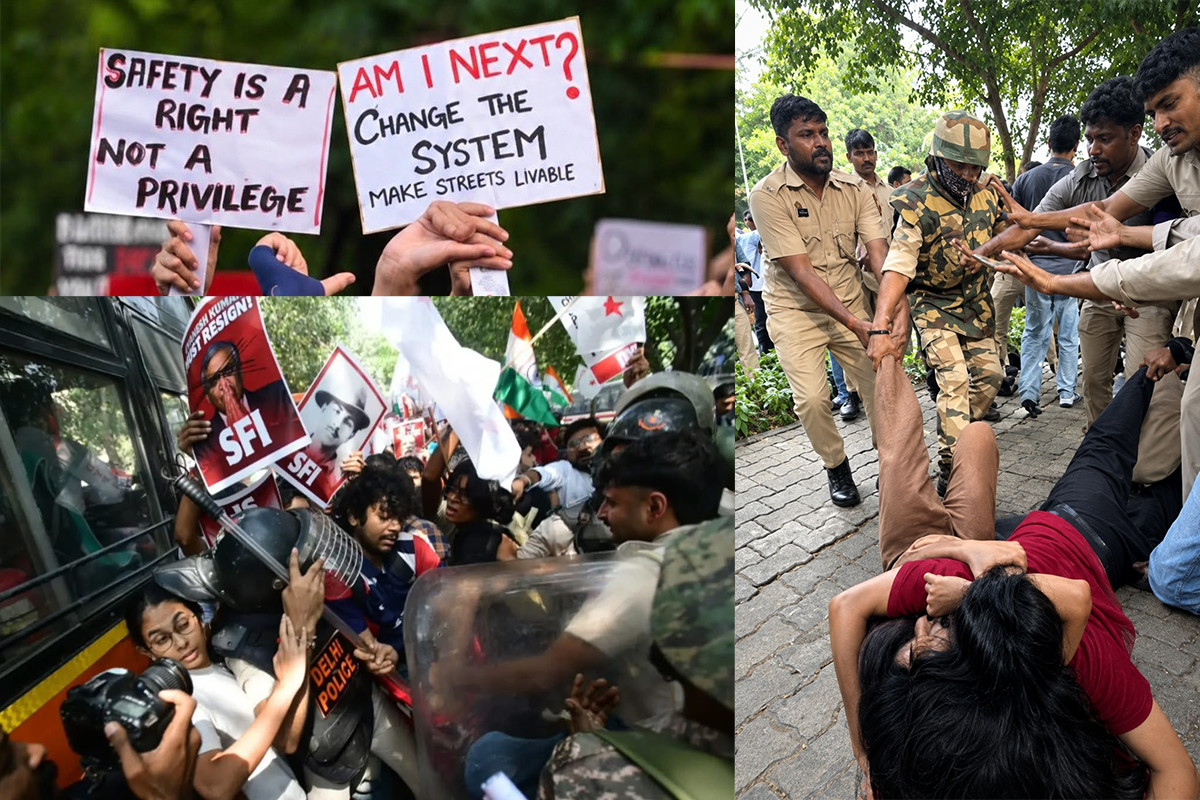
Protesters were picked up from everywhere, and journalists and even an MP, John Brittas, were dragged away.

What unfolded in ‘Fortress Delhi’ over Saturday and Sunday during the protests against Chief Election Commissioner Gyanesh Kumar and the Centre was more than a series of isolated confrontations. The INDIA bloc’s massive show of strength on Monday has offered a degree of redressal for protesters. But before that, with 30,000 boots on the ground ensuring the forcible removal of protesters from everywhere, the capital had been turned into Detention Central.
Protesters were picked up from everywhere, and journalists and even an MP, John Brittas, were dragged away as citizens were prevented from reaching a recognised protest venue without being provided an alternative.
Delhi’s public spaces began to resemble a security zone in which the presence of citizens expressing dissent was treated as a problem to be eliminated. This was the militarisation of democratic space: not necessarily the declaration of martial law, but the normalisation of a security-first approach in which public participation is subordinated to coercive control.
“Amit Shah’s Delhi Police has itself descended into thuggery—and it’s openly giving license and encouragement to the real goons of RSS-BJP to unleash violence on women and youth,” Leader of Opposition Rahul Gandhi observed ahead of Monday’s march, while sharing his take on what had come to pass.
Gen Z deserves better than an undeclared Emer-Gen Z, observed another Congress leader Shashi Tharoor.
Authorities cannot evade responsibility for this situation through routine references to security arrangements or administrative procedures. The authorities must explain why protesters were intercepted far from the designated venue, why mass detention was considered necessary, and what legal justification existed for the treatment captured on video.
Those responsible for unlawful violence must face accountability, and complaints concerning treatment in custody must be investigated independently. But accountability must extend beyond individual officers. It must also examine the decisions, orders and institutional practices that allowed the crackdown to unfold on such a scale.
Even more disturbing was the violence perpetrated by individuals claiming to be from right-wing groups against protesters, including women, in the presence of the police. Videos circulating from the ground showed women being dragged and assaulted, protesters being kicked and punched, and journalists facing threats and intimidation. Individuals identifying themselves with right-wing organisations were reported to have confronted protesters and journalists.
Some journalists who witnessed these incidents questioned the conduct of the police, reporting that officers appeared to stand by while protesters were assaulted and, in certain instances, seemed more concerned with restricting those recording the violence than intervening against the attackers.
Krishna Kant, a journalist, shared a video of how the Delhi Police let a car go despite a fellow journalist shouting that it was loaded with sticks and weapons. “Instead of checking, the police gave it full cover and let it go,” he observed.
These incidents expose a deeply troubling contrast: students and peaceful demonstrators were forcibly detained across Delhi, while individuals assaulting protesters appeared to operate in the presence of law enforcement.
The question is not merely why such violence occurred, but why the police failed to provide immediate protection to those being attacked.
When women are assaulted in public, journalists are threatened for documenting the violence, and police personnel fail to intervene effectively, the principle of equal protection under the law is seriously undermined. The police cannot claim neutrality if their conduct creates the impression that political affiliation determines whose rights deserve protection.
Nor can the authorities invoke public order to justify mass detentions while failing to protect citizens from violence committed by private individuals. Any police personnel who facilitated, encouraged or deliberately allowed such assaults must face an independent investigation, and those responsible for the attacks must be held accountable.
When peaceful protesters are treated as threats while those attacking them appear to receive greater latitude, the crisis is no longer simply about crowd control; it is about the impartiality of the state and the credibility of the rule of law.
The description of the present situation as an undeclared emergency by many Opposition voices is not a claim that a constitutional Emergency has formally been proclaimed. It is a warning about the normalisation of practices that progressively narrow democratic freedoms.
An emergency-like political climate can emerge when peaceful assembly becomes difficult, preventive detention becomes routine, and the state treats political mobilisation primarily as a threat to public order. Fundamental rights may remain formally intact while their exercise becomes increasingly precarious.
Article 19(1)(a) guarantees freedom of speech and expression, while Article 19(1)(b) protects peaceful assembly without arms. These rights are subject to reasonable restrictions on constitutionally recognised grounds. But this qualification does not provide the state with unlimited discretion to suppress demonstrations.
Restrictions must have a lawful basis and must be necessary and proportionate. Public order cannot become a blanket justification for preventing dissent. If authorities believe that a gathering poses a genuine risk, they must demonstrate why proportionate measures, negotiated arrangements and appropriate security provisions are insufficient. Denying permission, blocking access and detaining people before they reach a protest site raise serious questions about whether the objective is to regulate a demonstration or prevent it altogether.
The crisis extends beyond the conduct of the police. It concerns the ability of democratic institutions to preserve public confidence when citizens challenge the exercise of state power.
The Election Commission’s credibility depends on public confidence in the fairness and transparency of electoral processes. Allegations concerning electoral-roll revisions require serious examination through evidence and institutional accountability. Suppressing demonstrations about electoral integrity cannot settle those questions. Instead, restrictions on peaceful political expression risk deepening public suspicion.
This is not how democracy works. The police are not the private force of the government, and citizens are not subjects who must seek permission to question those in power without risking humiliation or violence.
The Constitution does not authorise the government to treat dissent as a threat to be crushed. It obliges the government to protect the rights of those who dissent, including those whose criticism is inconvenient to the government.
A government that responds to peaceful political mobilisation with barricades, mass detentions and coercion must answer for the democratic freedoms it has obstructed. The measure of policing is not how effectively it can silence protesters, but whether it can protect their rights even when they challenge the authorities.
The Supreme Court has a particularly important constitutional responsibility in such situations. Article 32 guarantees the right to approach it for the enforcement of fundamental rights. Judicial scrutiny becomes essential when the state invokes public order to restrict constitutional freedoms. However, the effectiveness of judicial protection must be assessed by more than the issuance of directions. It also depends on timely intervention, compliance and meaningful remedies for those whose rights may have been violated.
When citizens perceive that constitutional safeguards are inadequate or that remedies arrive only after detention and coercion, faith in the justice system can erode. Judicial decisions must remain open to rigorous criticism, particularly when their practical consequences affect fundamental freedoms. The question is not whether institutions should be trusted unquestioningly, but whether they consistently demonstrate their commitment to constitutional principles.
The President’s office carries constitutional and symbolic significance, but its authority is defined by the Constitution. The President ordinarily acts on the aid and advice of the Council of Ministers under Article 74. The office cannot simply replace the elected executive or directly reverse every police decision.
Nevertheless, the larger crisis raises an unavoidable question: when citizens lose confidence in the institutions meant to protect their rights, how can the constitutional order restore that trust?
The crackdown in Delhi raises a deeper question about the institutional culture of policing.
The Police Act of 1861 emerged from a system designed to maintain British rule, and the persistence of a control-oriented approach deserves scrutiny in a constitutional democracy founded on liberty, equality and fundamental rights. The events of October 10 illustrate why this question matters. The refusal of permission, extensive barricading, multiple detention points and the detention of protesters before they could reach Jantar Mantar turned the exercise of a democratic right into a confrontation with the state.
When authorities make a recognised protest venue inaccessible without providing a workable alternative, they risk transforming administrative control into practical denial of a fundamental freedom. The police cannot be expected to facilitate every gathering without restrictions, but they must demonstrate that restrictions are lawful, necessary and proportionate.
A democratic police force should not create fear among citizens seeking to exercise their constitutional rights. Its responsibility is to protect people, reduce tensions, communicate clearly and facilitate peaceful assembly while responding lawfully to genuine threats.
Protesters should not have to fear arbitrary detention simply because they intend to criticise the government. Policing must be grounded in empathy, restraint and accountability, not in the assumption that dissent is a threat to authority.
New Zealand offers a useful, though imperfect, point of comparison.
In 2025, its Independent Police Conduct Authority called for stronger legal protections and clearer guidelines for policing public protests, following complaints about police conduct at demonstrations. The review identified instances of unlawful or unjustified police action and recommended reforms to better balance public safety with freedom of assembly.
The lesson is not that New Zealand has solved every problem, but that democratic policing requires independent scrutiny, clear legal standards and a commitment to facilitating peaceful protest.
India needs a shift in institutional priorities.
Decisions restricting demonstrations should be explained in writing and open to timely review. Authorities should engage with organisers, seek workable alternatives when a venue is unavailable, and use negotiation and de-escalation before resorting to force wherever circumstances permit. Detentions must comply with legal safeguards, while credible allegations of excessive force must be independently investigated. Police accountability should be measured not by how effectively officers prevent dissent, but by how well they protect public safety while respecting constitutional freedoms.
The fundamental purpose of policing in a democracy is not to make citizens afraid of the state, but to ensure that they can exercise their rights without fear. When the police become an instrument through which peaceful dissent is obstructed rather than protected, reform is no longer merely an administrative necessity. It becomes a constitutional imperative.
Also Read:
‘A hammer to kill a fly’: Why the Delhi crackdown is a crisis of democracy
Lest we forget, India resisted Modi and his men long before the Gen-Z agitation
Citizens aren’t slaves, police aren’t servants of CM or PM, reminds Bombay HC’s Justice Jamdar
(Akhilesh Kumar is a PhD Research Scholar at Jamia Millia Islamia, New Delhi, Ambedkarite activist and an independent writer. Views are personal. Edited by R Rajesh Kumar.)



