

Published Oct 10, 2026 | 6:20 PM ⚊ Updated Oct 10, 2026 | 7:16 PM

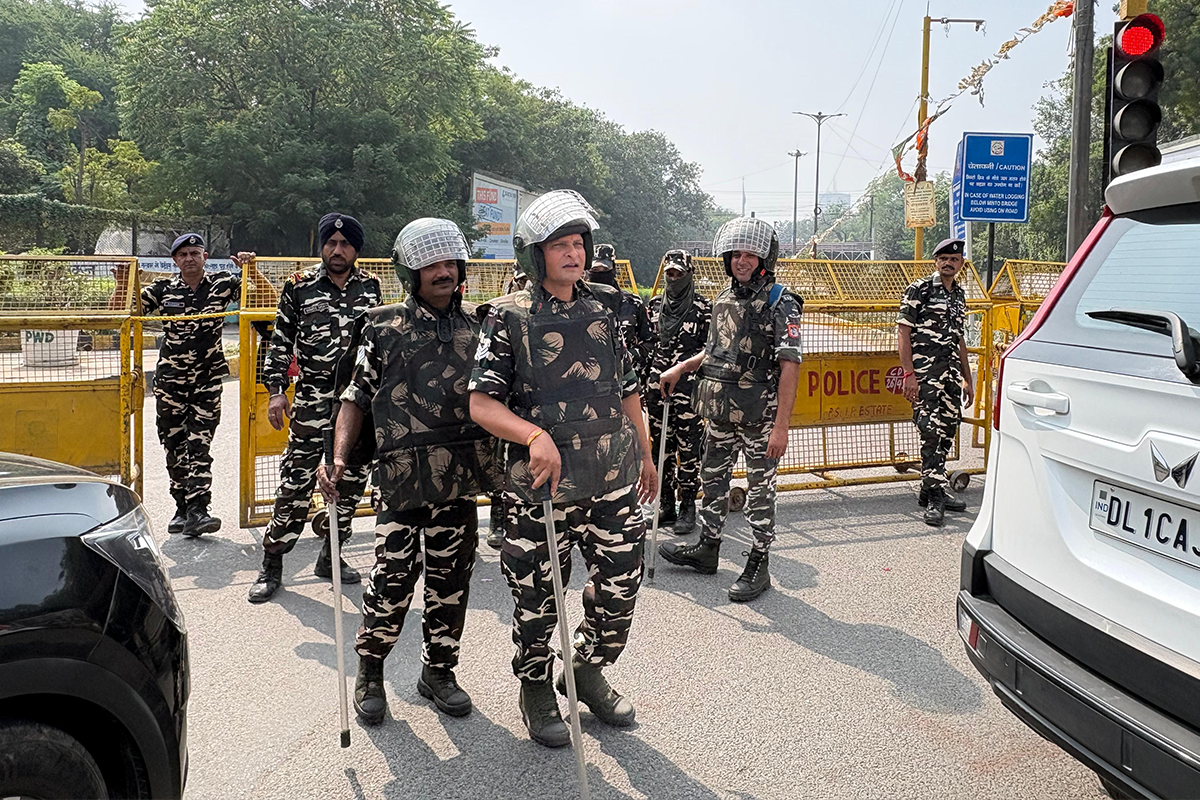
All major roads remained heavily guarded by police and armed personnel, with access restricted to everyone.

On a day when Delhi turned into Detention Central with over 26,000 boots on the ground and a sea of barricades all around, the hardest part of protesting was getting there.
45 metro stations were shut, internet was suspended, and student neighbourhoods were barricaded. As many as 3,000 people had been taken into custody by evening.
Saturday’s protest at Jantar Mantar, called by the Cockroach Janta Party (CJP) and backed by Left student groups, was for the resignation of Chief Election Commissioner Gyanesh Kumar over alleged irregularities in the Special Intensive Revision (SIR) of electoral rolls.
From morning, police were posted outside every major campus, and bus services and cabs into Connaught Place were badly curtailed.
To find out how students were managing it, I called Shreya, Delhi district secretary of the All India Democratic Students’ Organisation (AIDSO), whose members had planned to reach Jantar Mantar.
Shreya put me in touch with Adrika, a PhD scholar in comparative literature at Delhi University’s Arts Faculty. Their plan was already in motion: split into groups of four or five and travel separately.
The students had been staying in Vijay Nagar, a student neighbourhood near Delhi University that had been barricaded since early morning. They took one bus together to the Ambedkar University stop at Kashmere Gate, then broke up, each group boarding a different bus.
Adrika told me to come to Kashmere Gate. When I reached Ambedkar University, she guided me further: take a bus going towards Kamla Market and get down at the Zakir Husain College stop.
Three students were there when I got off: Adrika, Anjali, a linguistics student at the Jawaharlal Nehru University and Arkaprabha, who studies Urdu at the Urdu Academy near Kashmere Gate.
“This is my first time,” Anjali told South First. “It is true that I am scared for myself. But what is happening is wrong, and I decided I should be part of the protest against the Election Commission of India.”
“The way people are being removed in the name of SIR is unacceptable. We must fight it,” Arkaprabha said, referring to the removal of over 13 crore names from the rolls.
‘Is it that evident?’
As we walked, an old man in the basti called out: “Are you people going to Jantar Mantar?”
Adrika turned to me, smiling. “Is it that evident?” she asked.
They led me into the gallis of Basti Hazrat Khwaja Mir Dard, narrow lanes that open out near the Municipal Corporation of Delhi’s Civic Centre. There, the three joined a larger group of more than 15 AIDSO activists led by Shreya, who had come in, like them, from different directions.
Ahead of them stood a large contingent of police. Shreya did not hesitate. “They will detain us anyway. Let us raise our voice as much as we can,” she said.
They marched, raising slogans against Gyanesh Kumar, until the Delhi Police surrounded them, forcibly pushed them into buses and took them away to different locations. One batch was taken to Maurice Nagar police station and another to Sarai Rohilla police station.
For Shreya, being detained was the point: to be heard, and to register their voice against what they see as an undemocratic Election Commission.
“Today the entire country is witnessing hundreds of thousands of common people marching towards Jantar Mantar. The designated protest site has been sealed, and we have no right to raise our voice. Hundreds and thousands of youth and common people have been detained. We cannot connect with each other. The police have also snatched phones after detention. But we common students have come together to save democracy,” she told South First.
They were not the only ones. Several other organisations reached, as they had, the different roads leading to Jantar Mantar, only to find them sealed off by the Delhi Police and paramilitary personnel.
SFI (Students’ Federation of India) and DYFI (Democratic Youth Federation of India) cadres had assembled since morning at AKG Bhawan and HKS Bhawan, while AISA members had waited inside Gurdwara Bangla Sahib, a short walk from the protest site, where more than 45 police buses stood ready.
Members of the SFI, AISF, AISA and several other student organisations, who marched in much the same fashion, were detained, as were prominent leaders of the CJP movement.
Every major road remained heavily guarded by police and armed personnel, with entry barred to everyone, the press included. In fact, one Delhi Police officer even told journalists that ‘Koi media nahin hai‘ (Nobody is from the media here for us). It was such a day.
Also Read:
‘Cowardice!’: Rahul, Priyanka slam government, back India’s youth
Lest we forget, India resisted Modi and his men long before the Gen-Z agitation
Gen Z deserves better than an undeclared Emer-Gen Z, says Shashi Tharoor
Indira Gandhi, Narendra Modi and the march of folly: The same mistake, fifty years apart
(Edited by R Rajesh Kumar.)



