

Published Sep 29, 2026 | 4:30 PM ⚊ Updated Sep 29, 2026 | 4:57 PM

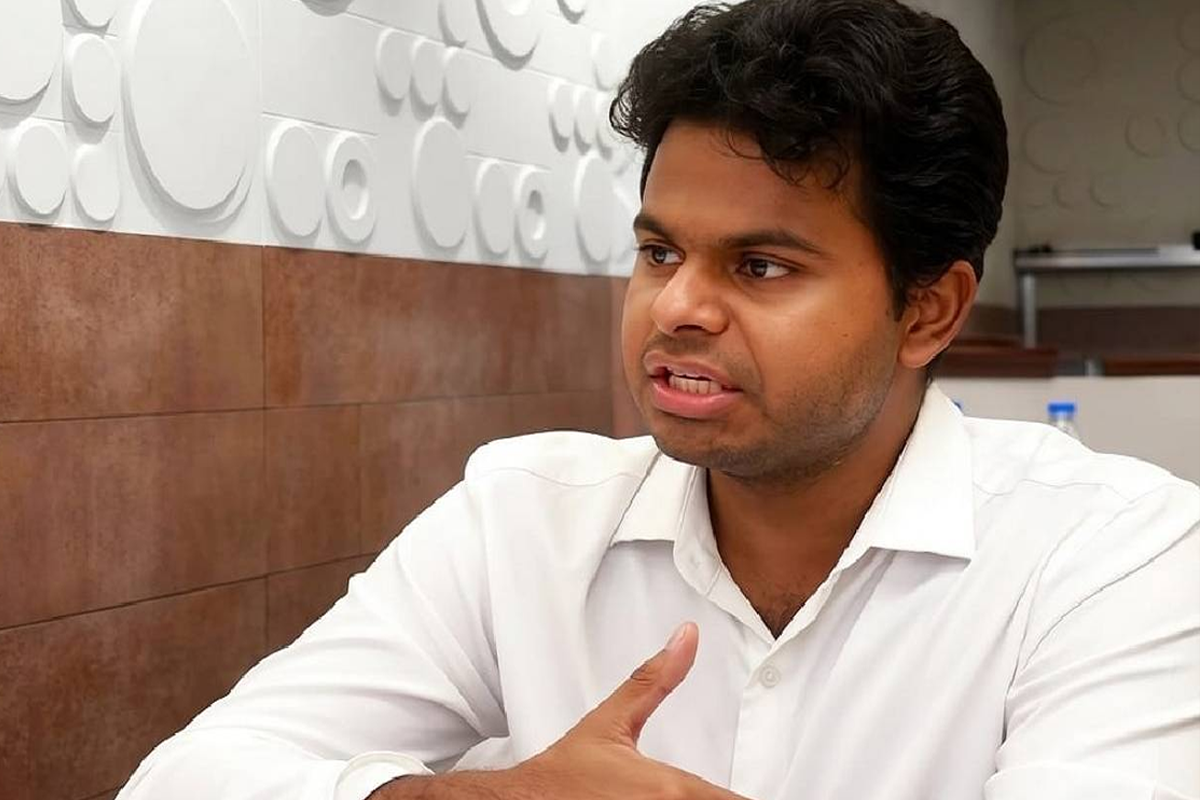
Vijay Reddy Mallangi.

Synopsis: Cockroach Janta Party’s Media Lead and South India In-Charge Vijay Reddy Mallangi was in Keralam on Sunday, 27 September, to attend the organisation’s South Zone meeting. The response the CJP received in Keralam seems to have excited him. So far, more than 20,000 people have signed up to join the CJP in Keralam. In a conversation with Sreelakshmi Soman, he discussed the ongoing controversy surrounding the Election Commission of India, the trust deficit in the Election Commission’s appointment process, and the CJP’s upcoming protest seeking the resignation of Chief Election Commissioner Gyanesh Kumar. He also has a message to two prominent political parties in Keralam, the CPI(M) and Congress.
The Cockroach Janata Party (CJP) has announced a nationwide protest from 2 October, demanding the resignation of India’s Chief Election Commissioner, Gyanesh Kumar. In a conversation with South First, CJP South India In-Charge Vijay Reddy Mallangi spoke about how the party plans to organise the protest and its push in South India. Edited excerpts:
Q: The Cockroach Janta Party has issued the Chief Election Commissioner, Gyanesh Kumar, an ultimatum to resign. What is CJP expecting to achieve through his resignation? Do you believe that everything will be fine with the Election Commission after his resignation?
A: The resignation should not only be seen as a simple signature. It’s about fixing accountability. Gyanesh Kumar has repeatedly violated the Constitution. The Election Commission is not part of a government or a political party. It’s a constitutional body, and he hasn’t upheld the Election Commission’s values and principles.
According to a report in The Indian Express, it’s the people within the Election Commission—the two Election Commissioners—who opposed him.
Whether it comes to Form 6, the handling of Form 6, or the centralisation of power, the power of adding and deleting votes, which actually lies with the BLOs, is now being routed all the way to the Centre through the software (ECINet).
This software has many glitches. People are finding it very hard to get their names back (in the electoral rolls).
We have seen instances in India where even for one voter in the most remote places, the entire government machinery goes so that that one person gets to vote. But at the same time, we have seen 13 crore deletions, and most of these deletions are very unlawful. People who have not moved from their residence are marked as moved. People who are alive are marked as dead.
So many discrepancies cannot happen unless electoral rolls are being fractured. It is being done at the behest of the BJP, and that’s what we are alleging against them.
We have also come across recent news about Jiji Thomson, the former Chief Secretary, who has made a shocking revelation.
He alleges that Gyanesh Kumar, back in 2016, asked him about his retirement plans.
Somebody would say that, “My future retirement plan is that I have these many savings, I have these fixed deposits, I want to go spend time somewhere.”
But rather, Gyanesh Kumar asked him to contest on a BJP ticket, become an MP, and then become a Cabinet Minister. So, Gyanesh Kumar is not meant to be a bureaucrat. If he wants to be a politician, he can wear the BJP’s flag. He can go to their office and become their spokesperson.
Also Read: MLA had confronted Gyanesh Kumar over inaction on illegal sand mining
Q: CJP’s NEET protest was centred around Jantar Mantar in Delhi and lasted 37 days. This time, you are starting from Mumbai and taking the protest across India. Why Mumbai?
A: We wanted to start from Mumbai because we have never held a national protest there. This time, the protest will move across States where there have been mass deletions and concerns, and eventually head to Delhi.
We are doing this with the same hope as before—that people who are tired of the system will come together.
I believe the youth are concerned that their voting rights are being snatched away. When democracy and free and fair elections are at stake, political parties need to come together beyond their ideological differences.
Whether through CJP or another platform, everyone should show their dissent. We are making this call and would appreciate your support.
Also Read: At Jantar Mantar, a generation that stopped being afraid
Q: During the NEET protest, you had a prominent face like Sonam Wangchuk associated with the CJP. Do you have a similar prominent figure supporting the campaign beginning 2 October?
A: Sonam Wangchuk sir is already working hard for Ladakh. He released a video this morning saying that he supports this movement. He also acknowledged that CJP now has greater recognition and a greater responsibility.
We will always be thankful to Sonam sir.
His hunger strike lasted close to 38,000 to 40,000 minutes, if you count it in minutes. We cannot stay without food for even 300–400 minutes, three to four hours. Imagine him staying on a hunger strike for close to 40,000 minutes. It is no joke.
We support Sonam’s campaign in Ladakh, and we are also thankful that he is supporting our movement.
Right now, we want the country to move together, and we also have high hopes for the opposition parties. We want them to unite, including the CPI(M) and Congress.
If there is no election, if the elections are rigged, what difference does it make whether you are CPI(M) or Congress? Please first fix the election system and then proceed with your political work.
Also Read: Why CEC Gyanesh Kumar should resign
Q: Special Intensive Revision (SIR) is one of the central issues you are raising. Specifically, what do you want the Election Commission to do? Do you want the exercise to be stopped or rolled back, or do you want an independent review? What are your key demands?
A: Our first demand is the resignation of Chief Election Commissioner Gyanesh Kumar. Second, we want a thorough inquiry into all files related to SIR, particularly the correspondence between the Election Commissioners of different states, Chief Electoral Officers and the Election Commission of India.
We also want the Supreme Court to take suo motu cognisance and ensure that all such records and communications are preserved.
Third, we want electoral reforms to begin, starting with the process of appointing the Election Commission. Under the 2023 law, the selection panel comprises the Prime Minister, a Union Cabinet Minister nominated by the Prime Minister and the Leader of the Opposition.
Because the government has a two-to-one majority on the panel, we believe the process does not give the Election Commission sufficient independence.
We want this system changed and broader electoral reforms undertaken through consultations involving all registered political parties, civil society, the public, and political pressure groups such as CJP. We believe electoral reforms need much wider consultation.
Also Read: Bar Council of India hands CJP an accidental win
Q: You are responsible for building CJP in the South. What does that mean on the ground? Are you building a movement, an organisation, or eventually a political party?
A: We are a political party; we are just not registered. We are not fighting elections because thousands of parties have emerged in this country, but most of them have not been able to bring systematic and substantial change.
We want to be a party that functions as a pressure group. Right now, people are accepting us in that role, so we are taking that shape. The people and our volunteers, including the zonal committee members, will decide what happens next.
The South Zone comprises five southern States — Telangana, Andhra Pradesh, Karnataka, Keralam and Tamil Nadu — along with the Andaman and Nicobar Islands. A 21-member zonal committee has been constituted, with representation from these states in proportion to their Lok Sabha representation.
The committee includes three members from Telangana, three from Andhra Pradesh, four from Karnataka, and corresponding representation from the other states.
The zonal coordinators are responsible for expanding the organisation to the local level and eventually to the Assembly level.
We have received immense support from Keralam. I am very happy to share that Keralam is one of the States where we have received the highest number of memberships. More than 20,000 people have signed up through our website.
We’ll share this membership data with the State team, who will reach out to these members, form local groups, and further expand the organisation.
Also Read: When books clashed with police batons for a better India
Q: What exactly is CJP looking for in the South? Do you have a separate or specific strategy for students and for states, particularly Kerala and Tamil Nadu?
A: We are very decentralised. We believe in the true spirit of federalism. Each State has its own identity, culture and language, and we don’t believe in the kind of imposition that sometimes happens from the Union Government.
I also want to make one point clear. There is nothing called the “Central Government”; we always say “Union Government”. Even I make that mistake sometimes. The Union Government is essentially a collective union of states.
When it comes to taxation, what is collected from a state and what is given back to it, the imposition of language, or the centralisation of schemes, these are all issues we are concerned about.
For instance, I’ve heard about a scheme called PM SHRI (Pradhan Mantri Schools for Rising India), where there have been concerns about conditions attached to funding — that if states adopt a particular curriculum or make certain inclusions, only then will they receive the money. Who are they to decide that? The people of Keralam who pay the taxes and work hard, and they deserve every penny without conditions.
So, we want to support the autonomy and rights of the states and ensure that their culture and heritage are preserved.
At the same time, this is a new organisation. How we shape it will shape how it evolves. How the team shapes it, how I work with them, and how I understand the region—it is a learning experience for me, too.
South India is extremely diverse, yet the states are geographically close. I speak Telugu, I understand a little Tamil, and I am very interested in learning Malayalam. I’m excited about this opportunity and will take on the responsibility.
Also Read: SIR row hits the streets
(Edited by Majnu Babu).



