

Published Sep 23, 2026 | 12:27 PM ⚊ Updated Sep 23, 2026 | 12:57 PM

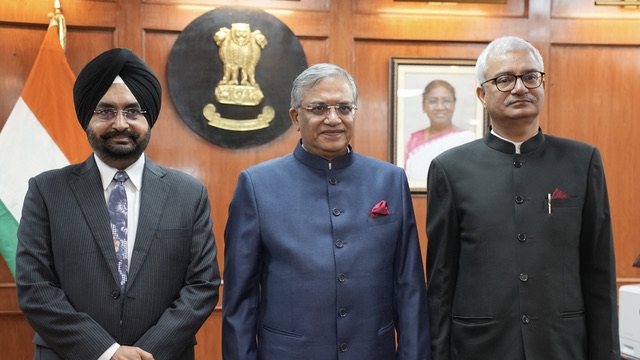
Chief Election Commissioner Gyanesh Kumar (centre) and Election Commissioners Sukhbir Singh Sandhu and Vivek Joshi.

Synopsis: Opposition leaders have demanded the immediate removal of Chief Election Commissioner Gyanesh Kumar and a court-monitored investigation into the Election Commission of India after an investigation by The Indian Express found that Election Commissioners Sukhbir Singh Sandhu and Vivek Joshi formally objected at least 14 times in the past 10 months to decisions on the Special Intensive Revision of electoral rolls that were taken without their knowledge or against their recommendations.
Opposition leaders have demanded the immediate removal of Chief Election Commissioner Gyanesh Kumar and a court-monitored investigation into the Election Commission of India after an investigation by The Indian Express found that Election Commissioners Sukhbir Singh Sandhu and Vivek Joshi formally objected at least 14 times in the past 10 months to decisions on the Special Intensive Revision (SIR) of electoral rolls that were taken without their knowledge or against their recommendations.
The SIR, now in its third phase, is supposed to be overseen by all three Commissioners. The CEC is first among equals and does not have the power to decide alone. Section 18 of the Chief Election Commissioner and Other Election Commissioners (Appointment, Conditions of Service and Term of Office) Act, 2023, says the Commission’s business “shall, as far as possible, be transacted unanimously”.
If the CEC and the Election Commissioners “differ in opinion on any matter”, the matter “shall be decided according to the opinion of the majority”. Yet, time and again, the poll body made decisions without the knowledge of, or sometimes against the recommendations of, the two Commissioners, according to The Indian Express.
Abhijeet Dipke, founder of the Cockroach Janata Party, dubbed the SIR “Special Intensive Rigging” in light of the investigation. Diamond Harbour MP and TMC Parliamentary Party Leader Abhishek Banerjee said the Supreme Court could not look away from the allegations.
Gyanesh Kumar is the enemy of India.
More than 12 crore names have reportedly been deleted from electoral rolls.
That is roughly 12.4% of the 97 crore registered electorate around the 2024 Lok Sabha election.
The gap between the BJP-led NDA and the opposition was just 2%.… pic.twitter.com/t7ZQjSYrId
— Abhijeet Dipke (@abhijeet_dipke) September 23, 2026
“The CEC must be removed immediately and a court monitored investigation ordered. Disenfranchising lakhs of voters to allegedly benefit one political party strikes at the very foundation of our democracy. Those responsible must be held accountable. After the West Bengal elections, all opposition parties of INDIA wrote to the CJI and SC judges raising serious concerns,” he wrote in a post on X.
“Those allegations, however, were neither examined nor given the scrutiny they deserved. When grave questions affecting the democratic process are repeatedly raised and yet remain unheard, it inevitably raises questions about institutional impartiality. The Supreme Court cannot look away. The buck stops there. Will the CJI led Bench act?”
Also Read: Election Commission extends Special Intensive Revision schedule for Karnataka and Telangana
The Congress spokesperson Pawan Khera said the report showed how CEC Gyanesh Kumar had exercised extraordinary control over an institution that was supposed to function collectively and accused him of being a BJP ‘plant’.
“Gyanesh Kumar Gupta is planted and being protected by the BJP to hollow out the Election Commission of India from within. It was already known that things were not exactly well within the ECI. But just how messy, dysfunctional and, frankly, disturbing things had become is laid bare by this brilliant exposé,” he wrote in a post on X.
“Think about what that means -Gyanesh Kumar Gupta exercises extraordinary control over an institution that the Election Commissioners are supposed to run collectively. In the process, he has single-handedly presided over the destruction of the integrity of India’s electoral process at the BJP’s behest. Gupta has to be the single most sold-out bureaucrat of the Modi era who has disenfranchised crores of Indians, and he must face the law.”
Mr @RahulGandhi had said it in December last year.
What Gyanesh Gupta has done is nothing short of TREASON. https://t.co/PhJkAxtJGl— Pawan Khera 🇮🇳 ಪವನ್ ಖೇರಾ (@Pawankhera) September 23, 2026
The Congress accused the CEC of behaving like a “dictator just like his boss [Prime Minister Narendra] Modi”.
“Modi’s favorite Gyanesh Kumar is running the Election Commission as he pleases. These complaints make it clear that in the three-member Election Commission, only Gyanesh Kumar’s writ runs. Gyanesh is ruling like a dictator just like his boss Modi and is engaged in ‘vote theft’ to please Modi. We have said this before as well – Modi has captured the Election Commission. Gyanesh Kumar is Modi’s puppet,” the party said on its official X account.
“Modi and Gyanesh together have caused great damage to the country’s democracy. But remember this – when the time comes, everyone will be held accountable, responsibility will be fixed. Punishment for this crime will surely be meted out.”
Leader of Opposition in the Lok Sabha Rahul Gandhi repeated his consistent charge of ‘vote chori” against the EC and promised to bring those responsible to justice.
“Vote chori is a crime against the Indian people and a direct attack on our constitution. The BJP, RSS and EC who organised it have committed an act of treason. Justice will be served,” he wrote.
The SIR was first rolled out in Bihar in June 2025 and has since expanded across most of the country in three phases. Phase I, conducted in Bihar, was completed in September 2025. Phase II, completed in April 2026, covered nine States—Chhattisgarh, Goa, Gujarat, Kerala, Madhya Pradesh, Rajasthan, Tamil Nadu, Uttar Pradesh and West Bengal—and the Union Territories of Andaman and Nicobar Islands, Lakshadweep and Puducherry. Phase III is now underway across 16 States and three Union Territories, including Andhra Pradesh, Karnataka and Telangana.
The ECI has since struck more than 13 crore names off the draft electoral rolls in 30 States and Union Territories. The deletions, apart from the very legality of the exercise, have put the Commission and its handling of the SIR under intense public scrutiny.
According to The IE, Sandhu and Joshi raised objections over the registration of new voters, deletion and restoration of names, appeals against decisions in the SIR process, and the custody and security of the electoral-roll database.
In July, the ECI made changes to Form 6, used by citizens to apply for registration as voters during Phase III of the SIR.
The revised form asked applicants whether they, or their parents or grandparents, “exist” in the “electoral roll of last SIR”. Applicants could not proceed without answering the question.
Two months earlier, in May, Joshi had recorded that Form 6 could not be changed in this manner without an amendment to the rules, according to The IE. Sandhu agreed.
The change was made despite their objections. Sandhu recorded his objection on August 13, calling it “unauthorised and illegal” and saying it “must be removed immediately”.
The ECI has long maintained that electoral-roll preparation is decentralised. Each constituency’s roll is prepared and controlled by its Electoral Registration Officer (ERO), usually the Sub-Divisional Magistrate.
The rolls are maintained on ERONet and its successor, ECINet. In the last year, however, the two Commissioners have repeatedly flagged the “gradual centralisation of the electoral roll database”, according to The IE.
In May, Joshi proposed an audit to establish that “no one, except the concerned statutory authorities, has credentials to make any change in the (voter) database.”
Sandhu raised the issue again in August, according to The IE. He recorded that State-level election officials had reported that they “don’t have proper and complete access” to the ERONet portal.
He also recorded that the Election Commission’s Director General of IT, Seema Khanna, “doesn’t have any legal authority to restrict proper and complete access and freedom to operate, as given by law, to the statutory authorities.”
Also Read: Lady Shri Ram College shifts classes online after teen allegedly gang-raped; MP criticises move
The SIR in West Bengal, completed ahead of the recent Assembly polls, was among the most hotly contested. The BJP won by a landslide after 15 years of TMC rule.
Of the 294 seats, deletions in 49 exceeded the victory margins. Though only a little over half of those seats were won by the BJP, the unprecedented deletions prompted the Supreme Court, in February 2026, during the final stages of the exercise, to take it off the ECI and direct judicial officers to decide the cases of 60 lakh voters flagged for “logical discrepancies”.
These discrepancies were identified when software attempting to match a voter with a parent or relative on an older electoral roll found a mismatch, such as a name that did not match or an age gap that did not add up. Of the 60 lakh electors, 27 lakh were subsequently deleted by the Commission.
The Supreme Court then ordered tribunals of retired High Court judges to hear appeals against those decisions.
Last week, the Commission told the court that 38 lakh appeals were pending before the tribunals. Of these, 22.21 lakh had been filed by deleted voters seeking restoration of their names.
Another 16.10 lakh appeals had been filed against voters whom the judicial officers had included, seeking their deletion. The Commission did not say who had filed those appeals.
Sandhu had raised this issue in August, according to The IE. He asked Commission officials: “Who was authorised to file these appeals on behalf of ECI, and by whom?” He also asked: “Who actually filed these appeals on behalf of ECI?”
Sandhu recorded that neither he nor Joshi nor the current Chief Electoral Officer of West Bengal had been informed about the basis or process of filing the appeals.
Also Read: Dalit student’s suicide: IIT-Bombay removes Prof Suryanarayana Doolla from dean’s post
The IE investigation also found that the ECI ended up leaving 97 eligible voters off the final electoral roll in Goa.
On January 29, the Supreme Court ordered that voters flagged for “logical discrepancies” during the SIR be allowed to submit documents and be heard before the final roll was published.
Goa’s EROs heard the cases and found 97 voters eligible for the final roll on the basis of the documents submitted. But the software had no way to record their decisions.
Between February 11 and 17, the office of Goa’s Chief Electoral Officer wrote eight times to Gyanesh Bharti, the Senior Deputy Election Commissioner in charge of the State. Director General of IT Seema Khanna was copied on every communication.
The Goa office sought a rollback option that would allow EROs to reverse the earlier deletions, as required by the Supreme Court. The requests went unanswered until the deadline for publishing the final electoral roll passed.



