
Published Jul 28, 2026 | 11:44 AM ⚊ Updated Jul 28, 2026 | 11:49 AM

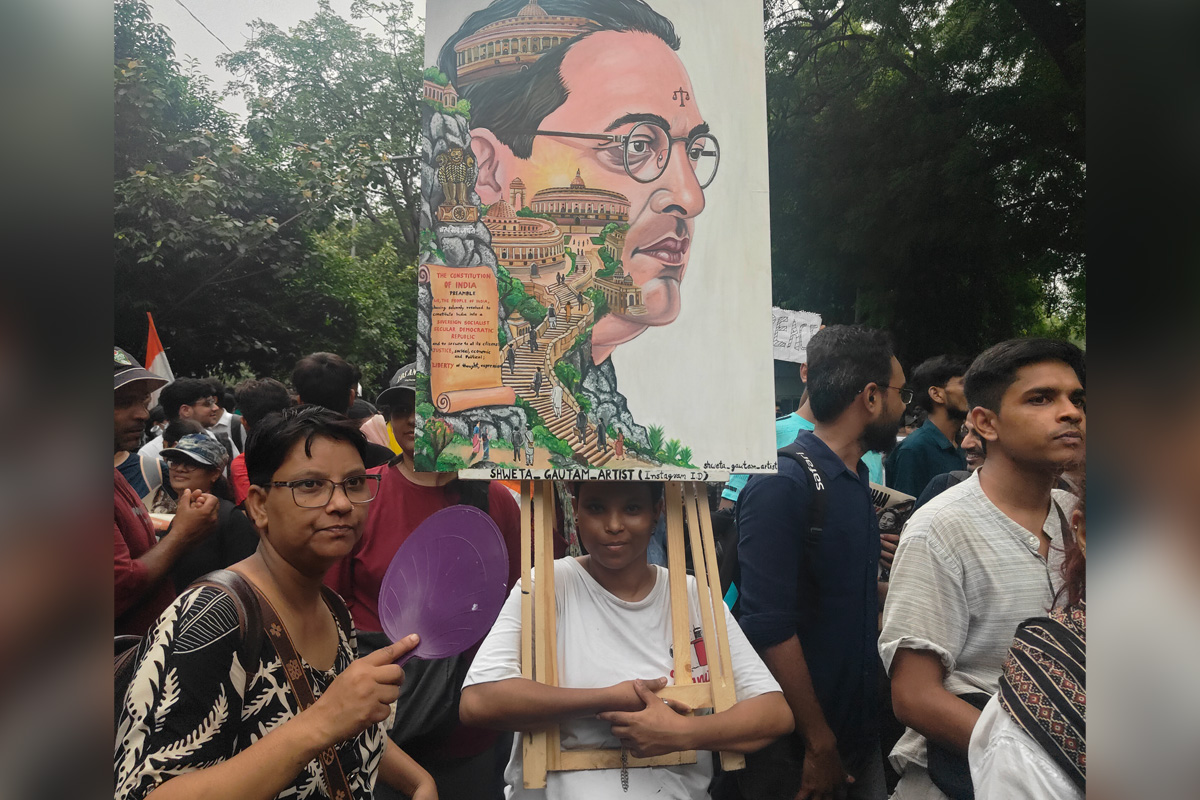
A protester holding a placard during the CJP protest against NEET-UG paper leak. (Photo | Kaushik Raj)

Synopsis: Words are mightier than the sword. More so in these days of the mobile internet. A remark made in a courtroom, a call from a balcony, a speech delivered to thousands or some key words from a poem can circle the globe within minutes. The feedback loops that amplify consequences are faster and more powerful than ever, as the Jantar Mantar protests proved.
I remember sitting in church recently, listening to a pastor speak from the Book of Proverbs. Two verses, in particular, stayed with me:
“Death and life are in the power of the tongue.”
“Reckless words pierce like a sword, but the tongue of the wise brings healing.”
At the time, they seemed like poetic warnings—abstract truths for a distant future. I did not fully grasp their weight until I watched the events of the past few months unfold in our country.
By now, everyone knows how India’s Chief Justice, in a moment of apparent frustration, reportedly likened unemployed youth to “cockroaches.” A word, once spoken, cannot be withdrawn. What if all cockroaches come together? Abhijeet Dipke had asked in response.
Come together they did, as, within days, the “Cockroach Janta Party” was born—not as a political organisation but as a defiant, satirical movement. Young Indians reclaimed the insult as a badge of honour. Protests erupted across the nation over unemployment and exam-leak scandals, channelling the anger the remark had ignited and demanding the resignation of the Minister of Education. Dharmendra Pradhan and the government finally had to bow down.
The proverb proved true: reckless words had pierced like a sword.
Let me explain the “butterfly effect”, which was coined by meteorologist Edward Lorenz in the 1960s. While running a weather simulation, he rounded a decimal from .506127 to .506—a seemingly trivial change. To his astonishment, this tiny alteration produced vastly different weather patterns. His insight gave rise to the chaos theory: in certain systems, small variations in initial conditions amplify over time, making long-term prediction impossible.
I learnt during my time in the Centre for Development Studies that this principle extends beyond meteorology to economics, social movements and human societies. As Japanese economist Shigeru Ishikawa observed, small differences at the start—the initial conditions, for example, in how land is owned, how institutions are built, or in local culture—can shape a country’s path of development for generations. A small difference at the starting point can lead to vastly divergent trajectories.
The same is true of words. A single phrase, uttered at the right moment in the right context, can alter the course of history. The butterfly flaps its wings—and a storm follows.
Not all words are born of reflection. Some escape before they are examined—uttered in a moment of carelessness, frustration, or arrogance. These unthought words carry a peculiar danger: they emerge without the filter of forethought, yet their consequences can be swift and devastating.
Consider the case of the former French President Charles de Gaulle. In 1967, during a state visit to Canada, he unexpectedly cried out from a balcony in Montreal: “Vive le Québec libre!” (Long live free Quebec!). This impromptu flourish was immediately interpreted as official French endorsement of Quebec separatism. The fallout was profound: it severely damaged Franco-Canadian relations, galvanised the separatist movement for decades, and ignited a diplomatic crisis that outlasted De Gaulle himself. A spontaneous burst of rhetoric had become a geopolitical earthquake.
Closer to home—and to our own time—is the case of Pinarayi Vijayan, the Left Democratic Front leader in Kerala. In March 2026, as the state hurtled toward Assembly elections, Vijayan’s party had invested heavily in a carefully curated PR campaign highlighting his record and accessibility. Yet all this image-building unravelled in a single moment when, at a party convention, he was reported to have dismissively told a grassroots worker who dared to raise a question about infrastructure: “Go home and ask that question.”
The video went viral within hours. The remark—spoken in irritation and perceived as arrogant—came to be seen as the last straw, crystallising public resentment. When the votes were tallied, the LDF suffered a massive defeat, widely attributed in part to the Chief Minister’s perceived dismissiveness.
Both examples share a common pattern: words spoken without reflection, amplified by pre-existing grievances, triggering consequences far beyond anything their originators could have imagined.
In stark contrast stand reflective words—expressions born of deep contemplation, moral conviction and conscious awareness of their potential impact. Unlike unthought words, their butterfly effects are often slower but more lasting. They bring healing rather than harm.
Maulana Hasrat Mohani, a revolutionary poet and freedom fighter, coined the slogan “Inquilab Zindabad!” (Long Live the Revolution!) in 1921. It was not a casual cry but a deliberate call for total societal transformation—a vision for a world free from exploitation, class distinctions and communal divisions. Popularised by iconic revolutionaries like Bhagat Singh, the slogan became a timeless and universal symbol of resistance against injustice. It energised the Indian freedom struggle and transcended its original context, with its essence inspiring movements worldwide, most recently the 2024 July Revolution in Bangladesh and the recent Cockroach Janata Party protests at Jantar Mantar in 2026. These words, carefully chosen, continued to inspire generations.
Standing before the Lincoln Memorial in the USA, Martin Luther King Jr declared in a speech in 1963: “I have a dream.” He was reflecting his deep moral conviction that one day the USA would rise and live out the true meaning of the creed that all humans are created equal. These pithy words, crafted through years of theological study and moral wrestling, became the moral compass of the American Civil Rights Movement. The speech reshaped laws, attitudes and millions of lives across generations who dared to dream that dream.
Both examples show that reflective words generate butterfly effects that are slower to manifest but more enduring. They are like trees of life, nourishing and sustaining those who hear them.
In an age of instantaneous communication, the butterfly effect is accelerated and magnified. A remark made in a courtroom, a call from a balcony, a speech delivered to thousands or some key words from a poem can circle the globe within minutes. The feedback loops that amplify consequences are faster and more powerful than ever.
This places an extraordinary responsibility on all of us. Every word we utter enters a complex system of meaning, emotion and history. We may never know the full extent of its consequences.
The “cockroach” incident teaches us that even dismissive words can become transformative—though through pain and struggle. The examples of Maulana Hasrat Mohani and Martin Luther King remind us that with reflection, courage and moral clarity, words can become the foundations of a better world.
Perhaps the most profound insight from chaos theory is not that tiny causes produce massive effects, but that we are all, in our small ways, butterfly-wing flappers. The question is not whether our words will have consequences—they will—but what kind of consequences we wish to set in motion.
Do we speak carelessly, leaving history to interpret our meaning as it will? Or do we speak with the awareness that each word is a potential seed—for beauty or destruction, for justice or oppression, for connection or division?
The choice, as always, is ours. And the ripples will outlast us all.
Also Read:
‘It’s the economy, stupid’: The making of India’s Gen Z discontent
The timeless satire of C Northcote Parkinson and what it teaches about our work life today
Book Essay: “At the risk of being pedantic…?”
(Edited by R Rajesh Kumar.)



