


Published Jul 21, 2026 | 7:58 PM ⚊ Updated Aug 10, 2026 | 11:21 AM

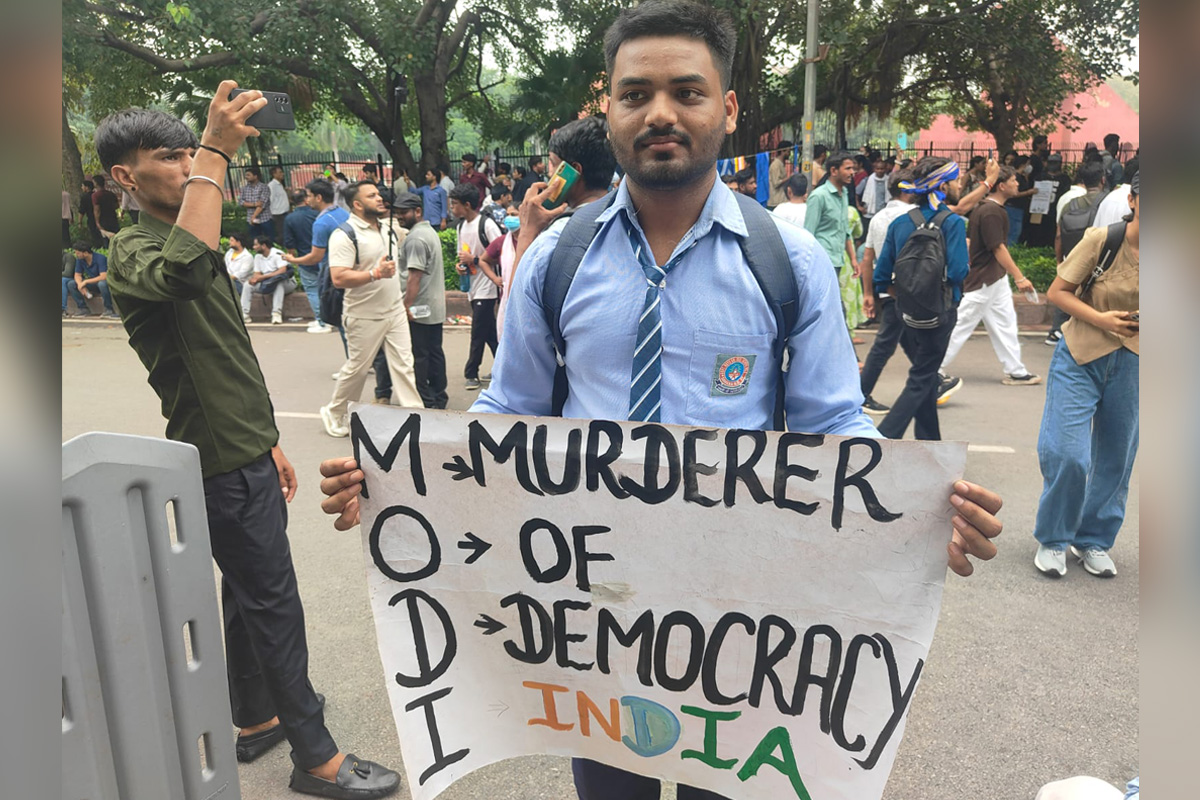
A protester holding a placard targeting Prime Minister Narendra Modi during the CJP protest against NEET-UG paper leak. (Photo | Kaushik Raj)

Synopsis: On 20 July, the might of the students rose at Jantar Mantar, raising issues that mattered and needed to be addressed. The Delhi Police tried to cow the protestors down with force. Even one of the reporters behind this story was not spared despite repeatedly showing his press card.
The difference was sharp. The grim-faced police personnel wielded batons, tear gas launchers, and even automatic rifles. They had been deployed almost all over Lutyens’s Delhi with a cold purpose. The police’s khaki stood shoulder to shoulder with the blue fatigues of the Quick Response Team.
Security vehicles, too, had rolled out onto the roads. Anti-riot Vajras stood still, looking menacingly over a sea of humanity that had descended on Jantar Mantar and spilt onto the nearby roads and the stretch leading to Parliament, the high temple of the world’s largest democracy.
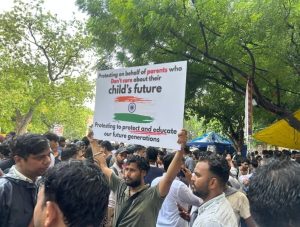
People attended the rally on their own, for themselves, for future generations, and for a better India.
The sea of humanity made the sharp difference. They came in different hues. Mostly young, boys and girls, and even a few children. Many of them carried books, posters, and placards. Rucksacks slung over their backs gave away their identity as students. They appeared resolute, enthusiastic, and hopeful. Their weapons were the words, or akshara, meaning imperishable — not batons, or rifles.
The stage had been set. The standoff had begun. The might of the Union Government had been pitted against the aspiration-fuelled resoluteness of the Indian youth, armed with books and the determination to live the life of their choice rather than survive. They required quality education to live the life they wanted.
The location provided further irony; the rest of the day would prove. “Jantar Mantar” means “instruments for measuring the harmony of the heavens.”
On Monday, 20 July, harmony looked the other way as the authorities clamped prohibitory orders across the New Delhi district, and deployed security personnel — reports said they numbered 5,000 — to prevent the Cockroach Janata Party (CJP) from taking out its Parliament march, or Chalo Sansad.
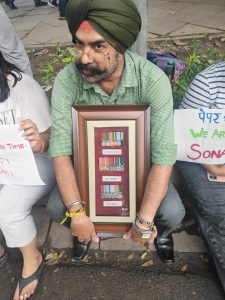
People from far and near, of all genders, caste, class and creed, arrived at Jantar Mantar to participate in the agitation.
The march was meant to press for the resignation of Union Education Minister Dharmendra Pradhan for what the CJP termed inept handling of NEET (UG)-2026. The CBSE fiasco was a reason, too. The party, still in its infancy, also called for reforming the examination process in the country’s education sector.
Founded two months ago — 16 May to be specific — as the immediate offshoot of an off-the-cuff remark by Chief Justice Surya Kant, the CJP had succeeded in achieving the kind of support that would embarrass all major Opposition parties.
“There are already parasites of society who attack the system, and you want to join hands with them? There are youngsters like cockroaches; they don’t get any employment, and they don’t have any place in a profession. Some of them become media, some of them become social media, some of them become RTI activists, some of them become other activists, and they start attacking everyone… And you people file contempt petitions,” Chief Justice Surya Kant had said a day ago, in an apparent reference to a contempt plea filed in the Supreme Court against the Delhi High Court for the delay in designation of senior advocate title.
The Chief Justice later issued a clarification. He said his remarks had been misquoted and that he was specifically criticising individuals who had entered the “legal, media, social media, and other noble professions,” using fake degrees. He added that he held India’s youth in very high regard.
Abhijeet Dipke, founding president of the Cockroach Janata Party.
The justification, however, came after digital communications strategist Abhijeet Dipke posted on social media, wondering, “What if all cockroaches came together?”
Those six words appealed directly to Gen Z and the Millennials. Those words echoed across the country like a silent roar.
Dipke-founded CJP soon found its first major issue in the NEET paper leak controversy, which pushed several distressed students to die by suicide. CJP’s stand on paper leaks and student suicides forced many people, including established political parties, to take the movement more seriously.
Curiosity mounted when Dipke announced that he would return to India on 6 June, after completing his studies at Boston University. His supporters welcomed him as a large contingent of media watched him emerge from Delhi’s IGI Airport holding a book on Dr BR Ambedkar.
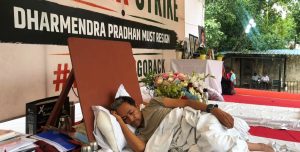
Sonam Wangchuk on hunger strike at Jantar Mantar. (abhijeet_dipke/ X)
The same day, CJP held its first protest at Jantar Mantar. It also called for nationwide demonstrations highlighting paper leaks and student suicides. It caught the attention of educator and climate activist Sonam Wangchuk and youngsters across cities including Bengaluru, Hyderabad, and Jaipur.
After days of hunger strike by Wangchuk and students from the left-leaning All India Students’ Association (AISA), CJP called for a march to Parliament. Two days before the march, Delhi police forcibly shifted Wangchuk to Safdarjung Hospital, leading to a large show of solidarity at Jantar Mantar.
Several public figures, including actors Prakash Raj, Shabana Azmi and several Members of Parliament, stayed with the protesters late into the night amid fears of a police crackdown.
Gen Z and the Millennials heeded Dipke’s call for the march. Those six words Dipke had posted on 16 May had kept them ready. They came to Delhi in swarms — like cockroaches. They knew there would be trouble clad in khaki and blue fatigues waiting for them. They didn’t care.
As early as 8 am on 20 July, even before the west-leaning shadows of the ancient observatory could shorten, the police had shut the metro stations closest to Jantar Mantar — the designated protest site in New Delhi.
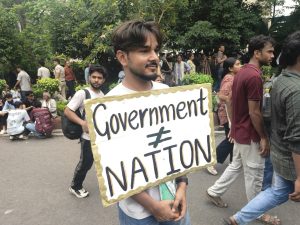
Words spoke louder than action.
Despite the Metro zipping past the stations without halting and the many barricades the police had set up, youngsters poured into the scene, mostly on foot after alighting at the nearest point where vehicles could drop them off. The crowd was so huge that the three-kilometre radius around Jantar Mantar was swarming with people.
Various estimates suggested that nearly one lakh people had gathered across the area. The entire stretch of road connecting Jantar Mantar and Janpath was packed with protesters. Delhi Police had barricaded the Jantar Mantar protest site, but thousands of people were outside the barricades while thousands more were inside.
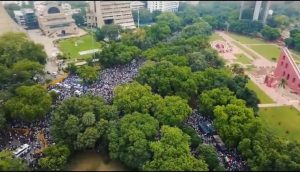
Various estimates suggested that nearly one lakh people gathered at Jantar Mantar and its nearby areas.(Screengrab)
Still, protesters came from all parts of the country, like a group of youngsters who huddled together, talking among themselves and watching others. One of them carried a portrait of Bhagat Singh; another clutched a book by BR Ambedkar. They hadn’t made many friends yet at the protest scene.
The youngsters were from Kannauj — India’s perfume capital — in BJP-ruled Uttar Pradesh. Their parents were unaware of their presence in New Delhi. They could not tell their parents before rushing to the national capital.
“Our democracy is in danger,” one of them explained why had rushed to New Delhi.
“People are struggling. There is no freedom to protest. I, myself, was a victim of police excesses when I stood up for my rights in my university,” he told South First, his voice calm but resolute.
His friends quietly listened and nodded in approval.
The air was electric, exuberant and energetic. The CJP had asked protesters to bring either the tricolour or a book.
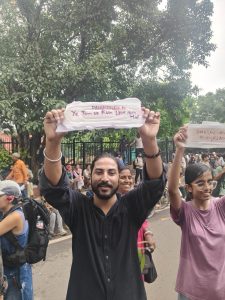
Many of the posters directed at the government were highly creative.
Most of the protesters held the Constitution of India. Slogans such as “Jai Bhim,” “Jab Jab Modi Darta Hai, Police Ko Aage Karta Hai” (Whenever Modi is scared, he puts the police in front), “Inquilab Zindabad,” “Vande Mataram,” and “Bharat Mata Ki Jai,” cut through the morning air, building up the tempo.
Another young hand held a beacon of knowledge and inspiration: a copy of Bhagat Singh’s Jail Diary. He had come from Kanpur. The youngster said he was a victim of paper leaks in Uttar Pradesh government-conducted recruitment exams.
“There is dictatorship in the country. If I did not speak up today, I will have to blame myself for the rest of my life,” he explained his travel that covered around 475 kilometres.
Unlike at political rallies, where a personality cult stands head and shoulders above the cause, posters of Dipke or any other CJP leader were absent from the crowd. A few people carried posters of Sonam Wangchuk, but the overwhelming majority of posters featured the Constitution of India, Bhagat Singh, and Dr BR Ambedkar.
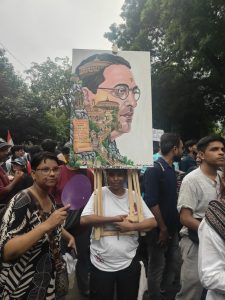
Posters of Dipke or any other CJP leader were absent at the rally.
The books people carried were also mostly copies of the Constitution, books on Bhagat Singh, and books by or about Dr Ambedkar. There were no CJP posters either. After all, cockroaches seldom prefer to be seen.
Many of the posters directed at the government were highly creative. One read, “Government is not equal to the nation.” One protester had written on a sanitary pad, “Pradhan, even this leaks less than you.” Another carried a poster that read, “1984 was not supposed to be an instruction manual.”
None of the people South First spoke to mentioned CJP, Dipke, or Wangchuk. Almost every protester expressed the same concerns that democracy was under threat, paper leaks had become rampant, the country was slipping towards dictatorship, and the government was refusing to listen to students.
A Class 12 student held a poster, expanding “M.O.D.I:” “Modi Means Murderer of Democracy in India.”
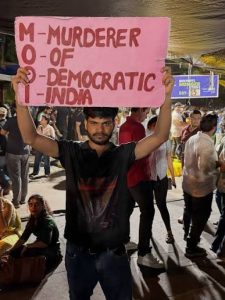
A protester holding a placard targeting Prime Minister Narendra Modi during the CJP protest. (Instagram)
He was confident when asked what had drawn him to the protest. “I had been reading about the situation in the country for a long time. People like us needed a space to express our dissent, and this seemed like the perfect occasion. That’s why I came,” the boy said, still holding the poster over his head.
The crowd did not comprise youngsters alone. Many others had come to stand in solidarity with the youngsters, India’s future.
Ravindra Kumar, now in his sixties, had come for his daughters and nieces. “In 2024, my daughter scored good marks in NEET. We thought she would get admitted to a good medical college. But then, the examination was cancelled. Our entire family went into depression. I am here on behalf of my daughters,” he said with newfound confidence.
For another protester, the CJP’s rally was the first rally she had ever attended. She told a larger truth that affects every Indian household. “Education is an issue that affects every household. That’s why you can see so many people here. Moreover, this government has become dictatorial. What disturbed us the most was that they are not even listening to us. Our anger has been building up over the years.”
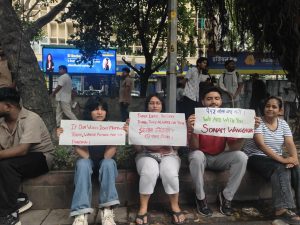
Many people turned up at the rally because education affects every household.
The pent-up anger has found a vent. Now, after all those years she had spent in silence. It has collectively erupted.
She had not come for herself. “I do not have any government examinations to take. I am an engineer. I came here for my country, for the future generations who will have to live with this dysfunctional education system.”
Dysfunctional! She was specific and aligned with the CJP’s thought.
Around 9:30 am, protesters at the designated protest site pressed against the heavy, yellow, steel, meshed police barricades, each weighing around 60 kilograms, in an attempt to start the march towards Parliament. The police contingent on the other side pushed back.
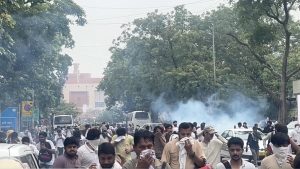
Protesters run from tear gas near Parliament during the ‘Sansad Chalo’ march in New Delhi on Monday.
A collective roar of excitement rendered the air as the first set of barricades came down.
The protesters soon reached the crossroads leading towards Parliament Street. One road led to the designated protest site, another to Parliament Street, and the third towards Janpath. Thousands of protesters gathered at the intersection, trying to move towards Parliament Street.
The police erected massive barricades across the road. Batons came down heavily on anyone who tried to push through them. The protesters retreated, recouped and tried again. Every ten minutes, the sequence repeated.
Protesters would surge towards Parliament Street, trying to cross or climb over the barricades. The police would respond with batons and physical force, pushing them back. The crowd would then run back together in panic. In the chaos, many people were injured while running, and many lost their slippers.
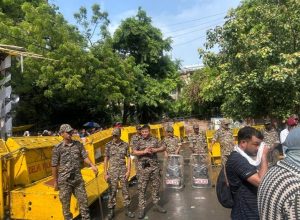
Reports said an estimated 5,000 police personnel were deployed in Delhi on Monday.
The standoff continued for quite some time.
Around 12 noon, the police realised that the crowd was too huge for them \to control at the intersection. They shifted the barricades farther along Parliament Street. This allowed protesters to move a little farther before being stopped again.
People sat in groups, talking on the road. They fanned one another to escape the heat.
Among them was Amit Kumar, a sleep-deprived autorickshaw driver. He had been driving his three-wheeler throughout the previous night to reach the protest site early. Losing a day’s earnings was not his concern. “Forget one day, I am ready to sacrifice even ten days’ earnings to save democracy.”
He then spoke about secularism, enshrined in the Constitution. “Why does this government want a Hindu Rashtra? This country belongs to people of every religion. We are fed up with all this,” he said, adding that he had come for the future of his children.
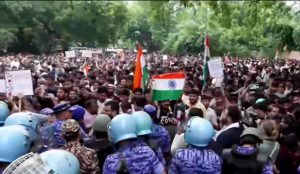
A protester said the government should be afraid of the people and not the other way round.
A group of students flocked together. “We chose the humanities when this government came to power in 2014, and since then the humanities have been on a continuous decline.”
Were they scared of what was happening around? “The government should be afraid of the people, not the other way around,” the students mentioned what a democracy should be.
By 2 pm, some protesters had managed to reach close to Parliament. Fuming tear gas shells welcomed them.
Meanwhile, when thousands of protesters realised that the police would not allow them to proceed through Parliament Street, they turned back from the intersection. They marched towards the Janpath Crossing — and the vehicular traffic came to a complete halt, a rarity in recent years.
At the Jantar Mantar intersection, traffic was usually unaffected during other protests, as protesters remained confined to the designated protest area. But the crowd on Monday was so huge that the designated area could not contain them.
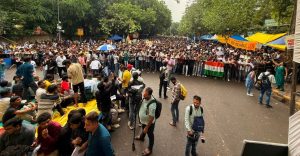
Protest at Jantar Mantar (CJP/ X)
In Central Delhi’s Connaught Place, there were only protesters. For the first time in recent years, a protest brought traffic across Central Delhi to a halt.
At the Janpath Crossing, protesters raised slogans demanding Dharmendra Pradhan’s resignation and condemning the Delhi Police “brutality”. Central Park in Connaught Place was packed with people. Police repeatedly resorted to baton charges and firing tear gas shells.
By around 4 pm, tear gas filled the air. People’s eyes and noses were burning. Many had covered their faces with handkerchiefs, while others had bandages on their bodies after sustaining injuries.
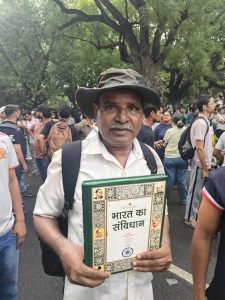
Several people attended the rally since they felt it was their duty to the nation.
Yet despite repeated baton charges, not a single protester was willing to go home. People remained scattered across the Connaught Place area. The anger against the government has grown manifold — so did their resolve to fight.
South First spoke to a first-time protester, affected by tear gas. “There is no freedom left in this country. Democracy has been murdered,” he sniffled while wiping his nose with the back of his palm.
Around 5 pm, the police used batons on protesters along the road leading from the Janpath Crossing towards Rajiv Chowk Metro Station Gate No. 6 in an attempt to disperse the crowd.
A woman there looked distressed. “Now Narendra Modi should also resign. He is at the helm of affairs. We are only demanding our rights, and look at how his police are treating us,” the tear gas has turned her eyes red.
From around 5 pm onwards, the police intensified their efforts to clear the Janpath Crossing. Protesters were chased away with batons. Vehicular traffic through the intersection was restored by around 5:30 pm.
South First asked Delhi Police Joint Commissioner Madhur Verma on camera why the police had used tear gas and force against the protesters. He did not respond.
Around 5:30 pm, after the protesters had been dispersed from the Janpath Crossing, riot police reached Rajiv Chowk Metro Station Gate No. 6 and began forcing protesters into the station entrance. The entrance quickly became overcrowded. Panic spread. As protesters tried to push their way out, police batons fell on them with force.
During the chaos, one of the reporters covering the event for South First was also assaulted. He repeatedly showed his press card and shouted out his identity. The police wouldn’t listen to him on that manic Monday.
Soon afterwards, the police asked all protesters over loudspeakers to return peacefully to their homes. They also warned that the police would otherwise use appropriate force.
Towards dusk, the protesters had formally been dispersed from major flashpoints, but the movement itself showed no signs of ending.
Even after hours of baton charges, firing tear gas shells and repeated attempts by the police to clear the streets, the anger among protesters remained visible.
For many of those who had travelled from across the country, the day was about far more than a march to Parliament. It was about what they described as a fight to defend democracy, demand accountability for repeated paper leaks, and seek justice for students.
A defiant CJP announced that its sit-in at Jantar Mantar would continue until its demands were met.
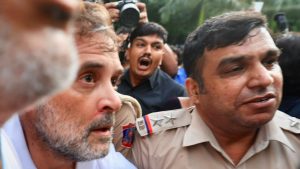
Rahul Gandhi is seen with a nosebleed while being dragged away by Delhi Police.
Meanwhile, on 21 July, Leader of the Opposition in the Lok Sabha, Rahul Gandhi, also launched a protest in support of the students at Prime Minister Narendra Modi’s residence on Lok Kalyan Marg.
He termed the attack on students brutal, and demanded the resignations of Prime Minister Modi and Home Minister Amit Shah.



