

Published Jul 19, 2026 | 12:00 PM ⚊ Updated Jul 19, 2026 | 12:00 PM

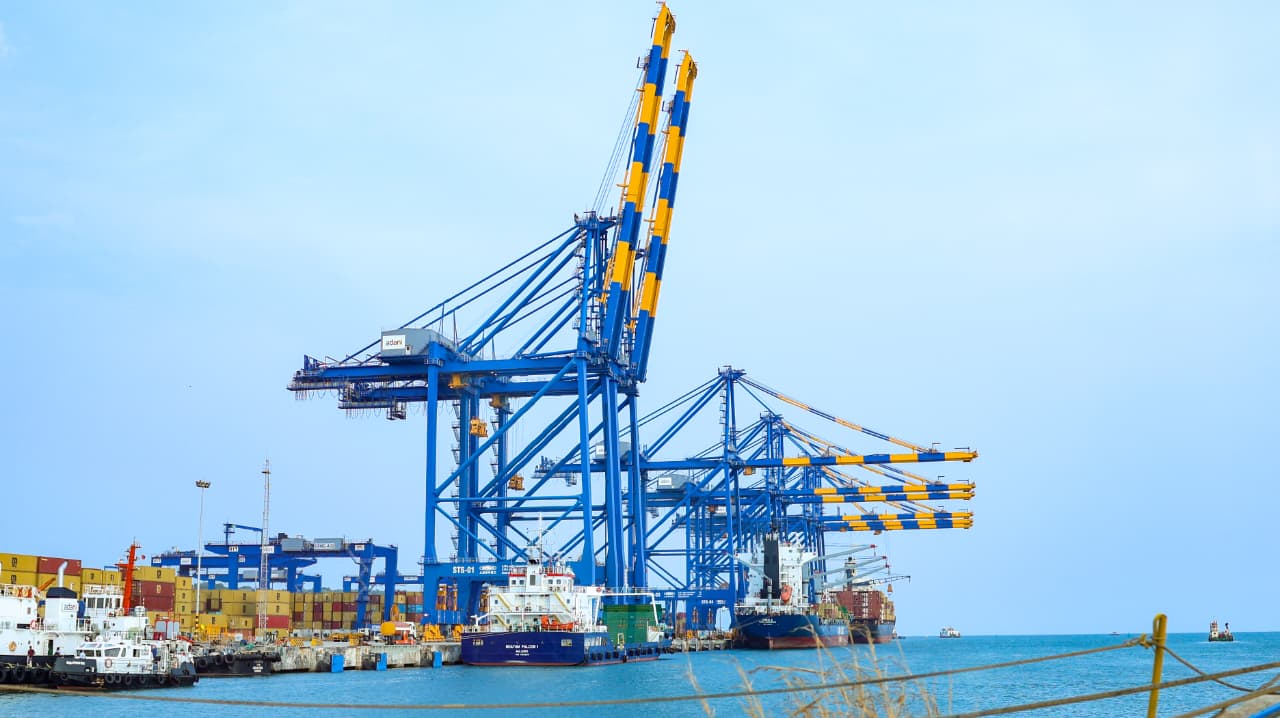
Vizhinjam International Seaport, Thiruvananthapuram

Synopsis: The political battle over the Vizhinjam International Seaport has shifted from the proposed sale of Adani’s stake to a far more consequential question: did the 2024 settlement agreement hand the concessionaire a ₹219-crore favour, or did it rescue a strategically vital project while extracting long-term gains for Kerala? The controversy hinges on two sharply competing narratives: one portraying the settlement as an expensive concession, the other arguing it was a calculated compromise that ended a multi-crore arbitration, protected the state’s future revenues and kept the port project alive.
The war of words over the Vizhinjam International Seaport project is showing no signs of abating. The latest salvo came from Kerala Chief Minister VD Satheesan, who sought to turn the spotlight back on the previous Pinarayi Vijayan-led Left government.
Accusing it of striking a favourable deal with the concessionaire, Adani Vizhinjam Port Private Limited (AVPPL), the chief minister alleged that the earlier administration extended the project’s timelines, lengthened the concession period and gave up the state’s claim to ₹219 crore. He took the political battle over the port to a new phase.
Satheesan was targeting the changes made in the Concession Agreement based on the Settlement Agreement, made in 2024.
Port Department officials, however, insisted that the settlement could not be described as a “waiver”. They argued that it was part of a negotiated package that extracted significant concessions from the concessionaire.
As the slugfest continued, a simple yet contentious question has found its way to the centre: was the 2024 settlement agreement led to a massive loss to the state exchequer, or was it a pragmatic “win-win” move to save a project teetering on the brink of collapse?
Also Read: Kerala footed the bill—the coast is paying the rest
The chief minister’s latest salvo targeted the decisions regarding the delays in the project’s implementation.
Defending the government’s decision to constitute an Empowered Committee to examine Adani Group’s proposal to divest its 49% stake in AVPPL to MSC on 15 July, Satheesan said the original concession agreement had envisaged completion of the project in 2019.
Since that deadline could not be met, the previous LDF government extended the Scheduled Completion Date by five years and increased the concession period from 40 years to 45 years.
He also alleged that compensation of around ₹219 crore, which the government was entitled to recover for the delay, was effectively given up and that even the payment of ₹43 crore was adjusted against the viability support fund.
He argued that the original concession agreement stipulated a daily penalty of ₹12 lakh for delays, and the state was theoretically eligible to claim ₹219 crore.
Targeting the Left, he said, “Was this not a deal? Even after considering floods and Covid, a five-year exemption was granted. Is it after making such deals that they have come forward to lecture others?.
He further added that the state would decide on the stake sale only after receiving the Empowered Committee’s report.
The optics seemed clear for the chief minister: the state was entitled to a hefty penalty, but instead, it chose to celebrate completion without actually holding the company accountable.
He mentioned a pattern of questionable deal-making that the current government has been forced to navigate.
Also Read: MSC’s TiL acquires 49 percent stake in Adani-operated terminal
The ₹219-crore figure cited in the political debate has its origin in Clause 4.3 of the original concession agreement dealing with damages for delay.
The clause states that if the concessionaire failed to fulfil the prescribed conditions within the stipulated period, and the delay was not attributable to the Authority (state government) or to force majeure, the concessionaire would have to pay damages at the rate of 0.3% of the Performance Security for each day of delay.
The Performance Security under the agreement was fixed at ₹120 crore. At 0.3%, the daily damage worked out to ₹36 lakh.
However, the agreement also imposed a ceiling: the damages could not exceed the value of the Bid Security. Once that limit was reached, the Authority could, at its discretion, terminate the agreement.
Officials pointed out that the maximum liability under the clause was therefore not open-ended and depended on the contractual cap.
Also Read: Adani-MSC deal rekindles questions over who benefits from Vizhinjam
In 2024, both the government (then the LDF government) and the concessionaire were locked in a stalemate.
AVPPL had invoked arbitration, claiming a five-year extension and seeking a staggering ₹3,855 crore in compensation, including ₹1,227 crore towards additional equity support. It cited factors like the Ockhi cyclone, the 2018 floods, the COVID-19 pandemic, and local protests—factors often classified as force majeure.
The state retaliated with a counterclaim of ₹911 crore, through Vizhinjam International Seaport Limited (VISL), for construction delays while opposing both the extension of the completion date and the concession period.
Port Department officials pointed out that rather than letting the project wither in years of litigation, the parties opted for a settlement.
According to presentations made before the 44th meeting of the Empowered Committee in July 2024, the government concluded that resolving the dispute was in the larger interest of completing what it described as a strategically important infrastructure project for both Kerala and the country.
The Empowered Committee, comprising representatives from the Department of Economic Affairs, Department of Expenditure (both part of the Union Finance Ministry), NITI Aayog, Ministry of Ports, Shipping and Waterways and state government officials, considered the changes in the Concession Agreement based on the Settlement Agreement in the project.
Also Read: CM Satheesan reminds Adani Ports of Clause 5.3 in Vizhinjam agreement
The settlement agreement formally condoned the five-year delay and shifted the Scheduled Completion Date from 3 December 2019 to 3 December 2024.
Consequently, the concession period was extended by five years, from 40 years to 45 years.
Government officials argued that it was not an extension of the operating rights beyond what had originally been promised. They pointed out that the original concession consisted of four years of construction and 36 years of operation.
Since construction itself was delayed by five years, the concession period was correspondingly extended to preserve the original 36-year operating period, rather than increasing it.
The settlement also contained financial provisions.
An amount of ₹219 crore was withheld from the equity support payable by the government as a Commitment Fee Deposit.
Of this, ₹175.2 crore was to be released only after completion of the second and third phases of the project in 2028, while ₹43.8 crore would continue to remain with the government.
Officials contended that the ₹219 crore was not waived but converted into a conditional financial commitment linked to future project milestones.
The chief secretary was then tasked with ensuring compliance with all conditions of the settlement and signing the tripartite agreement after withdrawal of the arbitration proceedings.
Also Read: Vizhinjam and the sea change in Kerala’s future
Officials maintained that the settlement secured several conditions that were missing in the concessionaire’s original demands.
The revenue-sharing schedule, they noted, was left untouched.
Although the Scheduled Completion Date was extended by five years, the concessionaire agreed that premium sharing with the state would still commence on 3 December 2034—the 15th anniversary of the original Scheduled Completion Date under the concession agreement.
Officials argued that it effectively shortened the period available to the concessionaire before revenue sharing begins, making the arrangement more stringent than what would ordinarily follow from a five-year extension.
Another significant change is related to capacity expansion.
Under the original concession agreement, the port’s capacity augmentation could have been completed as late as December 2045, the 30th anniversary of the appointed date.
The settlement, however, required the concessionaire to complete the augmentation by 2028, advancing the obligation by nearly 17 years.
Officials also underlined that despite the prolonged delay, the government (then the Left government) had not agreed to revise the project’s Total Project Cost, which continued to remain at ₹4,089 crore.
Any escalation resulting from the five-year delay—estimated by officials at 30% to 40% of the project cost—would have to be borne entirely by the concessionaire.
The political argument centred on whether the then Left government surrendered a contractual claim worth ₹219 crore and granted a five-year extension that favoured the concessionaire.
Some Port Department officials argued against viewing the settlement in isolation from the arbitration, where both parties had substantial monetary claims against each other.
They asserted that the agreement avoided prolonged litigation, secured withdrawal of AVPPL’s ₹3,855-crore claim, preserved the state’s revenue-sharing timeline, accelerated future expansion obligations and ensured that the cost overrun remained with the private developer.
It was also pointed out that the state had actually tightened the screws in areas that matter more than the immediate penalty.
The biggest victory, according to project proponents, was that the premium sharing start date remains fixed at 3 December 2034. By not pushing back the date, the then-government ensured that its future revenue stream remained intact despite the construction delay.
Furthermore, the concessionaire had agreed to “prepone [sic]” capacity augmentation—meeting the target by 2028 — 17 years before the scheduled capacity augmentation date.
According to a VISL official, the ₹219 crore at the centre of the controversy has been interpreted in two different ways.
VISL is a special-purpose government vehicle, acting as an implementing agency for the development of the Vizhinjam seaport
While Satheesan projected it as a penalty that the state had forfeited, officials associated with the project insisted that the amount was never written off but was dealt with through a different financial arrangement under the 2024 settlement agreement.
They pointed out that the settlement did not require the company to deposit ₹219 crore with the government as a conventional penalty.
Instead, the agreement provided that an equivalent amount would be retained from the government’s future equity support to the concessionaire.
The money was parked as a “Commitment Fee Deposit”, to be linked to the company’s fulfilment of construction milestones under the revised project schedule.
In effect, the state did not receive ₹219 crore as fresh revenue. At the same time, the company also did not walk away without any financial consequence, since an equivalent amount that would otherwise have flowed to it from the government’s equity support was withheld under the settlement mechanism.
This is where the disagreement lies.
The chief minister viewed the decision as a waiver of the contractual damages that the company ought to have paid for the delay. Those involved in negotiating the settlement maintained that the arrangement was designed to keep the project on track by creating a financial commitment tied to performance, instead of entering into what could have been years of litigation over the penalty clause.
An official who was part of the negotiations in forming the 2024 settlement agreement said, “Is it a loss or a win? The answer depends on which lens you use. If you view the project through the narrow window of ‘damages owed for delays,’ the decision to settle looks like a concession. If you view it through the broader lens of a multi-decade infrastructure project, the settlement agreement avoided a legal quagmire that could have halted the port for a decade.”
(Edited by Majnu Babu).



