

Published May 29, 2026 | 10:28 AM ⚊ Updated May 29, 2026 | 10:28 AM

Health spending as a share of GDP also declined, from 3.83 percent to 3.37 percent.

Synopsis: India’s household healthcare spending rose significantly in 2022-23 even as government health expenditure declined, according to National Health Accounts data. Out-of-pocket expenditure increased by ₹26,375 crore nationally, with southern states such as Kerala and Andhra Pradesh continuing to record high household burdens despite existing public insurance and welfare schemes.
India’s per capita out-of-pocket expenditure (OOPE) on healthcare increased from ₹2,600 in 2021-22 to ₹2,767 in 2022-23, according to National Health Accounts (NHA) estimates released by the Union Health Ministry on 27 May.
The increase came in a year when total government health expenditure declined, shifting a larger share of healthcare costs onto households.
The report showed that Total Health Expenditure (THE) fell from ₹9,04,461 crore in 2021-22 to ₹8,81,359 crore in 2022-23. Health spending as a share of GDP also declined, from 3.83 percent to 3.37 percent.
Government Health Expenditure (GHE) saw an even steeper drop, falling from ₹4,34,163 crore to ₹3,85,332 crore, a reduction of nearly ₹49,000 crore in a single year. On a per capita basis, government spending declined from ₹3,169 to ₹2,786.
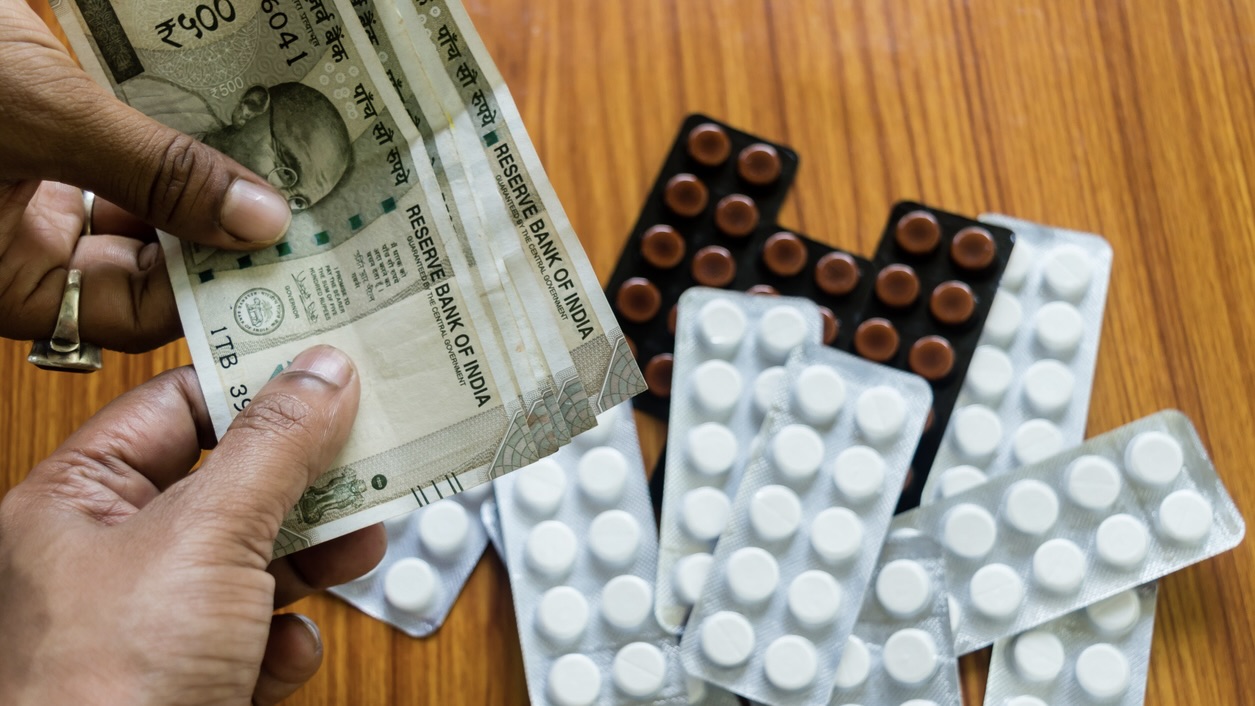
At the same time, household spending on healthcare continued to rise. Total OOPE increased by ₹26,375 crore, from ₹3,56,254 crore in 2021-22 to ₹3,82,629 crore in 2022-23. Its share in Total Health Expenditure also rose from 39.4 percent to 43.41 percent, indicating that households were bearing a growing share of healthcare costs directly.
Also Read: The world failed to reverse falling birth rates with cash. Andhra Pradesh still wants to try
For a family of four, annual out-of-pocket healthcare spending worked out to roughly ₹11,068 in 2022-23, nearly ₹923 a month on expenses not covered by insurance or public health schemes.
OOPE includes prescription medicines, diagnostic tests, consultation charges, transport, outpatient visits, and hospitalisation expenses not covered under insurance or government programmes. The burden is particularly significant for chronic illnesses such as diabetes, cardiovascular disease, and hypertension, which require long-term treatment and repeated medical visits.
Medicines continued to account for a substantial share of healthcare expenditure. Prescribed pharmaceuticals alone made up 17.55 percent of Current Health Expenditure (CHE), while pharmaceuticals overall accounted for 29.6 percent of total health spending in the country. Pharmacies accounted for 21.19 percent of CHE in 2022-23, up from 19.35 percent the previous year.
Meanwhile, the share of expenditure routed through government hospitals declined from 18.99 percent to 16.73 percent, while the share going to private hospitals increased from 26.96 percent to 30.83 percent.
Private health insurance covered only 9.19 percent of Total Health Expenditure. Most outpatient care, medicines, and diagnostic services remain outside the effective coverage of both public schemes and insurance products, leaving households to pay directly at the point of care.
The Union Health Ministry noted that expenditure under the Pradhan Mantri Jan Arogya Yojana (PM-JAY) more than doubled from ₹4,625 crore in 2021-22 to ₹9,328 crore in 2022-23. However, against total OOPE of ₹3,82,629 crore, PM-JAY spending still accounted for only a small share of overall household healthcare costs.
Also Read: Between sea and burial: The anthropology of death in Lakshadweep
Kerala continued to record the highest per capita Total Health Expenditure in the country at ₹13,116 in 2022-23, marginally lower than ₹13,343 in 2021-22, but still more than double the national average of ₹6,373.
The state also recorded one of the country’s highest household healthcare burdens. OOPE as a share of Total Health Expenditure rose from 59.1 percent in 2021-22 to 64 percent in 2022-23, the highest among southern states and well above the national average of 43.41 percent.
Per capita OOPE in Kerala reached ₹8,388 in 2022-23, translating to ₹33,552 annually for a family of four, or roughly ₹2,796 a month.
At the same time, government health expenditure per capita in the state declined from ₹4,338 to ₹3,592. For a four-member family, government-funded healthcare support fell from roughly ₹17,352 annually to ₹14,368.
Kerala also continued to allocate 4.5 percent of its Gross State Domestic Product (GSDP) to health expenditure, the highest share among southern states.
The state’s high healthcare spending is often linked to greater healthcare utilisation, an ageing population, and a larger burden of chronic disease. Longer life expectancy and greater reliance on specialist and private healthcare services also contribute to higher overall spending.
Karnataka recorded the lowest out-of-pocket burden among southern states despite an increase in household spending in 2022-23.
Per capita OOPE increased from ₹1,933 in 2021-22 to ₹2,049 in 2022-23, while OOPE as a share of Total Health Expenditure rose from 25.4 percent to 29.2 percent.
Government health expenditure per capita declined from ₹3,259 to ₹2,333 during the same period.
For a family of four, annual OOPE rose to ₹8,196 in 2022-23 from ₹7,732 the previous year. Despite the increase, Karnataka remained below the national average in household healthcare burden.
The lower OOPE share is often attributed to the wider reach of the Ayushman Bharat–Arogya Karnataka scheme, which provides broader hospital coverage across the state.
Also Read: Can a pandemic make healthcare stronger? Tamil Nadu’s maternity data says yes
Tamil Nadu continued to record one of the highest government shares in healthcare expenditure among southern states, even as household healthcare costs rose in 2022-23.
Government Health Expenditure (GHE) as a share of Total Health Expenditure declined from 51.7 percent in 2021-22 to 44.2 percent in 2022-23.
Over the same period, OOPE increased from 34.6 percent to 38.7 percent, while per capita OOPE rose from ₹2,280 to ₹2,448.
Per capita government health expenditure fell from ₹3,410 to ₹2,794.
For a family of four, annual out-of-pocket healthcare spending increased from ₹9,120 in 2021-22 to ₹9,792 in 2022-23.
Tamil Nadu’s public healthcare system, including the Tamil Nadu Medical Services Corporation (TNMSC), has historically played a significant role in reducing medicine-related expenditure through centralised procurement and free drug distribution across government facilities.
However, the 2022-23 data suggests that the state, too, experienced the broader national trend of declining public expenditure and rising household healthcare costs.
Telangana’s healthcare expenditure indicators remained broadly in line with the national average across both years.
Government Health Expenditure as a share of Total Health Expenditure declined from 46.2 percent in 2021-22 to 41.1 percent in 2022-23, while per capita government spending fell from ₹3,007 to ₹2,814.
At the same time, per capita OOPE increased from ₹2,449 to ₹2,697, a rise of ₹248 per person, among the steepest increases recorded in southern states.
For a family of four, annual household healthcare expenditure rose from ₹9,796 to ₹10,788 within a year.
The Aarogyasri scheme provides hospitalisation coverage for several listed conditions. However, outpatient care, medicines, and diagnostic costs continue to account for a large share of household healthcare expenditure.
Also Read: Study finds 4 out of 5 packaged biscuits in India contain palm oil and artificial flavours
Among southern states, Andhra Pradesh recorded one of the steepest increases in household healthcare burden between 2021-22 and 2022-23.
OOPE as a share of Total Health Expenditure increased from 52 percent to 59.6 percent, while per capita OOPE rose from ₹3,834 to ₹4,117.
For a family of four, annual out-of-pocket healthcare expenditure increased from ₹15,336 to ₹16,468.
Government Health Expenditure (GHE) as a share of Total Health Expenditure declined from 42.4 percent to 35.1 percent, the lowest among southern states in 2022-23.
Per capita government spending also fell from ₹3,129 to ₹2,425 during the year.
The Dr YSR Aarogyasri scheme primarily focuses on hospitalisation coverage for listed conditions, while outpatient consultations, medicines, and diagnostics remain significant sources of direct household expenditure.
Among major states, Uttar Pradesh recorded one of the country’s highest OOPE shares at 66.1 percent of Total Health Expenditure, exceeding even Kerala. Per capita OOPE in the state stood at ₹3,219 annually.
Bihar recorded the lowest per capita Total Health Expenditure at ₹2,189. Government and household contributions remained nearly equal at ₹1,056 and ₹1,043 respectively.
The Union Health Ministry highlighted that Government Health Expenditure as a share of Total Health Expenditure increased from 28.6 percent in 2013-14 to 43.7 percent in 2022-23. Over the same period, OOPE declined from 64.2 percent to 43.4 percent, while per capita government health expenditure increased from ₹1,042 to ₹2,786.
However, 2022-23 marked a reversal in some recent trends, with lower government spending, higher household expenditure, an increased private hospital share, and a decline in preventive healthcare spending.
Preventive care expenditure fell from 10.42 percent to 5.30 percent of Current Health Expenditure within a single year.
The NHA estimates suggest that while public investment in health has increased over the longer term, household spending continues to remain a major component of healthcare financing in India, particularly for outpatient care, medicines, diagnostics, and chronic disease management.



