
Published Aug 16, 2026 | 10:30 PM ⚊ Updated Aug 16, 2026 | 10:30 PM

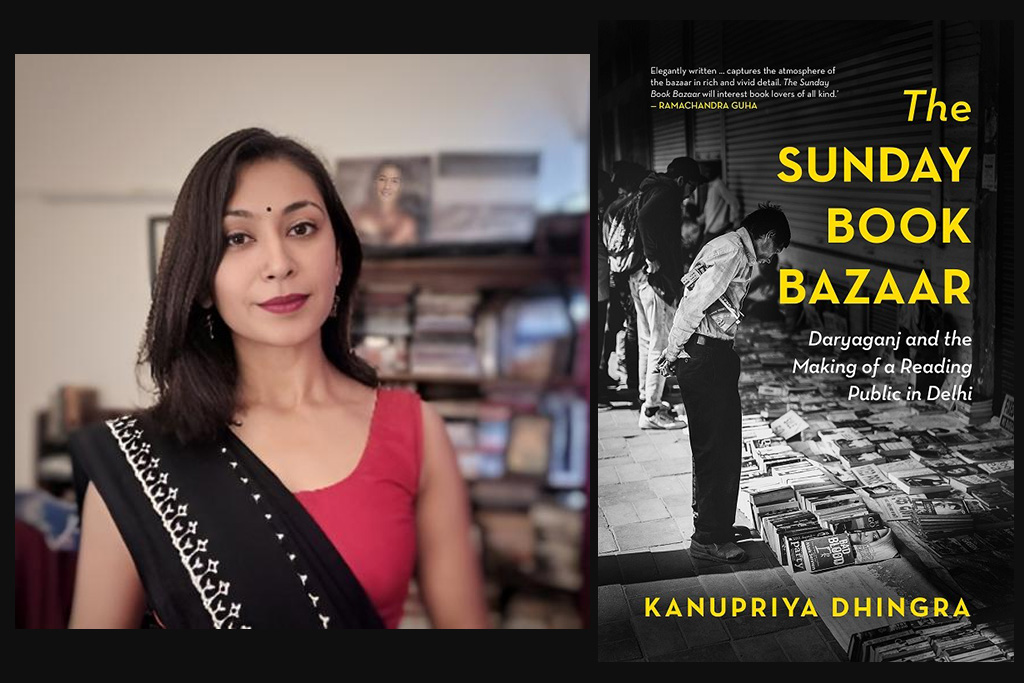
The author Kanupriya Dhingra and her book.

Synopsis: Kanupriya Dhingra’s study of the Daryaganj book market brings its booksellers to life and asks what happens to a city when the disorderly, spontaneous spaces where readers stumbled upon unexpected treasures disappear.
I have never learnt to enter a bookshop without first looking at the pavement. Some of my earliest ideas about books came not from orderly shelves but from piles lying on the ground, from booksellers seated behind them, from old paper mixed with dust and traffic, and from the excitement of finding something I had not come looking for. A bookshop tells you what it has; a pavement asks you what you are willing to discover. That difference quietly changes the experience of reading itself.
Kanupriya Dhingra’s The Sunday Book Bazaar: Daryaganj and the Making of a Reading Public in Delhi is, at one level, a study of Delhi’s famous Sunday book market. Yet while reading it, I kept travelling to other cities and other pavements: Patna, Banaras, Kolkata and Bengaluru. Daryaganj became part of a larger Indian geography of books, where reading is shaped not only by libraries and bookstores but also by streets, improvisation and chance.
My own memory of such a world begins in Patna, especially around Gandhi Maidan and near Patna Science College, where a bookseller named Bhushan became part of my education as a reader. You went looking for one book and often came away with another. Sometimes you knew only that you wanted a history book, a novel, an essay collection or an old university text. The bookseller understood this uncertainty. He was not merely selling a book; he was helping you discover what you might want to read.
This is one of the things Dhingra captures especially well. Her booksellers are not background figures; they are central actors in the making of the market. Their knowledge does not sit inside a database. It lives in memory, observation, conversation and experience. They know which editions are worth keeping, which books might sell, and which reader may be persuaded to take home something unexpected. In the second-hand book trade, this knowledge becomes a form of cultural capital.
Dhingra’s research, which grew out of her doctoral work at SOAS, combines ethnographic observation, oral histories and close attention to the market’s rhythms. She is interested not simply in the fact that Daryaganj existed, but in how it worked: how books arrived, how booksellers sorted them, how buyers searched, and how a Sunday pavement acquired the density of an institution without ever becoming one.
Kolkata’s College Street offers another version of this republic of books. There, books belong to the bloodstream of the city: in shops, narrow passages, pavements and conversations among students, teachers, booksellers and passers-by. A student searching for a textbook may leave with poetry; a professor looking for one text may find another. Such markets permit accidents because they do not insist that every reader arrive with a perfectly defined intention.
Banaras offered me a similar lesson. Around Lanka and towards Godowlia, books seemed woven into ordinary movement. One could be going somewhere else, notice a pile of books, stop, turn a few pages and forget the original destination. This power to interrupt the planned day is one of the great pleasures of a street book market.
Dhingra shows that Daryaganj was sustained by precisely such interruptions. Students, collectors, casual browsers and serious readers occupied the same public space. A student could arrive looking for an examination guide and encounter a novel. Someone searching for a known author might discover an unknown subject. The market’s cultural importance lay partly in this unpredictability.
This is where the old book market differs sharply from the digital marketplace. The algorithm remembers what you liked yesterday and suggests what you may like today. The pavement does not know your past preferences. It simply places something before you and asks you to look. The inconvenience is real, but so is the possibility of discovery.
The book becomes most compelling when it moves from the pleasure of browsing to the politics of public space. A pavement is usually imagined as a space through which people should move; the bookseller asks them to stop. The planner sees circulation, the bookseller sees congregation, and the reader sees possibility. Between these competing understandings of the city lies the tension that eventually transformed Daryaganj.
For decades, the Sunday bazaar existed in an uneasy relationship with the state. It was tolerated, regulated and occasionally challenged, but it remained part of Delhi’s cultural life. In 2019, as the city increasingly preferred order, cleanliness and regulated public space, the booksellers were moved from the historic Daryaganj footpaths to Mahila Haat.
The distance was not large, but the social shift was significant. A pavement permits accidental entry; a gated market requires a decision to enter. Daryaganj had depended on people who were not necessarily there to buy books. A passer-by could become a browser, and a browser could become a reader. Once the market moved into a more controlled space, something of that casual encounter changed.
Dhingra avoids turning this into a simple conflict between booksellers and administrators. Cities do need sanitation, traffic management and public order. Her larger question is harder: must urban order always be achieved by moving aside the spaces that do not fit neatly into official design? What happens when everything disorderly is treated as something to be cleaned up, regulated or displaced?
This is where the book moves beyond Daryaganj. It becomes a meditation on the modern Indian city and on who gets to occupy its public spaces. A city is not only its roads, flyovers, malls and corridors. It is also its temporary markets, tea stalls, street conversations and places where people stop without making an appointment to stop.
Bengaluru, where I now live, offers yet another variation through Church Street, where old and new books coexist within a contemporary book culture. The old book does not appear as an embarrassment from another age. It waits beside the new book for another reader. This coexistence suggests that a book need not be new to remain alive. It becomes new again when it enters another reader’s life.
This is the deeper story of the second-hand book. It is not merely a cheaper version of a new book. It has travelled through another life and may carry an inscription, a library stamp, an underlined sentence or a folded page. These traces remind us that reading is not isolated. Books move between people, and in moving they create relationships that last longer than the transactions through which they were bought.
The Daryaganj Sunday Book Bazaar mattered not simply because it sold books, but because it allowed people to encounter books without first belonging to the world of books. A student with limited money could enter. A curious passer-by could stop. Someone searching for a textbook could discover literature. A collector could find an obscure edition. The market created a reading public by making books available in the middle of everyday life.
This makes The Sunday Book Bazaar more than an urban history or an ethnography of an informal market. Dhingra is writing about the relationship between books and public life. She asks what kind of city allows reading to happen spontaneously, and what kind of city makes every cultural encounter dependent on a designated institution.
Today, digital platforms remember our choices and predict future ones. The experience is convenient, but convenience can narrow the field of possibility. When a machine repeatedly tells us what we might like, we risk forgetting the pleasure of finding something we had never imagined liking.
A book begins with an author, but its public life begins after publication. It passes through printers, publishers, distributors and booksellers before entering somebody’s room. It is read, underlined, lent, forgotten, rediscovered and perhaps sold again. Then someone picks it up from a pavement pile, and the book begins another life.
This afterlife of the book is what I thought about most while reading Dhingra. Her immediate subject is Daryaganj, but her larger subject is the journey of books through Indian cities and the people who keep that journey alive: booksellers, students, collectors, browsers, pavements and streets.
I began by saying that I have never learnt to enter a bookshop without first looking at the pavement. I realise now that the pavement taught me something the conventional bookstore never could: books are not only objects waiting to be purchased. They are encounters waiting to happen.
That encounter may happen in a library, in a bookstore, in front of Patna Science College, in College Street, on the streets of Banaras, among the old and new books of Church Street, or on a Sunday morning in Daryaganj.
The pavement may change, the bookseller may move, and the city may build a wall where once there was an open road. But as long as readers are willing to stop, look through old books and allow themselves to be surprised, the republic of letters will continue to find its unexpected streets.
Book: The Sunday Book Bazaar: Daryaganj and the Making of a Reading Public in Delhi
Author: Kanupriya Dhingra
Publisher: Speaking Tiger Books
Pages: 336
Price: ₹599
Also Read:
On Cinema: Political films from All The President’s Men to The Manchurian Candidate
Let us abolish this executioner’s system: Varavara Rao makes the case as only he can
Withdrawing consent: Gene Sharp and the Cockroach uprising



