
Published Aug 02, 2026 | 12:08 PM ⚊ Updated Aug 02, 2026 | 12:08 PM


Synopsis: Film critics keep naming them. But what are the great political films of all time? Here’s a two-part dive with the earliest film seeing Jimmy Stewart heading to Washington in 1939.
Classification into categories, genres and lists, even of creative endeavours, is common. Where applied to political cinema, it is often a lazy way to think about often nuanced and complex issues.
A look at film critics’ tabulations of best films of this type is revealing. Is a film about a politician or a campaign automatically political? If a character articulates a political view, does that make the film eligible? These obstacles necessitate unhelpful sub-categories: political drama, political thriller, political comedy or satire.
Arranging works into familiar formats implies common elements, which, if met somehow, qualifies as success. The unwelcome simplification gives comfort but often impedes assessment of merits.
There are other problems as categorisation feigns an objective standard for subjective opinions. Most art is imperfect, which is its charm. Pablo Picasso’s Les Demoiselles d’Avignon is flawed. The artist refused to show it for decades as he regarded it as incomplete despite its crucial role in the cubist evolution. As Jorge Luis Borges wrote in his 1951 essay Kafka and his Precursors: “Every writer creates his own precursors”. Each artistic work is inevitably defined by what came before and comes after as well as external events. Cinema shares these qualities. Works, some with admirable qualities, gain or lose political significance over time.
Director Alan J Pakula’s 1976 All The President’s Men is frequently cited as an important political film. It is, in reality, a documentary about two journalists (Bob Woodward and Carl Bernstein played by Robert Redford and Dustin Hoffman) investigating the Watergate scandal that brought down President Richard Nixon. It is a faithful exposition of journalistic craft as it once existed. Dialogue-heavy (as much of the film is people talking or arguing), it is unusual in depicting the boring work that good reporting entails. Its fame derives from Watergate itself, whose excesses are now routinely exceeded.
Primary Colours, made by director Mike Nichols in 1998, is a thinly disguised look, based on Joe Klein’s novel, at Bill Clinton’s 1992 presidential campaign focusing on revelations about his extramarital sexual affairs. Busy (there are multiple sub-plots), like President’s Men, it relies on known facts about the now-deified Clinton. It is ultimately about human weaknesses—a man’s self-destructive behaviour and his wife’s choice to remain loyal to a flawed husband, hiding her own ambitions behind an unconvincing fidelity to his fictitious beliefs.
The film has its moments, including an amusing turn by Billy Bob Thornton as a fictionalised James Carville, Adrien Lester’s Henry Burton as the grandson of a civil rights leader, and Mykelti Williamson’s black man speaking in an illiteracy class of the pain of being unable to read. Primary Colours’ most telling political scene comes when John Travolta’s Clinton appears late at a union rally and shows a seemingly sincere solidarity with workers. He does not promise to save their jobs but only to do all that he can for them. The moment of candour and empathy lies at the heart of what made Clinton an attractive and, at times, an effective politician.
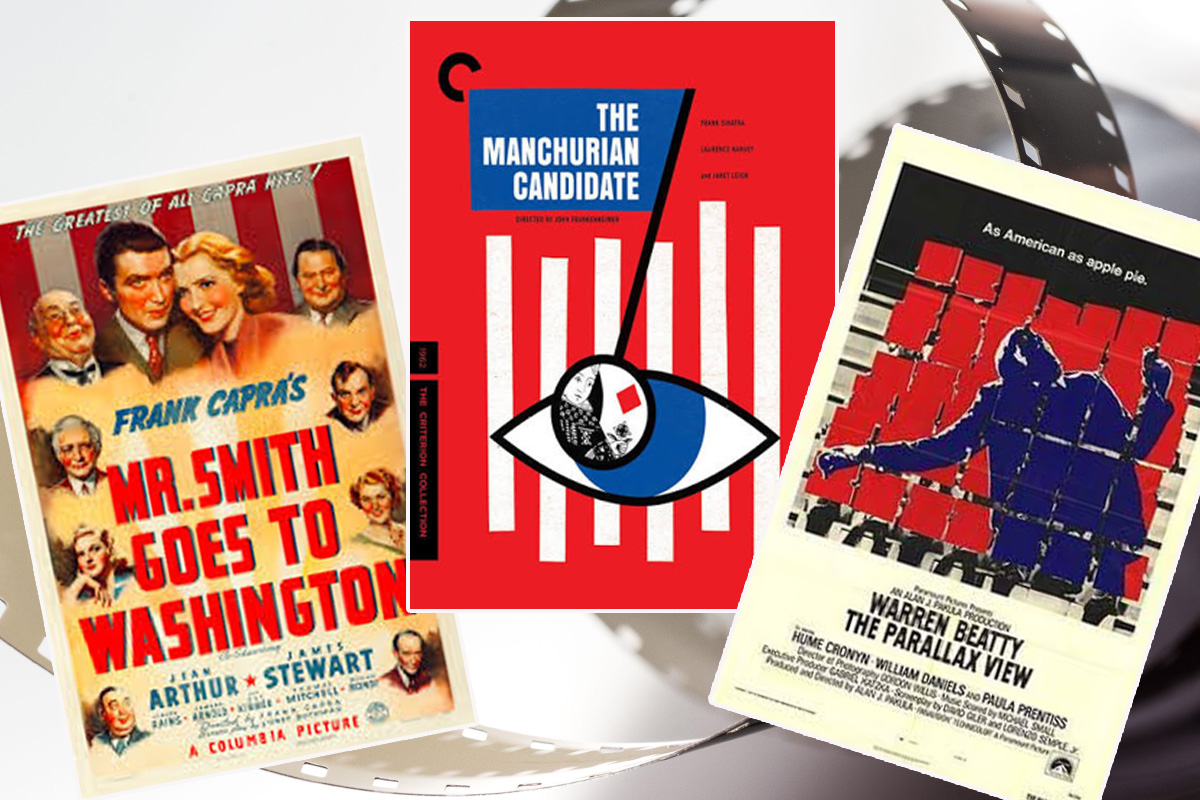
Frank Capra’s Mr Smith Goes to Washington is an idealist’s journey into predictable teary disillusion.
Jimmy Stewart, then the American everyman, is Mr Smith, leader of the Scout-like Boy Rangers, who takes on Washington corruption after being appointed to replace a dead US Senator. The mawkish plot is simplistic. Its central complaint is that Washington has sold its soul to vested interests and no longer serves its citizens, something that probably was not a surprise in 1939, when the film was released, and certainly is accepted today.
Despite cinema’s most notable filibuster scene (who knew that bad acting could be so watchable?) Jean Arthur’s Congressional staffer and Claude Rains’s duplicitous Senator Joseph Paine steal the show. While now an overrated ‘classic’, it lacks the subtlety and range of Capra’s best work such as It’s A Wonderful Life.
In 1972’s The Candidate, Robert Redford plays Bill McKay, a handsome (it would be difficult for him to play anything else without straining the capabilities of makeup), clean-cut young progressive, running for a Senate seat. Assuming he cannot win, McKay speaks the truth to the electorate. Gaining unexpected momentum, he learns the essentials of political success—spinning facts and flexible positions. Having captivated voters with his honesty and idealism, he proceeds to sell them and himself out.
Director Michael Ritchie traces the usual script of surrendering to ambition and being overwhelmed by image management. “What do we do now?”, the film’s famous last line, speaks to an obvious truism of politics: the primacy of power, not its purpose.
Parallax View (1974), Three Days of the Condor (1975), and The Manchurian Candidate (1962) seem to be delivering political messages but are, in fact, thrillers.
Parallax View, also directed by Alan Pakula, follows the fatal trajectory of reporter Joe Frady investigating the murder of a prominent senator and presidential hopeful. Noticing the mysterious deaths of every eyewitness, he traces the event to the mysterious Parallax Corporation, seemingly an undercover covert government operation. Well-acted, especially by Warren Beatty in the title role, and beautifully filmed by Gordon Willis, it is a taut and precise film undermined by its well-telegraphed logic.
Three Days of the Condor, directed by Sydney Pollack, is a rote thriller that fails to transcend its starting sequence in which a team of hitmen enters a clandestine spy agency office and murders the entire staff. The hero Robert Redford (seemingly a perennial figure in political cinema) survives as he is out to lunch. A credibility-straining romance between the leading man and Faye Dunaway dominates the film’s rather flimsy plot. Its dramatic tension comes mainly from the threat to Redford as he is being hunted and the bloodless, matter-of-fact dialogue about death and other “contingency plans”. There are excellent performances by Max von Sydow, an assassin, Cliff Robertson, a bureaucrat, and a deliciously demented John Houseman, a security functionary.
John Frankenheimer’s The Manchurian Candidate exploits fears of communist infiltration of the US government during the McCarthy years. The plot revolves around two characters, played by Frank Sinatra and Laurence Harvey, captured and brainwashed by the Chinese and returned to American society awaiting action using a buried hypnotic suggestion by their enemy controller to turn them into assassins.
The opening sequence shows a group of captured American combat infantrymen being brainwashed. The controller demonstrates his power by having one man cheerfully strangle his colleague. The plot’s occasional implausibility is covered by some notable acting: James Gregory’s hen-pecked Senator (who cannot remember how many communists there are in government) and Angela Lansbury’s poisonous turn as his scheming and ruthless wife. At one point, she rasps at her son played by Harvey: “Raymond, why do you always have to look as if your head were about to come to a point?” Frank Sinatra as the star is wooden and his romance with Janet Leigh is a distraction. The recent remake is weak and lacks the compelling drive of the original.
Parallax View, Three Days of the Condor, and Manchurian Candidate dally but never really embrace the labyrinthine political conspiracies they allude to. They are creatures of the post-war period where Cold War paranoia and disillusionment were widespread, in part driven by the fear of nuclear war and several political assassinations. They convey the feeling that an unaccountable state could and would do anything, something which gives the films a contemporary relevance.
Some lists of political cinema include the 1976 film Taxi Driver, arguably Martin Scorsese’s best work. Despite an unconvincing plot and especially an incredulous ending, it revolves around the mesmerising performance, improvised in part, of Robert de Niro, easily his best, as Travis Bickle.
The film traces the descent into his personal nightmare and maze of contradictions. Michael Chapman’s cinematography captures a seedy New York that is mostly gone. Excellent supporting performances, especially by Cybill Shepherd (as a political campaign worker) and Jodie Foster (as the terrifyingly precocious underage prostitute who Bickle sets out to ‘save’) underpin the film. Rather than political themes, Taxi Driver is an exploration of rejection, alienation and the familiar, much-covered disordered side of America.
English filmmaker Ken Loach’s considerable body of work exemplifies the difficulty of genres. His films—Riff-Raff (1991), My Name Is Joe (1998), I, Daniel Blake (2016), Sorry We Missed You (2019)—repeatedly deal with social issues like labour practices, immigration, poverty, class, and exclusion. His work’s political credentials rely on many of his films having been banned or excluded from festivals or showings because of Loach’s well-known positions, especially on Palestinian statehood and ill-treatment.
Influenced by Italian neo-realism, especially Vittorio De Sica’s Bicycle Thieves (1948), Loach’s work is focused on ordinary people and their relationships, where the broader political environment provides a backdrop to the personal dramas. His didactic views, irrespective of whether you agree, make the films propagandist in intent, seeking to engineer required change.
That is not to say that many of these works aren’t fine films. It is just that they are less political than the label suggests.
Also Read:
Withdrawing consent: Gene Sharp and the Cockroach uprising
Book Essay: “At the risk of being pedantic…?”
Gift Siromoney, Indian polymath who used AI concepts in the 80s to solve historical mysteries
Pyotr Ilyich Tchaikovsky: The Glass Child turned genius who transformed classical music
(Satyajit Das is a former banker and author of numerous technical works on derivatives and several general titles: Traders, Guns & Money: Knowns and Unknowns in the Dazzling World of Derivatives (2006 and 2010), Extreme Money: The Masters of the Universe and the Cult of Risk (2011) and A Banquet of Consequence – Reloaded (2016 and 2021). His latest book: The Everything Bubble: A Guide to the New Age of Financial Speculation and Phantom Wealth will be released in 2027. He has also written on ecotourism – In Search of the Pangolin (2006) (with Jade Novakovic) and Wild Quests: Journeys into Ecotourism and the Future for Animals (2024). This is being co-published with nakedcapitalism.com).
(Edited by R Rajesh Kumar.)



