
Published Jul 29, 2026 | 8:00 AM ⚊ Updated Jul 29, 2026 | 12:25 PM


Synopsis: An author who detailed 198 methods of non-violent action 53 years ago and deserves to be known better made lasting observations that the Jantar Mantar protests once again brought to the fore.
I recently wrote about the weight of words—how a single careless remark by India’s Chief Justice, likening unemployed youth to “cockroaches,” set off a chain of events far beyond anything he could have intended. Within days, young Indians had turned the insult into a badge of honour, calling themselves the “Cockroach Janta Party.” Protests spread. An education minister resigned. A small, thoughtless word had become, in the language of chaos theory, a butterfly’s wing-flap that grew into a storm.
But watching videos of the movement more closely, I found myself thinking less about the chaos theory and more about someone I had cursorily read in my youth, when I first began working with small-scale fishing communities in Kerala: The American political science scholar Gene Sharp.
Sharp spent much of his life studying how ordinary people, without weapons or armies, have brought down or bent powerful regimes. His central insight was disarmingly simple. Rulers, however powerful they appear, do not hold power on their own. Their power rests on the daily cooperation of everyone beneath them—officials who carry out orders, citizens who pay their taxes, workers who show up to work, crowds who stay quiet.
Sharp argued that this cooperation is not fixed. It can be withdrawn. And when enough people withdraw it, at the same time, even the most entrenched authority finds it has very little to stand on.
In 1973, Sharp catalogued this idea into something like a what-to-do manual: 198 Methods of Nonviolent Action in his book The Politics of Nonviolent Action. It grew out of his doctoral thesis at Oxford. It contained a list of concrete, everyday tactics through which people have historically withdrawn their cooperation. Strikes. Boycotts. Mock funerals. Renaming things. Wearing symbols. Sit-ins. Go-slows. Satire aimed at the powerful.
None of these requires an army or a party machine. Many require nothing more than a shared understanding, spreading person to person, that today is the day we stop playing along.
This is what struck me about the cockroach movement. Until that remark, young Indians facing unemployment, exam-paper leaks and a government many see as increasingly unaccountable had, on the whole, gone on cooperating—filling out forms, waiting in queues, writing exams, keeping their frustration private.
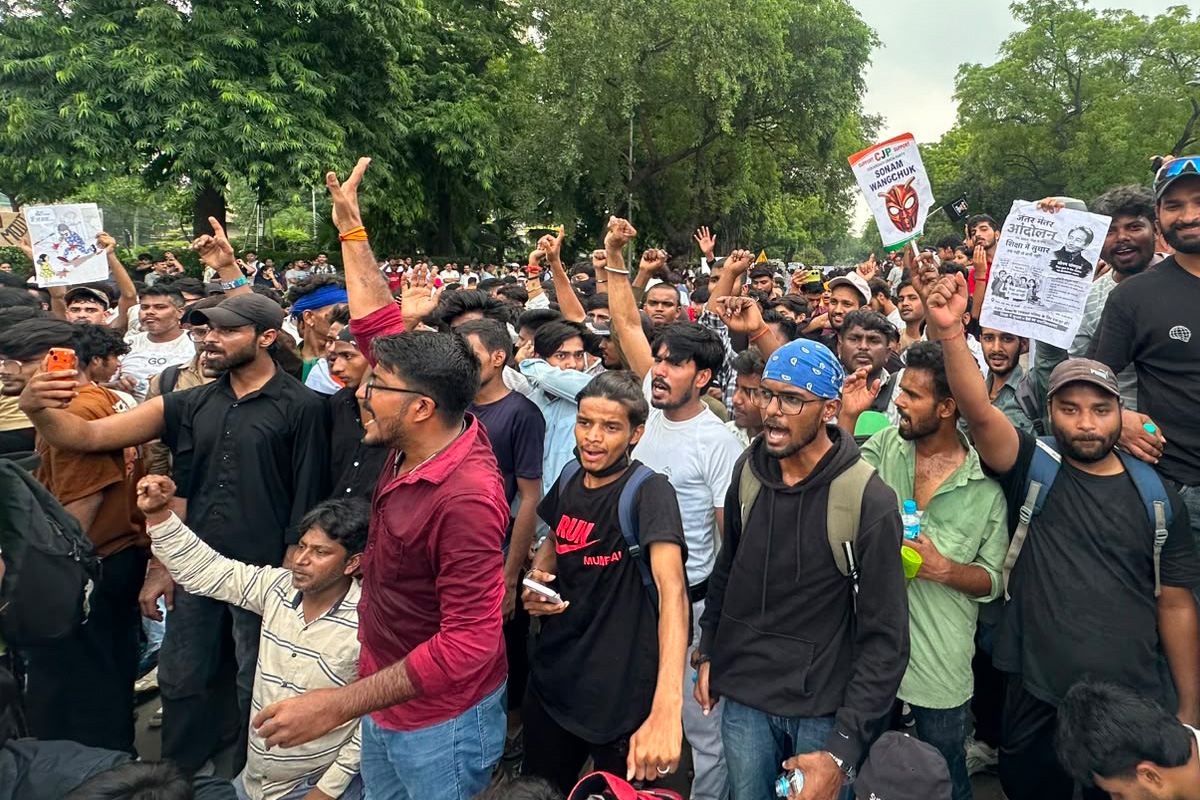
Then, almost overnight, thousands of small, seemingly uncoordinated acts of refusal appeared at once. A student turns an insult into a nickname and posts it online. A group prints it on a t-shirt. A crowd gathers at Jantar Mantar. Others simply stop pretending things are fine, and say so, loudly, in public.
None of it was ordered from above. But all of it rhymed.
That is exactly the pattern Sharp described. What looks, from the outside, like spontaneous chaos is often many people independently reaching the same quiet decision—to stop cooperating—and finding, to their own surprise, that they were not alone. This seemed very evident at Jantar Mantar and on the streets around.
The Chief Justice’s remark did not create that decision. It only gave it a name and a moment to gather around. The butterfly effect and Sharp’s theory of power are, in this sense, describing the same event from two different angles: one asks how a small cause grows large, the other asks why, once it does, the old order finds itself standing on nothing.
I mention Sharp here mainly because I think he deserves to be better known outside academic and activist circles, especially now.
His most accessible book is a short pamphlet, From Dictatorship to Democracy. I came across it in Myanmar, while working with a group of NGO activists during the brief democratic interregnum experienced by that country in 2011-15. It has been translated into several languages and used from Serbia to Egypt to Sudan.
Perhaps our Gen Z digital experts could translate Sharp’s methods into their own digital equivalents—a website instead of a printed pamphlet, an online petition instead of a paper one—and surely dream up far more creative tools than a 75-year-old like me ever could. Using the internet well will not change what Sharp described; it will only shorten the fuse.
Whatever new form they take, his methods were never a call to arms. They are closer to a field guide—practical, unsentimental, and built on a single, hopeful premise: that obedience is a choice, made fresh every day, and that ordinary people, simply by choosing differently and together, still hold more power than they usually believe.
Also Read:
The timeless satire of C Northcote Parkinson and what it teaches about our work life today
Vizhinjam tango: Kerala footed the bill—the coast is paying the rest
The licence to kill: How corruption at Kerala’s RTOs is fuelling a road safety catastrophe
(Edited by R Rajesh Kumar.)



