
Published Aug 12, 2026 | 11:58 AM ⚊ Updated Aug 12, 2026 | 12:25 PM

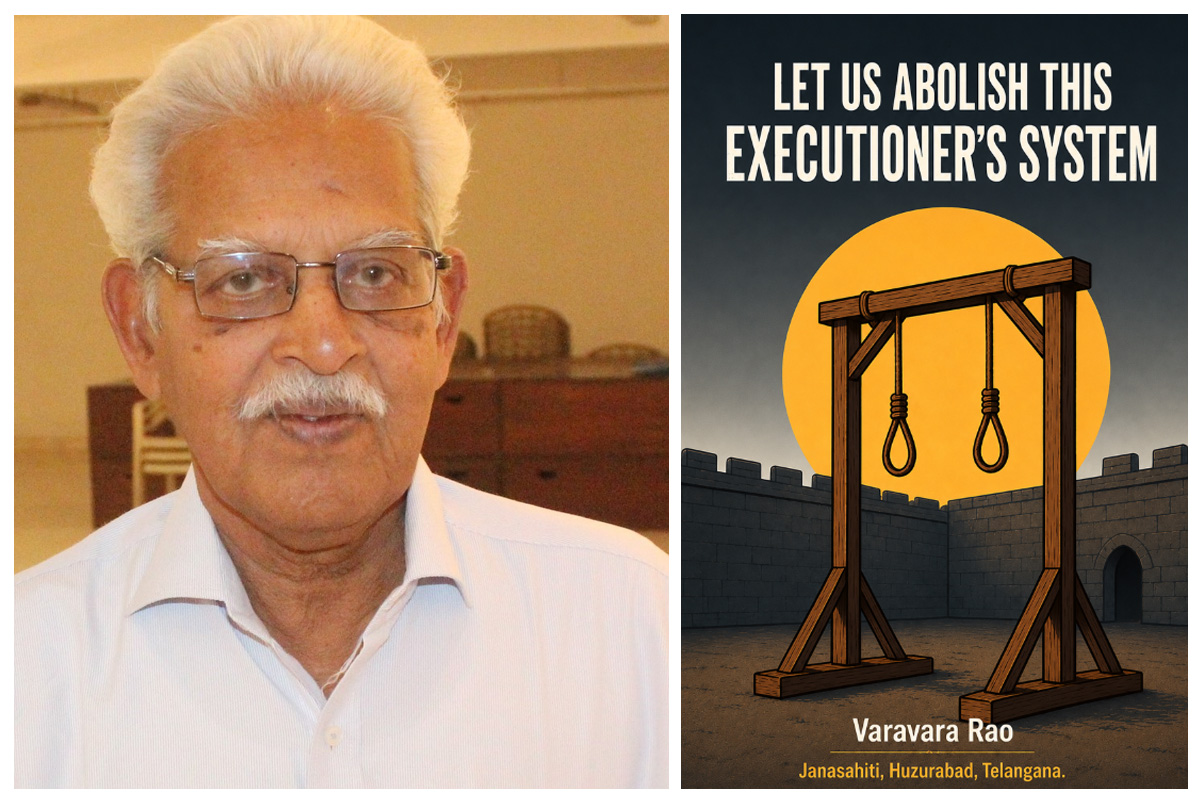
Varavara Rao and his book.

Synopsis: Through his account of the lives and deaths of Bhumaiah and Kishta Goud, Varavara Rao crafts his memorial to two men executed during the Emergency while also penning a passionate manifesto for the abolition of the death penalty. Stirring figures like Sri Sri and the author’s own vivid memories light up the narrative.
Death. All of us who live have to embrace it in the end.
But how should it arrive? Should the state and the law have the right to take a life? Is capital punishment a barbaric relic to which these institutions, meant to be hallowed, continue to cling?
Increasingly, nations across the world believe so.
In fact, on December 16, 2020, the United Nations General Assembly passed a resolution calling for a moratorium on the use of the death penalty. One hundred and twenty-three countries voted in favour. India was among the 38 countries that opposed.
In the US, another country that voted against the resolution, the Supreme Court in Furman v Georgia in 1972 struck down the death penalty statutes existing then, though the punishment made a comeback four years later.
Justice William O Douglas, during that famous judgment, recalled what Warden Lewis E Lawes, credited with transforming the notorious Sing Sing prison, had to say: “Not only does capital punishment fail in its justification, but no punishment could be invented with so many inherent defects. It is an unequal punishment in the way it is applied to the rich and to the poor.”
Justice Potter Stewart, in a separate concurring opinion, termed the death penalty “cruel and unusual in the same way that being struck by lightning is cruel and unusual”, highlighting how fickle it can be.
Nobel laureate Albert Camus had earlier argued why capital punishment should never have made its way into the law books.
“Retaliation is related to nature and instinct, not to law. Law, by definition, cannot obey the same rules as nature. If murder is in the nature of man, the law is not intended to imitate or reproduce that nature. It is intended to correct it,” he wrote in the Reflections on the Guillotine.
These thoughts came to mind while reading Let us abolish this executioner’s system by the revolutionary Telugu poet and writer Varavara Rao.
The book brings together essays, diary jottings and a poem reflecting on the “ordinary, yet extraordinary” lives of Kosuganti Bhumaiah and Gunnala Kishta Goud.
Varavara Rao, who was in prison with the two men and met them, talks of how “they had no powerful friends — only their convictions, their courage, and the dispossessed for whom they chose to live and struggle”. He also terms “their deaths as among the gravest violations of natural rights committed during the Emergency,” before making his central argument: “Yet this is not merely a matter of Emergency history. The gallows have never been simply an instrument of punishment. From Spartacus (71 BCE) to Sacco and Vanzetti (1927), from Bhagat Singh, Rajguru, and Sukhdev (1931) to the Kayyur comrades (1943), the gallows have always signified a declaration of power — the state’s ultimate claim over the lives of those who dare to challenge the existing order. No state, however constituted, should possess that power.”
Bhumaiah hailed from the Jangam priestly clan while Kishta Goud was from the toddy-tapping caste, though he never went into the profession. Both had witnessed considerable oppression and were inspired to join the Communist revolutionaries after their involvement in the Telangana Peasant Armed Struggle and the wider Communist movement.
As the book notes, Bhumaiah was sentenced to death for killing Lachhu Patel of Ginnedari village and Kishta Goud for killing Bodikunta Mallaiah, former Police Patel of Perkapalli village.
It was not that everyone powerful had turned their back on them. Political leaders like Atal Bihari Vajpayee, George Fernandes and Jayaprakash Narayan argued on their behalf and against the death penalty. Internationally, they had support from such world-renowned figures as Jean-Paul Sartre, Noam Chomsky, and Tariq Ali.
KA Abbas and the French journalist Laurence Lifschultz wrote in support in national and international publications. Varavara Rao and the revolutionary poet Sri Sri, both luminaries in their own right, were among their many supporters in the home state of Andhra.
The two men were spared the noose on two occasions—on November 26, 1974 and again on May 11, 1975.
Their final appeal for mercy came before Justice VR Krishna Iyer in the Supreme Court.
Justice Iyer summed up how RK Garg, the lawyer of Bhumaiah and Kishta Goud, had argued that theirs was “a politically motivated offence committed by the two frustrated men who were disenchanted by the die-hard injustice of massive suffering and suppression”.
The judge observed in his judgment that “Not raw ferocity but warm humanity is the real heart of law”. Yet he dismissed the appeal on October 3, 1975, noting that “these great facts cannot deflect us from our constitutional duty not to interfere where we have no jurisdiction. We accordingly dismiss the special leave petition.”
Justice Iyer suggested that the prisoners urge the President to pardon them by making the appeal they had presented in court while reminding India’s first citizen that the sword of Damocles had been hanging over their heads for over four years.
President Fakhruddin Ali Ahmed and Prime Minister Indira Gandhi, however, refused to budge. This despite Communist leader and Rajya Sabha MP Bhupesh Gupta meeting the President on the morning of November 30, 1975 and imploring him to pardon the two men. On December 1, 1975, the execution was carried out.
The hangings of Bhumaiah and Kishta Goud would be the penultimate executions in the Andhra region. Only Nambi Kishtappa was hanged after that, at the Rajahmundry Central Prison in February 1976.
Varavara Rao, as readers would have noticed earlier, is impassioned in his defence of the two men and categorical in his demand for the abolition of the death penalty. He appeals at the start of the book that December 1 be observed “as a Day of Struggle for the Abolition of the Death Penalty in India.” He argues that this would be our “commitment to a world in which the dispossessed are not hanged for demanding what belongs to them.”
The title of the first section, How many times must the same man be hanged for the state to satisfy its vengeance?, captures the nub of his argument and the depth of his sympathies. He writes in a language of memory that is evocative and empathetic. The many characters who people the age come alive, as does the time period. There are fascinating nuggets like how Mrinal Sen’s film Mrigayaa (The Royal Hunt, 1976) was inspired by Bhumaiah and Kishta Goud.
The second section is made up of pages from Varavara Rao’s diary and draws us closer to the story of the two men.
A memorable title, The secret the beheaded head whispered from the gallows, kicks off the third section that is dedicated to Sri Sri. The fervour, genius and character of the great Telugu poet, for whom Bhumaiah and Kishta Goud were “earth and sky”, are etched with firm strokes. Sri Sri’s revolutionary poetry is linked to Rao’s own memories and to the larger discussion on the dispossessed and the state’s power over life and death.
A minor quibble is that the translators could have made some of the terms friendlier for the uninitiated instead of signposting them for later in the chapter endnotes. I was also left wondering whether the sections might have worked better in a different sequence.
That said, the 74-page booklet has enough riches to offer and sees one of India’s most empathetic thinkers make a powerful argument against the death penalty. The booklet is both a memorial to Bhumaiah and Kishta Goud and a manifesto for ending the death penalty once and for all.
Also Read:
Withdrawing consent: Gene Sharp and the Cockroach uprising
Book Essay: “At the risk of being pedantic…?”
The timeless satire of C Northcote Parkinson and what it teaches about our work life today



