
Published Aug 02, 2026 | 8:00 AM ⚊ Updated Aug 02, 2026 | 8:00 AM

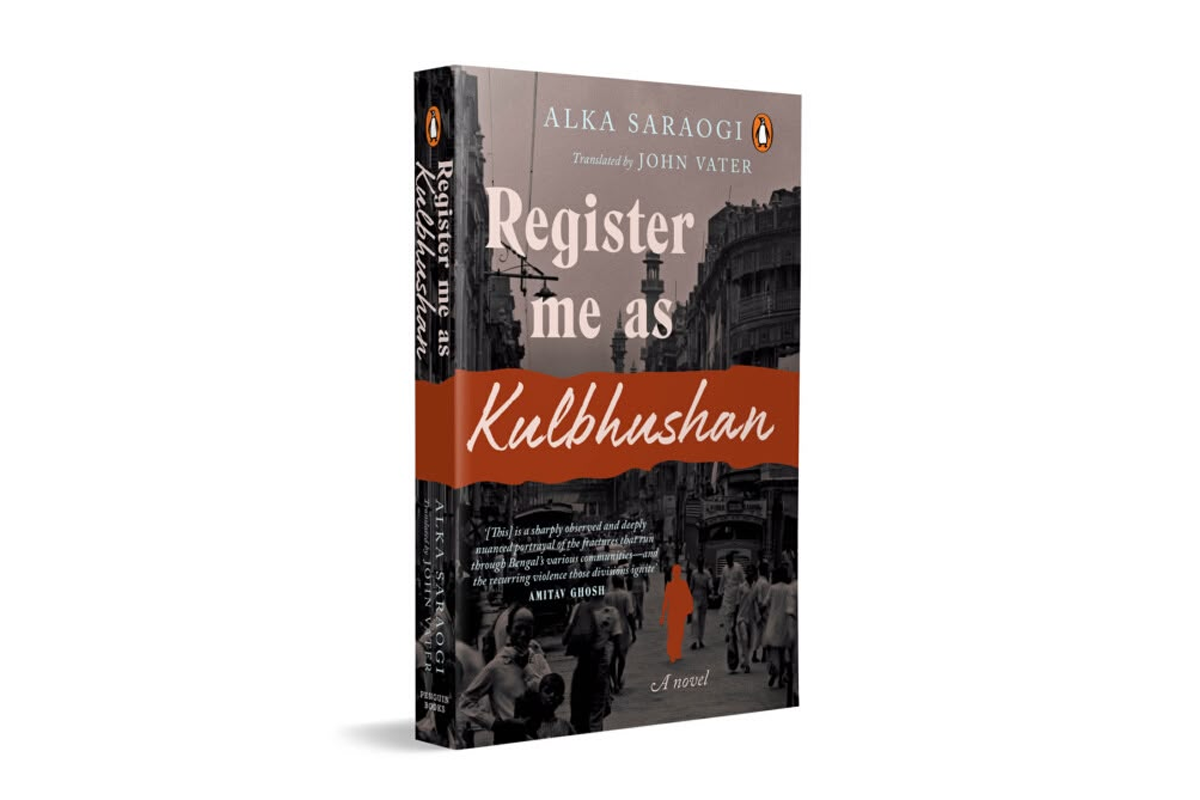

Synopsis: Alka Saraogi’s Register Me as Kulbhushan, translated by John Vater, explores themes of Partition-era displacement, memory, and administrative identity. With an ordinary man having multiple names as the protagonist, the novel explores the restoration of dignity and recognition to lives lost in official state archives.
Modern states recognise individuals through documents, certificates and registers. Literature, however, remembers them differently. It remembers them through stories, through names that survive in family conversations, through journeys that continue long after maps have changed.
Originally published in Hindi as Kulbhushan Ka Naam Darj Kijiye and now brought into English through John Vater’s accomplished translation, Alka Saraogi’s Register Me as Kulbhushan unfolds in the long shadow of Partition and the Bangladesh Liberation War, where borders continue to leave their imprint upon lives long after they have been drawn.
At the centre of the novel stands a man who carries several names across the shifting terrain of recollection and loss. He is Kulbhushan Jain, Gopal Chandra Das and Bhushan Chacha. He belongs everywhere and nowhere at once.
Through his journey, Saraogi traces questions of displacement, citizenship and belonging. What begins as a search for recognition gradually becomes an exploration of lives that often remain outside official narratives.
Few contemporary Indian novelists have listened to the quieter afterlives of historical change with the attentiveness that Saraogi brings to her fiction. Since Kalikatha: Via Bypass, she has remained drawn to those living at the edges of dominant histories. Here too, her gaze rests not on the spectacle of events but on the lives that continue in their wake, carrying history’s traces into ordinary days.
Kulbhushan is one such figure. Having endured displacement and loss, he develops an unusual coping mechanism. He imagines a forget button that allows him to temporarily shut away painful memories. Forgetting becomes a strategy of survival. Yet the past, however deeply buried, refuses to disappear.
Saraogi treats acts of remembering not as repositories of fact but as shifting and unstable spaces where identities are repeatedly assembled and undone. Human beings remember selectively, forget strategically and reconstruct themselves through fragments of the past.
One of the novel’s greatest strengths lies in its refusal to reduce its protagonist to a symbol of suffering. Kulbhushan is vulnerable and resilient, tragic and comic. He wanders through Kolkata with a peculiar dignity that makes him difficult to forget. Saraogi allows him his eccentricities and contradictions. In doing so, she restores his complexity and resists turning him into a representative figure.
Kolkata as an archive of lives
Kolkata itself emerges as one of the novel’s most riveting presences. Saraogi’s city is not simply a setting but a living archive where multiple histories intersect. Bengali, Marwari and East Bengali refugee experiences overlap in ways that reveal the city’s layered social fabric. Identity here is fluid rather than fixed. Communities coexist, influence one another and occasionally clash.
The streets, neighbourhoods and households of Kolkata become repositories of lived histories. Every lane appears to carry traces of migration, aspiration and loss. Saraogi’s portrayal of the city is affectionate without becoming nostalgic. She understands that cities preserve history not through monuments alone but through the lives of ordinary people.
The novel is also populated by a rich cast of characters whose stories illuminate different dimensions of social change. Among them, Shyama Dhobi is particularly memorable. His movement across different forms of labour and social worlds offers an alternative perspective on mobility, labour and aspiration.
Through characters like Shyama, Saraogi demonstrates how large historical processes enter everyday life. Social transformations are never entirely abstract. They are experienced through work, relationships, migration and survival. Opportunities emerge, but inequalities persist. Social mobility remains possible yet uneven.
Also Read: Hyphen and the dream of a shared Indian literature
The sociology of recognition
What makes Register Me as Kulbhushan especially relevant today is its engagement with the politics of recognition. The novel repeatedly asks what it means to exist in the eyes of the state.
In an age increasingly governed by documents, certificates and databases, identity is no longer merely a matter of memory or community. It has become administrative. One’s existence often depends on being properly recorded. The title itself carries immense symbolic force. It is not merely a request to correct an official record. It is a plea for acknowledgement.
From a sociological perspective, the novel offers a rich examination of displacement and its long-term consequences. Much has been written about the immediate violence of Partition and migration. Far less attention has been paid to the decades that follow. Saraogi fills this gap by showing how displaced communities rebuild lives, negotiate new social realities and struggle for dignity in unfamiliar environments.
The novel can also be read through the lens of memory studies, particularly the distinction between personal and collective memory proposed by Maurice Halbwachs. Kulbhushan’s recollections never remain entirely private; they are shaped by community histories, displacement and inherited experiences. Saraogi suggests that remembering is not solely an individual act but something produced within larger social worlds.
At another level, the novel examines collective memory. Nations often commemorate major events while overlooking the quieter experiences of ordinary people. Saraogi reminds us that history is also shaped by migrants, labourers, refugees and countless others whose names rarely enter official records.
Any discussion of this novel would remain incomplete without acknowledging the contribution of John Vater.
Translating Alka Saraogi is no easy task. Her prose moves between irony and tenderness, anecdote and reflection, humour and melancholy. It carries within it multiple linguistic and cultural registers shaped by Hindi, Bengali, Marwari and the social worlds they inhabit.
John Vater’s translation succeeds because it never draws attention to itself. He preserves the novel’s conversational ease while retaining its intellectual depth. The rhythms of Saraogi’s storytelling remain intact, and historical and cultural nuances travel into English without becoming overburdened by explanation.
At a time when translation increasingly shapes the reach of Indian literature, Vater’s work demonstrates how it can function not merely as linguistic transfer but as an act of cultural mediation
The novel’s expansive structure mirrors the fragmented nature of the lives it depicts. Stories emerge, disappear and reappear. Characters drift in and out of focus. Personal histories intersect with larger historical processes. The result resembles a mosaic of interrupted lives rather than a conventionally structured narrative.
What remains after the final page is not simply the story of Kulbhushan. It is the recognition that countless lives remain suspended between personal histories and official histories, visibility and erasure. Saraogi understands that displacement is not only geographical. One can be displaced within a language, within a city, within a family and even within one’s own memories.
Register Me as Kulbhushan ultimately asks difficult questions about identity, belonging and recognition while remaining attentive to the textures of ordinary lives.
In giving voice to those who often remain absent from official histories, Alka Saraogi performs an act of literary recovery. John Vater’s translation carries that act of recovery to a wider readership.
The novel eventually suggests that survival by itself does not guarantee belonging. To continue living is one thing; to have one’s life acknowledged, remembered and granted meaning is another.
In an age increasingly organised around databases, documents and verification, Register Me as Kulbhushan quietly asks a difficult question: what happens to those whose lives exceed the categories meant to contain them?
Also Read:
Withdrawing consent: Gene Sharp and the Cockroach uprising
Pyotr Ilyich Tchaikovsky: The Glass Child turned genius who transformed classical music
Jantar Mantar Protests: Weight of words and the Butterfly Effect
(Ashutosh Kumar Thakur is a Bangalore-based literary critic, translator, bilingual writer and curator. Edited by R Rajesh Kumar.)



