
Published Jul 29, 2026 | 12:11 PM ⚊ Updated Jul 29, 2026 | 12:11 PM

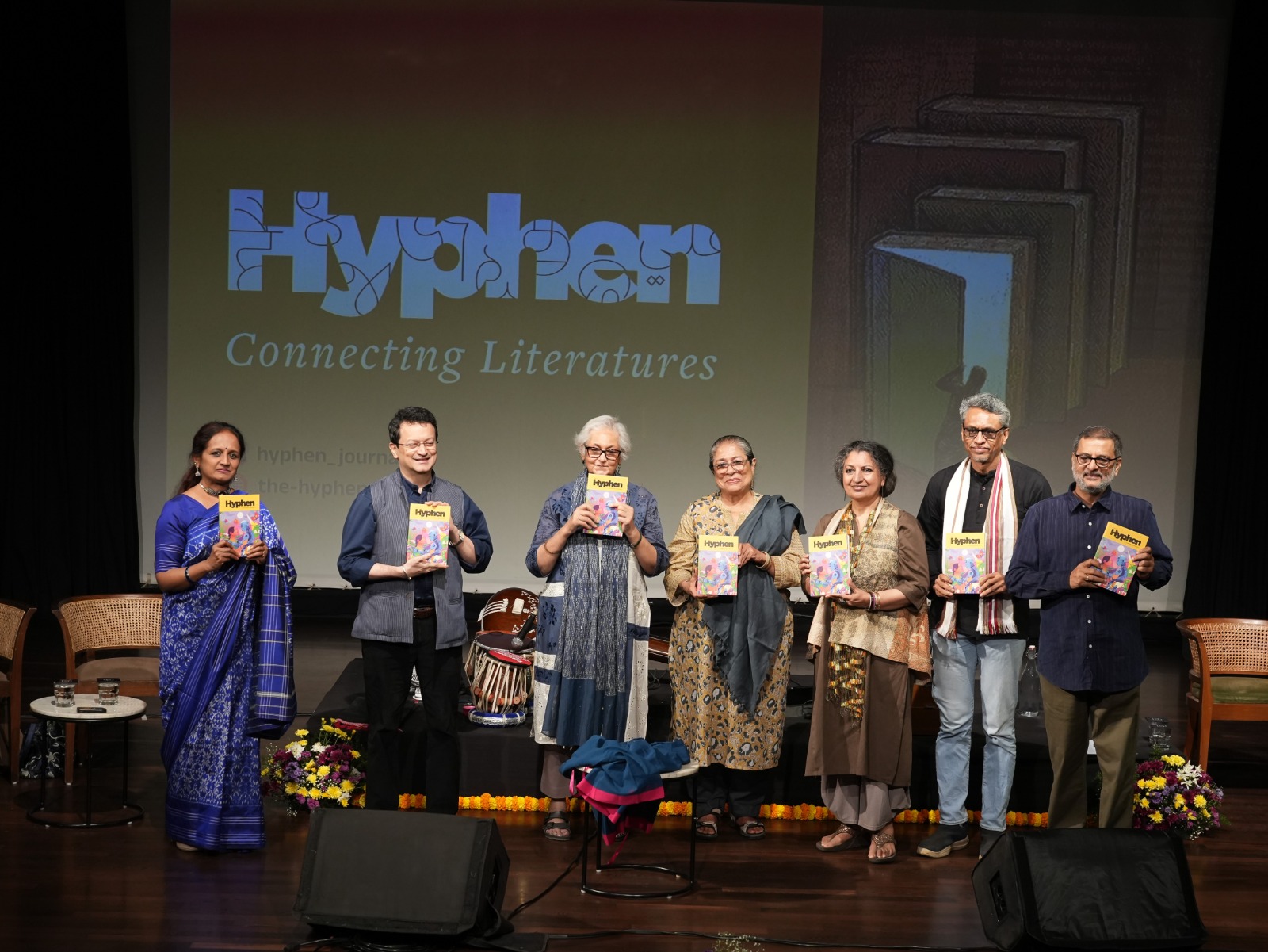
The launch of Hyphen's inaugural issue. (Photo | Special Arrangement)

Synopsis: Noted Kannada playwright-novelist Vivek Shanbhag has launched Hyphen, a translation initiative spread across Indian languages. It comes at a time when the translations of Geetanjali Shree’s Tomb of Sand and Banu Mushtaq’s Heart Lamp have gained renewed attention after their Booker wins. Hyphen plans to have its books printed and distributed in the United States and the United Kingdom through its partners. It could turn out to be an important experiment for Indian literature.
On Sunday, July 26, Bengaluru offered one of those rare reminders of why it continues to occupy a distinctive place on India’s cultural map. The occasion was the launch of Hyphen: Connecting Literatures at the Bangalore International Centre in Domlur, an event that drew together writers, translators, publishers, academics, students and readers from across linguistic traditions. The hall was overflowing long before the programme began. It was less the launch of a journal than the unveiling of an idea whose time has perhaps finally arrived.
I had travelled from Sanjaynagar, in north Bengaluru, to Domlur, a journey of nearly seventeen kilometres that on most days demands patience. Yet the city’s mild monsoon morning and the anticipation surrounding the event made the distance seem incidental. What had begun with an invitation from writer Vivek Shanbhag became an opportunity to witness what may well become one of the most significant literary initiatives in recent years.
Established under the Bahuvachana Trust and closely associated with Vivek Shanbhag, Hyphen seeks to address one of the oldest paradoxes of Indian literature. India possesses one of the richest multilingual literary traditions in the world, yet its languages often remain strangers to one another. Translation has flourished in pockets, but sustained institutional efforts to carry Indian-language writing across linguistic boundaries have remained relatively few.
Hyphen aims to change that. It has been conceived as a biannual journal in print and digital formats. A publishing programme, a digital platform and a dedicated online bookstore for translations are in the works.
The bookstore will not be limited to Hyphen’s own titles; it will also make available translated books from other publishers, positioning itself as a one-stop shop for readers seeking literature in translation. Alongside workshops, fellowships, mentorships and literary conversations, its ambition is not merely to publish translations but to build an ecosystem where Indian languages can encounter one another with greater frequency and seriousness.
The inaugural issue, edited by Deepa Ganesh, reflects that aspiration with remarkable confidence.
Also Read | Bengaluru to host 3rd edition of Book Brahma Literature Festival from 14 August
The first issue was formally launched by Namita Gokhale, Ranjit Hoskote and Geetanjali Shree, alongside members of the editorial team. Their presence lent both intellectual weight and symbolic significance to the occasion.
Among those in attendance were historian and public intellectual Ramachandra Guha, designer Sujata Keshavan, writer Pratibha Nandakumar, Mani Rao, Shinie Antony, Keshava Dhananjaya Guha, Westland Editor-in-Chief VK Karthika, and many distinguished writers, translators and publishers from across the country.
What was striking was not merely the prominence of those present but the diversity of the gathering. Kannada writers mingled effortlessly with authors from other Indian languages, translators exchanged ideas with young readers, and students moved comfortably among some of the country’s most accomplished literary figures.
Bengaluru has cultivated this atmosphere over decades. Literature here still commands public attention without demanding spectacle.
Also Read: The timeless satire of C Northcote Parkinson and what it teaches about our work life today
The speakers approached translation from different directions, but together they outlined a compelling vision of India’s literary future.
Namita Gokhale spoke with characteristic warmth about the necessity of reading across languages. She reminded the audience that India’s literary imagination remains incomplete if languages such as Maithili, Bhojpuri and several others continue to occupy the margins of national literary conversations. Literary diversity, she suggested, cannot remain a slogan. It must become a reading practice.
Ranjit Hoskote placed the discussion within a much larger historical frame. Multilingualism, he argued, is not an embellishment added to Indian civilisation but one of its defining conditions. South Asia’s literary cultures have long emerged through movement, migration and exchange. Stories, songs, beliefs and vocabularies have travelled across regions for centuries, creating a civilisational archive that is layered, interconnected and profoundly multilingual.
He also observed that translation between Indian languages has gradually diminished over time. While English has become an important intermediary, direct conversations between Indian literary traditions have become less frequent than they once were. In that context, he suggested, a journal like Hyphen has the potential to reopen channels of literary exchange that history had once made almost instinctive.
Geetanjali Shree reflected on her literary journey before and after the International Booker Prize for Tomb of Sand. Speaking with disarming honesty, she described how translation transformed not simply the reach of a book but the conversations it could generate across cultures. Her own career stands as one of the clearest demonstrations of what literary translation can achieve without compromising the integrity of the original work.
Vivek Shanbhag perhaps articulated the philosophy of Hyphen, speaking of discovering Indian-language writers afresh through English. The distinction was subtle but important. English, in this imagination, is not a substitute for Indian languages but a meeting place where they become visible to one another and to the wider world.
Also Read | Book Essay: “At the risk of being pedantic…?”
Literature beyond the printed page
There was also a poetry reading by Arundhati Nag and a Natyasangeet performance by Aniruddh Aithal, accompanied by Prasad Kamath and Yogeesh Bhat. Together, they reminded the audience that literature has never existed in isolation from performance, music and oral traditions. The spoken word, the sung word and the translated word formed a seamless continuum.
The conversations continued well after the formal programme ended.
During lunch, I had the opportunity to speak with poet and translator Mani Rao. She observed that initiatives like Hyphen are essential if Indian languages are to travel more confidently across borders and participate in creating a literary culture that is more inclusive, reciprocal and intellectually generous. Her observation distilled the spirit of the day. Translation is ultimately not only about expanding readership. It is also about recognising the equal dignity of languages and enlarging the imaginative possibilities available to all of us.
Hyphen arrives at a particularly significant moment. Indian writing is receiving unprecedented international attention, yet that recognition remains uneven. A handful of translated works have travelled globally, while countless others continue to remain confined within linguistic boundaries despite their artistic excellence.
The challenge today is no longer the absence of literary talent. It is the absence of sustained institutions capable of discovering, translating, editing, publishing and circulating that talent across languages and continents. Hyphen’s plans to have its books printed and distributed in the United States and the United Kingdom through its partners therefore acquire particular importance and could help extend the reach of translated Indian literature beyond domestic literary circuits.
Hyphen aims to be much more than a new literary journal. It is an attempt to reshape the ecology of Indian literature itself. It invites readers to imagine India’s many literatures not as isolated traditions but as parts of a shared intellectual landscape connected through translation, curiosity and conversation.
Those who gathered at the Bangalore International Centre on July 26 were not merely present at another book launch. They witnessed the beginning of an experiment that, if sustained with the seriousness it deserves, could help redefine how Indian literature speaks to itself and to the world.
Also Read | Withdrawing consent: Gene Sharp and the Cockroach uprising
(Ashutosh Kumar Thakur is a Bengaluru-based writer and columnist. He writes on literature, society, politics and South Asian cultural histories.)
(Edited by R Rajesh Kumar.)



