
Published Jun 28, 2026 | 7:10 AM ⚊ Updated Jun 28, 2026 | 7:10 AM


Synopsis: Parkinson’s “laws” give us a lens to identify the ailments that plague collective work. The power he hands is through having names for the dysfunctions plaguing our work culture.
In an age of increasing institutional complexity, it is often wise to revisit the perceptive—and delightfully satirical—thinkers of the past. Their diagnoses, though dressed in wit, reveal enduring truths about how organisations falter. One such voice deserving revival is that of C Northcote Parkinson.
Some events only reveal their full impact in hindsight, such as when I attended a talk by Professor C Northcote Parkinson at Madras Christian College, Chennai in 1970. I recall the burly gentleman in his three-piece suit, standing at the lectern in a half-full hall, speaking of his past in the British Navy stationed at Malaya. But what stayed indelibly was his witty presentation of “Parkinson’s Law”: Work expands so as to fill the time allotted for its completion. First expounded in 1955, this simple truth is something I have quoted countless times since, across careers in academia, activism, and development.
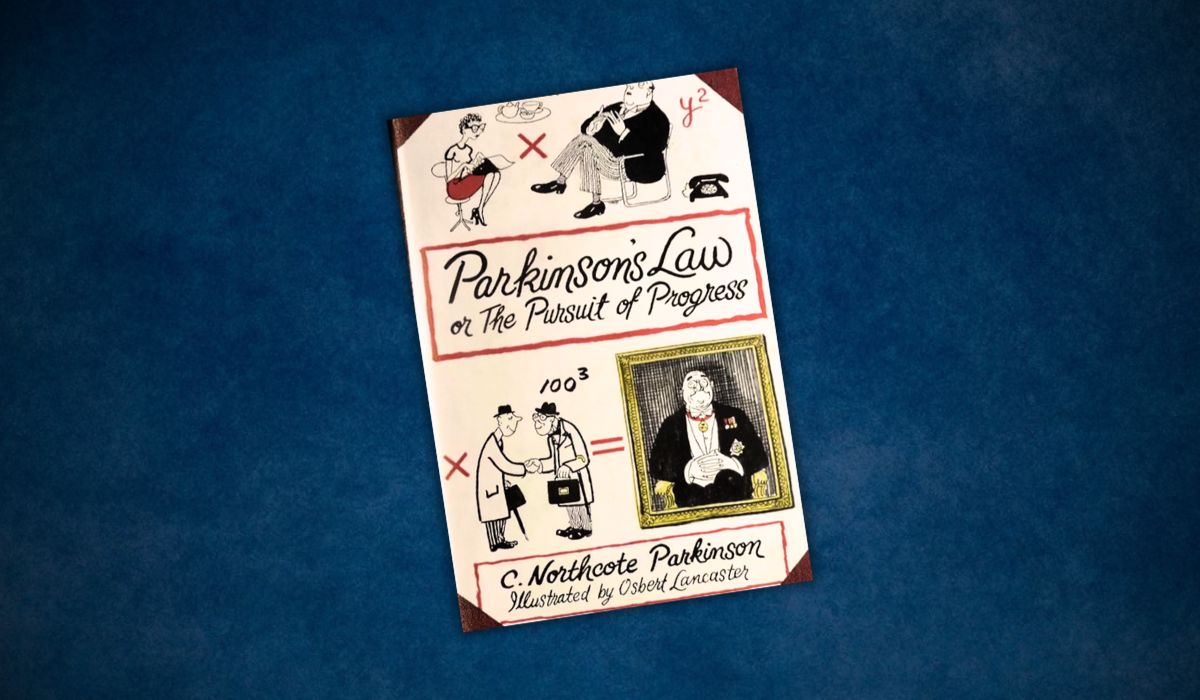
Yet there is far more to Parkinson worthy of revival today. His book, Parkinson’s Law, is written with brilliant satirical flair. He claims, tongue-in-cheek, to have discovered his laws like Newton discovered gravity. He notes the book was “almost purely satirical,” meant to “reveal sad truth without suggesting a remedy.”
Writing with mock-scholarship, playful exaggeration, and razor-sharp observation, he invents formulas and coefficients with academic pomp, using them to expose the absurdities of government, bureaucracy, and organisational behaviour. You laugh, but you also recognise the systems around you.
Three gems
That first law—his most famous—about Work Expansion is just the entry point. It captures not laziness, but a system’s instinct for self-preservation. The same task, given a month instead of a fortnight, will inflate with reports, working groups, and reviews. This is the physics of our inboxes. Whether in government offices, NGOs, parishes, or our own homes, tasks inflate when time is plentiful and contract when deadlines loom. Parkinson was holding up a mirror to the inefficiency we all know.
Then comes the Law of Triviality: the time spent on an agenda item is inversely proportional to the sum involved. Parkinson illustrated it with a committee that approves a nuclear reactor quickly but debates a bicycle shed’s colour for an hour. People avoid complex topics—they require expertise and risk disagreement. Trivial issues feel accessible, inviting everyone’s opinion. Consequently, organisations chronically misallocate their most precious resource: focused attention.
A third gem is his life cycle of committees, or “comitology.” Here, Parkinson coins the ‘Coefficient of Inefficiency,’ attempting to pinpoint when a decision-making body becomes too large to function. Through satirical formulas and historical examples, he argues that once a group exceeds about 20 members, genuine discussion collapses. Responsibility diffuses, decisions become ceremonial, and efficiency plummets. Size itself, he shows, can doom collective wisdom.
Perhaps my favourite is his chapter subtitled ‘Palsied Paralysis’, where he describes a fatal organisational disease. It arises, he writes, when Incompetence (I) combines with Jealousy (J). “When these two qualities reach a certain concentration—I³J⁵—they fuse to form a new substance: Injelititis.” An insecure, incompetent leader appoints even less capable subordinates to avoid being challenged. They, in turn, repeat the pattern. The organisation becomes a hierarchy of mediocrity, hostile to talent and innovation. Parkinson deemed it “incurable”—once the cycle starts, paralysis sets in.
So, what does this satire offer us today?
Parkinson provided a diagnosis, not a cure. In our age of hyper-connected, yet often bloated institutions, that diagnosis feels more relevant than ever.
We should revive him as a master of patterns. His “laws” give us a lens to identify the ailments that plague collective work. When a project team refines a presentation endlessly instead of acting, that’s Work Expansion. When a meeting obsesses over minor aesthetics while skimming a major ethical policy, that is the Law of Triviality operating. When talented people leave an organisation that rewards mediocrity, we are likely seeing Injelititis. And when a large committee achieves nothing, we have met the Coefficient of Inefficiency.
The power lies in recognition—in having a name for these dysfunctions. Once named, they can be questioned and countered. My assessment of Parkinson’s book is that his true legacy is an invitation to vigilance. He reminds us never to confuse the mechanics of administration with the meaning of the work itself. In a world ever more governed by procedure, that reminder remains a vital and subversive tool.
John Kurien is a former Professor, Centre for Development Studies, Thiruvananthapuram. His business management training predates the internet—but not bureaucratic folly.
Also Read:
Book review: Trump-ite world or not, there was never any West—only arguments about it
No, India’s ‘great’ Global Capability Centres aren’t transformational yet



