
Published Jul 19, 2026 | 6:03 PM ⚊ Updated Jul 19, 2026 | 6:03 PM

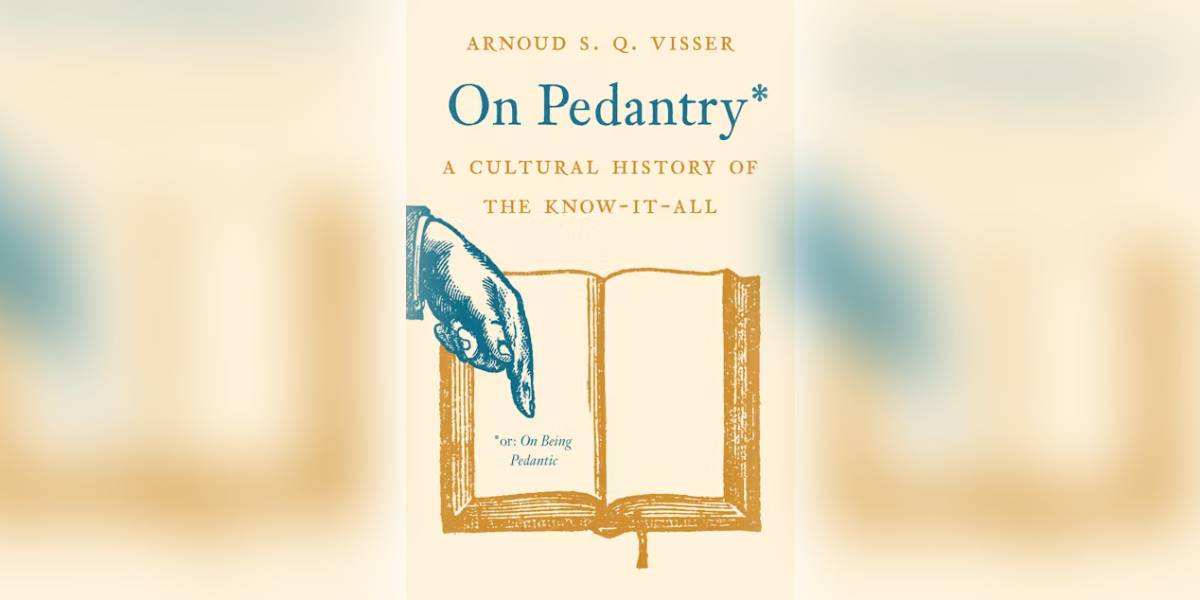
At the risk of being pedantic…?

Synopsis: Professor Arnoud S.Q. Visser’s On Pedantry takes on a grand subject, but ends up being a missed opportunity on many counts. Not that it is without its silver linings…
Writing or commenting on a book on pedantry is impossible without being pedantic! It does not help that the author proudly states that at school he took pride in correcting his teachers and confesses that in his adolescence he was “verbally precocious” and could not understand the irritation that this induced.
Arnoud S.Q. Visser is a Dutch Professor of Renaissance textual culture, a humanities discipline that this reviewer was unaware of but takes to be a book about other books—an ouroboros of self-indulgence essential to burnishing scholarly credentials. On Pedantry: A Cultural History of the Know-It-All (Princeton Press, 2025) purports to be a history and critique of pedantry, a vice of Western culture and, one suspects, a capital crime within the places of high learning.
Professor Visser traces the origins of the word ‘pedant’ to ‘pedante’, the name given to private tutors, usually of low social status, who were hired to instruct the children of the wealthy in Renaissance Italy. The concept is older, originating in ancient Greece with thinkers like the Sophists. The helpfully short book is a chronological historical tour covering 2,500 years. Part 1 covers the period preceding the actual concept of pedantry per se. Part 2 looks at the phenomenon in early modern Europe and the Enlightenment. The final Part looks at it in a modern context.
On Pedantry’s central thesis, at least as your ontologically challenged and intellectually deficient scribe was able to discern, is that pretensions and exaggerated displays of learning have always been annoying. Professor Visser sees three patterns.
Firstly, “the repertoire of pedants and know-it-alls that can be traced through the ages transcended individual stories and formed a cultural script of improper intellectual conduct”.
Secondly, the history of pedantry “reveals…the prominent contribution of the pedants themselves”.
Thirdly, pedantry involves “the persistent importance of etiquette… Bad manners, unseemly appearance, and improper behaviour have continued to mark the pedant”.
In translation, it appears that the concept of the pedant is based on stereotypes, gender biases (“pedantry is a male-coded phenomenon”), a lack of manly vigour (“dead from the waist down”), and effeminacy. Much of the conflict on the matter is pedant-on-pedant verbal violence. Who would have thunk it!
The title is misleading. On Pedantry is concerned with the treatment of anti-intellectualism. The primary focus is the evolution of a “cultural script” against intellectuals, genuine and pretenders, through history. The harassment involves well-known portrayals of this group variously as subversive or futile, shabby or pretentious, effeminate or toxically masculine. There is nothing new about this, which is the main thing that Professor Visser illustrates.
The book never really comes to terms with the underlying concepts, frequently shifting meanings and interpretations of pedantry and intellectuals, both elusive ideas. He makes intellect synonymous with scholarship. This distorts the book, such as beginning with Socrates, who was put to death as a subversive thinker rather than a scholar.
The author flirts with the differences between fact and opinion. Correcting a factual error, even of grammar or expression, is not pedantry. Disagreements of opinion, especially on philosophical matters, reflect variations of perspective. It is hardly pedantic to offer a critical analysis of someone’s position. As the late politician Daniel Patrick Moynihan observed, “You are entitled to your opinion. But you are not entitled to your own facts.” To the extent that people dismiss facts or avoid debate based on their belief does not change reality.
This lack of clarity finds the author in the same position as Supreme Court Justice Potter Stewart who in his concurring opinion in the 1964 Jacobellis v. Ohio case delivered the well-known line related to the detection of “hard-core” pornography: “I know it when I see it.”
The author fully embraces the judge’s approach: “I shall not today attempt further to define the kinds of material I understand to be embraced within that shorthand description; and perhaps I could never succeed in intelligibly doing so.”
Professor Visser’s weak argument is that pedantry is about degrees. He is concerned with how much accuracy is excessive. But pedantry is inherently contextual and depends on the parties: “I am correcting you, you are being pedantic!”
The book has a constantly irritating tone that pedantry is negative. The author struggles to delineate between an argument and the personal characteristics of the interlocutor, which are irrelevant. The book fails to make a cohesive argument, instead becoming a social history of the pedant in Western tradition as a negative persona or stereotype in society.
On Pedantry ends up as a collection of negative tropes used against knowledge and intellectuals over time. Professor Visser tries to link this to more fundamental social conditions and debates, but succeeds only in illustrating that petty precision, “vexatious fault-finding” and “exasperating attention to detail” are annoying to some. In reading the book, one feels sympathy towards scrupulous intellectuals who are misrepresented by anti-intellectuals or self-interested politicians as pedants.
The book’s lack of a clear core position is stylistically unhelpful. Professor Visser wants to cater to popular as well as academic audiences, resulting in uncomfortable compromises. On Pedantry ends up as a series of sometimes enjoyable digressions and asides. It hews to the familiar non-fiction formula in vogue. Set out a brief biography of someone, outline some of his thinking, add or subtract a critique, divide by another thinker, then rinse and repeat. It sometimes feels like a lurch through successive Wikipedia articles.
The attempt to enhance the book’s general appeal by using cultural examples, especially films, rarely appears authentic. Professor Visser’s use of Woody Allen’s 2015 movie Irrational Man, about a philosophy teacher, is curious. Your diligent scribe had never heard of it and had to sit through 96 minutes of unrelenting mediocrity. His misreading of Simon Gray’s play Butley (Professor Visser references the film version, which stars Alan Bates as the eponymous central figure) is another case in point. It is about self-loathing and tiredness of being alive, not pedantry. It has little to do with the decline of intellectual and cultural authority.
The omissions are especially surprising. Anonymous internet trolling and “mansplaining” are mentioned but not explored at any length. The impact of new knowledge technologies, especially AI, is absent. These recent phenomena are far more relevant than obscure cinematic works.
The book blurb makes claims of wit. This obviously requires an understanding of Dutch humour and character beyond your scribe’s acquaintance. Given former Dutch Prime Minister and now head of NATO Mark Rutte’s shameless, grovelling sycophancy to his “daddy” US President Donald Trump, it is perhaps an acquired taste.
On Pedantry is a missed opportunity to examine anti-intellectualism, now more prevalent than ever. During the Brexit debates, British politician Michael Gove dismissed economic concerns (which have since been proven to be correct), arguing that “the people of this country have had enough of experts”. Professor Visser correctly identifies American mistrust of scholars, which gave rise to a 19th-century political party, the Know-Nothings. But he does not make the full link to today’s rampant rejection of knowledge and embrace of “alternative facts”.
Tom Paine argued for “useful knowledge” on the grounds that “dictionary men” get everything wrong. The clever linking of pedantry to monarchical tyranny and rejection of religion was to further political objectives. The same is true in the 21st century and can be found today in “anti-woke” and “anti-elite” nativist agendas and the general disregard and fear of expertise and knowledge.
Anti-intellectualism is dangerous and corrodes society. Under the two Trump administrations, there has been an assault on research, universities, science, information (including environmental data), critical thinking, and the discrediting of vaccines. The full cost will only emerge over time. Professor Visser could have chosen the historical antecedents to illustrate how history informs these modern developments.
Ultimately, On Pedantry undercuts its own arguments. While it is true that it is quite difficult to judge the value and integrity of an argument or thought, the academic tendency towards deliberate incomprehensibility and technical jargon merely disguises the triviality or meaninglessness of what is being said. The common abrasive approach often hides uncertainty and anxiety. The author ends On Pedantry sharply asserting his authority, arguing that if readers do not find the book convincing, “[their] objections are absolutely understandable. But pedants will know better.”
Professor Visser cites but does not heed Michel de Montaigne’s condemnation of scholarship: “What have we got to say? What judgments do we make? What are we doing?”
Also Read:
Trump-ite world or not, there was never any West—only arguments about it
The timeless satire of C Northcote Parkinson and what it teaches about our work life today
(Satyajit Das, a former banker and author of numerous technical works on derivatives and several general titles: Traders, Guns & Money: Knowns and Unknowns in the Dazzling World of Derivatives (2006 and 2010), Extreme Money: The Masters of the Universe and the Cult of Risk (2011) and A Banquet of Consequence – Reloaded (2016 and 2021). His latest book, The Everything Bubble: A Guide to the New Age of Financial Speculation and Its Phantom Wealth, will be released in 2027. He has also written on ecotourism – In Search of the Pangolin (2006) (with Jade Novakovic) and Wild Quests: Journeys into Ecotourism and the Future for Animals (2024). This is jointly published with www.nakedcapitalism.com.)
(Edited by R Rajesh Kumar.)



