
Published Oct 02, 2026 | 7:00 AM ⚊ Updated Oct 02, 2026 | 7:56 AM

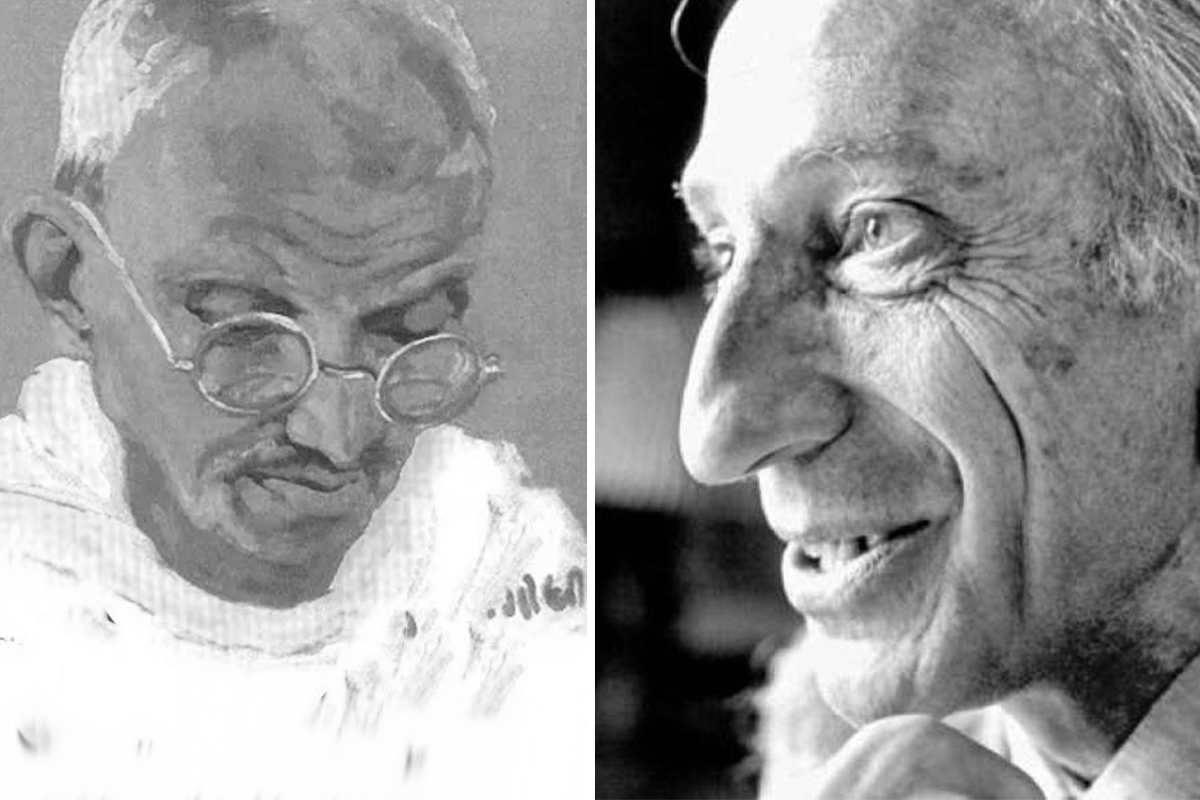
Ivan Illich once stated that all of his own writings could be viewed as a series of footnotes to the work of Mahatma Gandhi.

It is fitting that this final reflection appears on the birth anniversary of Mahatma Gandhi.
Gandhi worried that colonial schooling would produce clerks rather than citizens; Illich warned that institutional schooling manufactures obedience rather than curiosity.
Gandhi saw in Western medicine a system that could erode the body’s own capacity to heal; Illich exposed how medical institutions create new forms of sickness even as they treat others.
Gandhi famously called machines “the emblem of Satan” and urged swadeshi—the use of tools that serve the many, not the few; Illich drew the same line between convivial tools and industrial tools that enslave.
And Gandhi’s critique of the railway and the motorcar—that they encouraged haste, centralised power, and impoverished the villages—anticipated Illich’s argument in Energy and Equity that beyond a certain threshold, speed creates inequality. Hind Swaraj and Energy and Equity are, in different idioms, the same warning: when a society worships speed and machines, it risks losing its soul.
Ivan Illich was, as I came to see during my encounters with him in Kerala and Varanasi, a scout from the future—a man who had walked ahead of us and returned to warn of the traps we were about to enter. As we honour both these prophets of human dignity, the question before India is whether we will listen.
In education, Illich warned that institutional schooling substitutes certification for genuine learning. It manufactures obedient workers rather than curious minds.
India has built one of the world’s largest education systems, yet only 56.4% of graduates are considered employable. The NEET protests of 2026—when millions of students took to the streets over a leaked exam and forced the education minister to resign—were not an aberration. They were the eruption of a generation that had done everything right and still found itself betrayed.
The “Cockroach Janata Party” was a movement of young people who had lost faith in the system. Illich would have recognised the pattern: a system that promises salvation but delivers only anxiety.
In healthcare, Illich argued that the medical establishment had become a threat to health. Clinical, social, and cultural iatrogenesis combine to strip individuals and communities of their capacity for self-care and mutual aid.
India’s public health system remains chronically underfunded—just 1.8% of GDP—while private, profit-driven healthcare caters to the elite. In Kerala’s Government Medical College Hospital, patients lie on the floor for want of beds. The children who died in Uttar Pradesh from oxygen shortages, the family pushed into debt by a medical bill, the quiet outsourcing of diagnostics in a Delhi hospital—these are not failures of the system. They are its logical outcomes.
In technology, Illich distinguished between convivial tools that amplify human agency and industrial tools that create dependency.
“Industrial tools replace competence with demand,” he wrote. The fishermen of Kerala, who started with 5 HP outboard motors and now race with 45 HP engines to catch the same fish, are a parable of this enslavement.
The farmers locked into debt by patented seeds, the gig workers controlled by opaque algorithms, the millions facing job displacement from generative AI—all are living Illich’s warning that tools meant to liberate have become instruments of control. The deeper enslavement, as Illich would note, is that we have lost the capacity to see the chains.
In energy and speed, Illich demonstrated that beyond a certain threshold, speed creates injustice. “Civilization has a speed limit,” he wrote.
India’s airport-building frenzy—from the farmers of Parandur who faced displacement to the villages of Goa losing their water sources—is a vivid testament to this truth.
The bullet train, designed for the wealthy and subsidised by public debt, redistributes time from the poor to the rich.
Kerala’s highways, carved through a continuous “rurban” landscape, privilege private cars over buses and pedestrians. The pursuit of speed has become a tool of inequality—a means by which the powerful accelerate while the powerless are left behind.
What connects these four critiques is a single, unified diagnosis: modern institutions, justified in the name of progress, have become counterproductive. They do not educate; they school. They do not heal; they commodify. They do not liberate; they enslave. They do not connect; they divide.
Illich’s genius was to see that these are not separate failures but expressions of a deeper logic—a logic that substitutes institutional control for human agency, that confuses movement with progress, and that measures development by the speed and scale of consumption rather than by the dignity and autonomy of persons.
He was not a pessimist. He did not believe in returning to some imagined past. He believed in the possibility of a different future—one rooted in conviviality, in human scale, in communities of mutual care. His vision was of a world where people could learn together, heal together, work together, and travel together, at a human pace, without the mediation of institutions that had become ends in themselves.
India stands at a crossroads. The path we have been on—the path of accelerated development, of institutional expansion, of technological dependence—has brought us to a place of deepening crisis.
Our education system produces anxiety, not curiosity. Our healthcare system commodifies suffering, not heals. Our technologies create dependency, not liberation. Our infrastructure widens inequality, not connects communities.
Illich offers us something rare: not a blueprint, but a set of questions. Fundamental questions that our institutions prefer we ignore:
Are we educating citizens capable of thinking and acting autonomously, or are we manufacturing compliant workers dependent on certificates?
Are we healing, or are we commodifying suffering and creating a new class of managed patients?
Are our technologies serving human flourishing, or are they creating new forms of enslavement that enrich a few whilst disempowering the many?
Whose time are we saving, and at whose expense? Can we recover a rhythm of life rooted in community rather than speed?
These are not abstract philosophical queries. They are questions the NEET protesters, the families in Uttar Pradesh, the fishermen of Kerala, and the communities displaced by airports and highways are asking in their own ways every day.
Ivan Illich walked barefoot through Kerala in 1978, asking questions that seemed radical then but have become urgent now. He sat on the banks of the Ganges, learning Hindi from a guru who asked no fee but demanded complete presence. He embodied the very thing he wrote about: a life lived at a human scale, open to encounter, unmediated by institution or credential.
When he left India, he left behind a map—a way of seeing the traps of progress, of diagnosing the pathologies of our institutions, of imagining a different way of living. But a map is only useful if we dare to read it, and have the wisdom to follow it.
As we mark his hundredth birth anniversary, the question for India—for all of us—is whether we will. The barefoot prophet we ignored may yet show us the way home. But only if we have the courage to ask the questions he gave us, and to imagine a future rooted not in speed and scale, but in dignity and community.
The map remains. The choice is ours.
Also Read:
The Sea speaks Malayalam: The 122 words that sailed back with Vasco da Gama from Calicut
(Edited by R Rajesh Kumar.)



