
Published Sep 30, 2026 | 9:00 AM ⚊ Updated Sep 30, 2026 | 9:00 AM

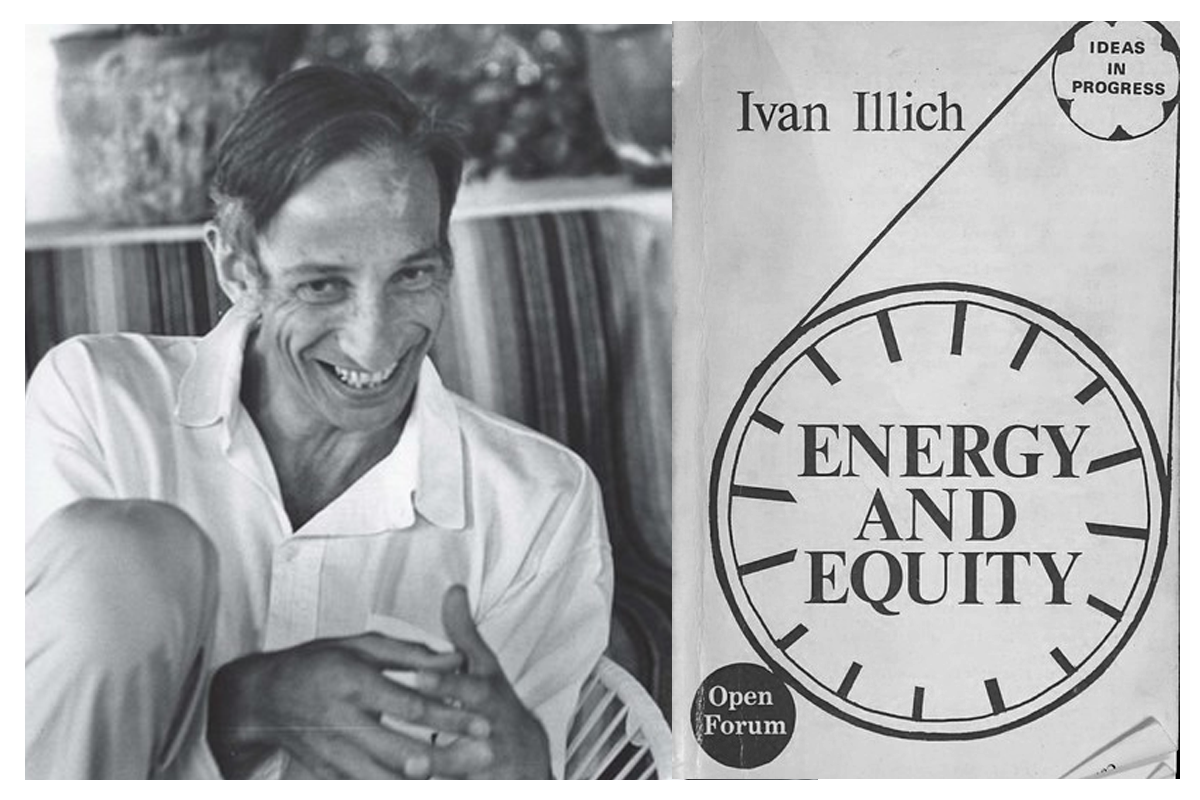
Ivan Illich's 1974 book Energy and Equity.

Synopsis: Ivan Illich argued that beyond a certain threshold, speed creates injustice, redistributing time from the poor to the rich. From Parandur and Goa to the bullet train and Kerala’s highways, India’s pursuit of speed is exacting a price from communities, ecosystems and the many.
In 2026, as India’s mandatory E20 ethanol blending policy sparked fierce debates over food security and the rising cost of mobility, another, more visible transformation was underway.
Across the country, from the wetlands of Tamil Nadu to the fragile coasts of Goa, bulldozers were clearing land for new airports. Tamil Nadu, thankfully, has had a rethink on Parandur. Better late than never.
In Gujarat, the first bullet train was taking shape. And in Kerala, hillsides were being carved open for highways that promised speed but delivered collapse. Each of these projects shares a single logic: progress measured by velocity. Each exacts a price paid by the many for the convenience of the few.
Ivan Illich had mapped this territory half a century earlier.
In his 1974 book Energy and Equity, Illich made a radical claim: beyond a certain threshold, speed creates injustice. “Civilization has a speed limit,” he wrote. “Beyond a certain point, more energy means less equity.”
His argument was precise. High-speed transport systems do not save time collectively; they redistribute it from the poor to the rich. “Beyond a certain velocity,” Illich argued, “passengers become consumers of other people’s time, and accelerating vehicles become the means for effecting a net transfer of life-time.”
The faster a society moves, the more unequal it becomes. The elite, with their private cars and airplanes, consume enormous amounts of energy to accelerate. But their speed comes at a cost: it monopolises public space, destroys ecosystems, displaces communities, and erodes social solidarity. The majority, who cannot afford high-speed travel, are left to bear the hidden costs—through congestion, pollution, displacement, and exclusion.
Illich’s most beautiful and radical declaration was this: “A true choice among political systems and of desirable social relations is possible only where speed is restrained. Participatory democracy demands low-energy technology, and free people must travel the road to productive social relations at the speed of a bicycle.”
Speed, in other words, is not neutral. It shapes the society that embraces it.
India’s airport-building frenzy is a vivid illustration of Illich’s warning. The government’s ambitious plan to develop 100 airports under its regional connectivity scheme has gathered pace, but at enormous cost.
Consider Chennai’s revived proposal for the second airport at Parandur. The project required acquiring 5,746 acres of land from 20 tiny village settlements. Of this land, 47.46% is currently used for agriculture, while 26.54% is covered by water bodies. Environmentalists warned that constructing an airport on over 26% of wetlands will exacerbate flooding risks in Chennai.
The possible human cost was equally devastating. Over a thousand farming families faced displacement.
“We were assured that 13 villages would be impacted, but I know that at least 30 to 40 villages will be affected,” said one villager. “Hotels and offices will be constructed around the airport premises, and that means we will end up being refugees in our own land.”
Villagers spent over three years in protest before the new TVK government, led by Chief Minister Vijay, agreed to scrap it.
The story repeats across India.
In Goa, the new airport on the Barazan plateau has allegedly disrupted water availability for over 7,000 residents of six villages. The plateau’s laterite rock geology, which facilitated groundwater recharge, has been compromised. Residents have consistently opposed the construction, fearing destruction of the dense forests of the Western Ghats—a UNESCO World Heritage Site and one of the 36 biodiversity hotspots in the world.
In the Andaman and Nicobar Islands, the ₹72,000-crore Great Nicobar Infrastructure Project—comprising an airport, transshipment port, power plant, and township—has been condemned as an “ecological and humanitarian disaster.” It threatens the Shompen, a Particularly Vulnerable Tribal Group, and displaces at least 263 families who have lived on the island for generations.
The Mumbai-Ahmedabad High-Speed Rail corridor—India’s first bullet train—is another testament to the same logic.
Approved at an estimated cost of over ₹1 lakh crore, the project has already required the removal of 847 mangrove trees, including nearly two hectares of mangrove habitat—an ecosystem recognised for protecting coastal regions from flooding, erosion, and storm surges. The Bombay High Court, while permitting the project, warned against treating distant compensatory plantations as an adequate substitute for local ecological restoration.
The economic logic is equally questionable. The fare structure, expected to be 1.5 to 3 times the current AC bus or train fares, places the bullet train out of reach for most Indians. It is a project designed for the wealthy, subsidised by public debt that future generations will repay. Illich would have recognised this as a classic case of speed redistributing time from the poor to the rich.
Kerala’s highway-building spree offers the most intimate illustration of Illich’s warning—a case where the pursuit of speed has met its match in geography.
The state’s new super-highways, reportedly patterned after Germany’s Autobahn, presuppose low population densities and clear urban-rural boundaries. But Kerala is neither urban nor rural; it is a continuous “rurban” fabric where people live, work, and interact along a seamless settlement corridor. A high-speed, limited-access highway in such a landscape does not pass through settlements; it cuts across a continuous living fabric.
The design itself privileges private cars over buses and smaller vehicles. Wider roads, higher speeds, and limited access points naturally favour the car owner while marginalising the bus passenger, the two-wheeler rider, and the pedestrian. Kerala has historically had the highest road density in India—550 km per 100 sq. km—a network that evolved organically to serve its dispersed population. The new highways do not fill a gap; they impose a new logic of movement alien to the land’s organic pattern.
The consequences are already visible. In several places, even before completion, sections of these highways have collapsed due to waterlogging and poor design. Landslides and retaining wall failures occur precisely where local communities had protested, warning of the dangers. Communities living beside the older roads, now reduced to “service roads,” have lost small-scale tertiary employment that thrived in the “slow lane.” They face increased pollution, waterlogging, and greater risk. The right to cross the road, once a simple social interaction, becomes a dangerous undertaking.
This is not development; it is the imposition of a foreign logic on a living landscape—a logic that values speed over stability, and private convenience over public good.
Across all these projects—airports, bullet trains, and highways—a single pattern holds. They are underwritten by public debt, creating long-term liabilities for future taxpayers who will repay these loans for decades, often for infrastructure they may seldom use. They impose private costs on users—higher fuel consumption, accelerated maintenance, perpetual tolls—while externalising social and ecological costs onto the majority who are non-users.
The farmers of Parandur, the villagers of Goa, the residents of Kerala’s highway corridors—these are the people who pay the price of speed. Their land is acquired, their water sources depleted, their livelihoods destroyed, their communities fractured. And for what? So that a small minority can travel faster.
Whose time are we saving, and at whose expense? Are we building for the convenience of the few, or the mobility and dignity of the many?
From the airport projects of Tamil Nadu to the bullet trains of Gujarat, from the highways of Kerala to the displaced villages of the Nicobar Islands, the pattern holds. The pursuit of speed has become a tool of inequality—a means by which the powerful accelerate while the powerless are left behind.
“Civilization has a speed limit,” Illich wrote. Beyond it, community decays, ecosystems collapse, and inequality deepens. India’s love affair with speed is pushing us past that limit. The question is whether we will pause before it is too late.
Also Read:
Tools that enslave: Ivan Illich’s questions for India
Ivan Illich and India’s unfinished questions
When schooling destroys learning
When healing becomes harm: Ivan Illich’s ‘Medical Nemesis’
(Edited by R Rajesh Kumar.)



