
Published Sep 14, 2026 | 12:15 PM ⚊ Updated Sep 15, 2026 | 11:17 AM

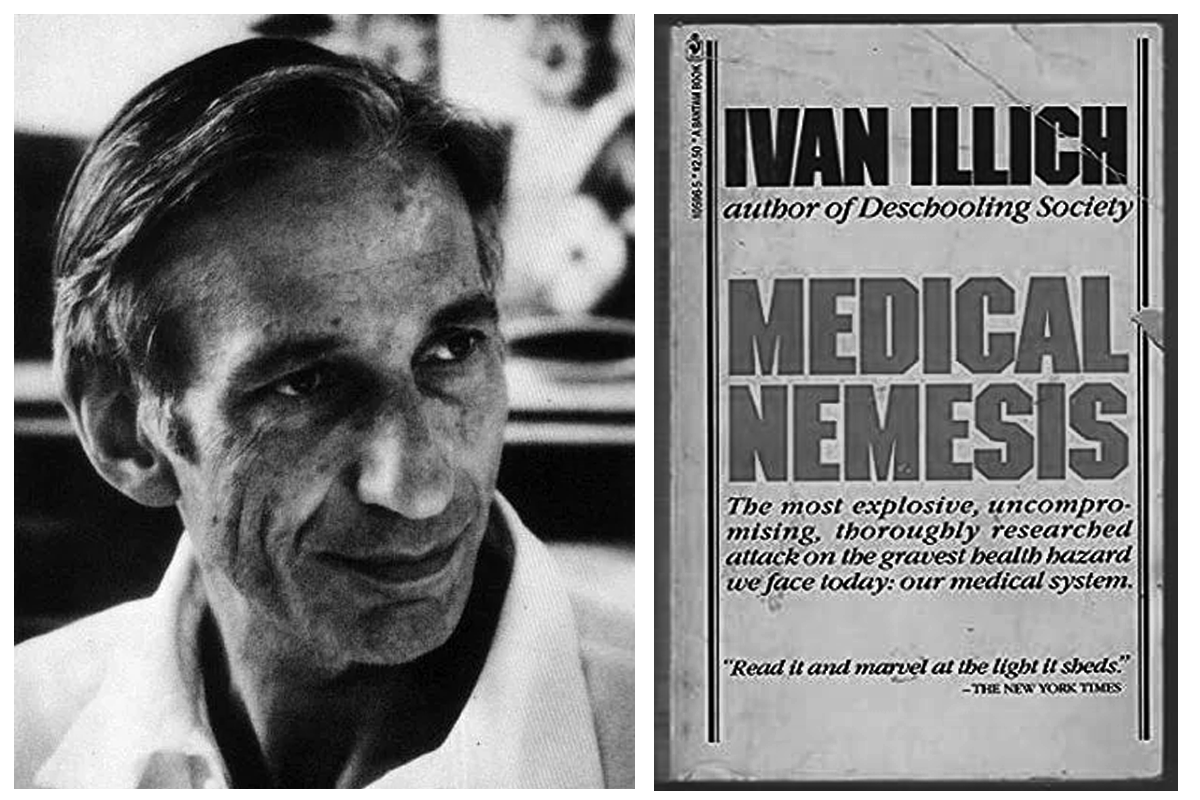
Ivan Illich's 1975 book Medical Nemesis

Synopsis: Patients lie on the floor for want of beds, hospitals struggle with critical shortages, and families are pushed into debt by private hospital bills. These are not isolated aberrations. They are symptoms of a deeper pathology—one that Ivan Illich diagnosed half a century ago.
In August 2026, a woman in India was rushed to a hospital after a leg fracture from a road accident. Without informing her family, the hospital performed a heart procedure and inserted a stent. She died the next day.
In Uttar Pradesh, 30 infants died in a government hospital, with investigations pointing to oxygen shortages.
In Maharashtra, the state health department had to halt batches of Ringer Lactate after complaints of adverse reactions.
And in Madhya Pradesh, a 19-month-old boy was left permanently blind when hospital staff mistakenly dropped a cough syrup into his eyes instead of administering it orally.
In Kerala, a state once celebrated for its public health achievements, the signs of decay are equally visible. At the Government Medical College Hospital in Kozhikode, patients lie on the floor for want of beds. The casualty ward, designed for 50 patients, routinely handles over 150. There are critical shortages of doctors, nurses, and even basic medicines.
Patients are referred from private hospitals when care becomes unaffordable, dumping the burden on an already overwhelmed public system. The state’s famed palliative care movement—a community-based alternative to institutional medicine—struggles to fill the gap left by a retreating state.
These are not isolated aberrations. They are symptoms of a deeper pathology—one that Ivan Illich diagnosed half a century ago.
In his 1975 book Medical Nemesis, Illich made a startling claim: “The medical establishment has become a major threat to health.” He introduced the concept of iatrogenesis—illness caused by medical intervention itself. But Illich’s critique went far beyond clinical errors. He identified three forms of iatrogenesis:
Clinical iatrogenesis is the direct harm caused by medical treatment—the unnecessary surgery, the wrong prescription, the hospital-acquired infection.
Social iatrogenesis occurs when medicine becomes a monopoly over healing, stripping individuals and communities of their capacity for self-care and mutual aid. Health becomes something one buys rather than something one does.
Cultural iatrogenesis is the most profound. It “sets in when the medical enterprise saps the will of people to suffer their reality.” Pain, impairment, and death are transformed from personal challenges into technical problems. “Pain, impairment, and death,” Illich wrote, “are transformed from a personal challenge into a technical problem.”
The result is a system that creates dependence while destroying resilience. “Beyond a certain level of industrial hubris,” Illich warned, “nemesis must set in, because progress, like the broom of the sorcerer’s apprentice, can no longer be turned off.”
Medical Nemesis should be standard reading for every conscientious medical professional—not as a critique of their intentions, but as an invitation to reflect on the systemic forces that turn healing into harm, and patients into profit centres.
India’s healthcare system today is a near-perfect illustration of Illich’s warning.
First, the galloping privatisation. Roughly 63% of total health expenditure flows through private providers. They house 60% of hospital beds and employ nearly 80% of practising physicians.
In 2025, 61 % of hospitalisation cases were in private hospitals. But private healthcare is profit-driven. Private equity investment in Indian healthcare reached $5.5 billion in 2023. The result is rising costs and deepening inequity. Medical inflation in India is estimated at 11-13%, while the average out-of-pocket expenditure per hospitalisation in a private hospital is ₹50,508—far beyond the means of most families.
The state is quietly retreating. In a municipal hospital in Delhi, diagnostic services have been outsourced to a private operator. Patients now pay MRI rates—₹4,500—at a counter not operated by hospital staff. As one senior doctor put it: “This is still a government hospital, but diagnostics are no longer part of the public system.” There was no legislative debate, no announcement. Just a quiet transfer of control.
Second, the chronic underfunding of public health. The National Health Policy of 2017 set a target of raising government health expenditure to 2.5% of GDP by 2025. By 2026, public health spending remains at a meagre 1.2% of GDP. The Union government’s share is even lower—about 0.5% of GDP.
As development economist Jean Drèze has noted, “India is one of the world’s champions in public underspending on healthcare.” Meanwhile, the health cess collected specifically for health has not increased actual spending; it merely masks what would otherwise be a steep decline in the share of health in the total budget.
Third, the collapse of the three-tier system. Primary health centres (PHCs), meant to be the first point of contact for millions, remain chronically underfunded. Community health centres face a 79% shortfall of specialists—with just 4,413 specialists in place against a requirement of 21,964. The result is that patients bypass primary and secondary care entirely, flooding tertiary hospitals.
In Kerala, government medical college hospitals are “being pushed to the limit” by the influx. Patients are referred from private hospitals when care becomes unaffordable, dumping the burden on an already overwhelmed public system.
The Union budget reflects this distortion. Rather than reinforcing primary health infrastructure, the 2026-27 budget leans heavily toward tertiary care expansion—trauma centres, cancer institutes, robotic surgery facilities. As one analysis noted, “technologically advanced healthcare is important, it benefits only a fraction of the population.”
Illich’s critique was not of medicine itself but of its institutionalisation. He did not oppose healing; he opposed the expropriation of healing by experts and corporations. He did not deny the value of medical knowledge; he questioned the monopoly that turned knowledge into a commodity and patients into passive recipients.
What would Illich say if he walked into a Kerala hospital today? He would ask: Who decides what it means to be healthy? Who profits from our sickness? Can we recover the capacity to care for ourselves and each other, or have we surrendered that capacity entirely?
He would remind us that health is not something one buys; it is something one does. It is a practice rooted in community, in mutual aid, in the courage to suffer meaningfully. Institutions that claim to deliver health but actually deliver dependence are not solutions; they are part of the problem.
India’s healthcare crisis is not a failure of the system. It is the logical outcome of a system designed to serve institutions rather than people, profits rather than well-being. The tragedy is that we have accepted this as normal.
Are we healing, or are we commodifying suffering? Can we recover sovereignty over our bodies and our dying?
From the patients lying on the floors of Kozhikode’s medical college to the families pushed into debt by private hospital bills, the pattern holds. The system we have built does not heal; it manages. It does not empower; it controls.
Illich offered no simple solutions. But he gave us the most important tool of all: the ability to see clearly. To see that what we call “healthcare” is often its opposite. To see that progress, unchecked, becomes its own nemesis.
That clarity is the first step toward reclaiming what has been taken from us.
Also Read:
Ivan Illich: When schooling destroys learning
Ivan Illich and India’s unfinished questions
Withdrawing consent: Gene Sharp and the Cockroach uprising
The timeless satire of C Northcote Parkinson and what it teaches about our work life today



