
Published Sep 29, 2026 | 9:15 AM ⚊ Updated Sep 29, 2026 | 9:15 AM

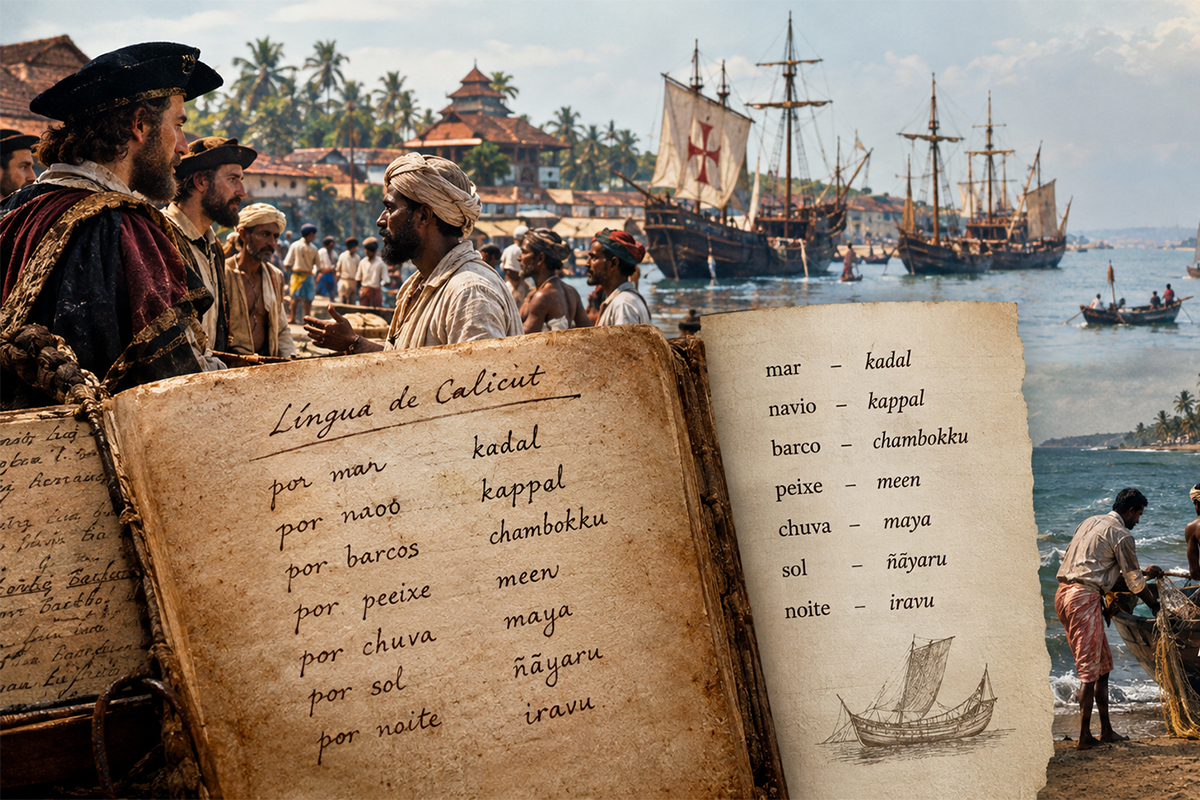
Image used for representational purpose. (AI generated image)

In 1498, when Vasco da Gama’s fleet dropped anchor off Calicut—today’s Kozhikode—the Portuguese did not walk into silence. They stepped into a bustling, multilingual port city that had been trading with the world for centuries. What they carried back, tucked into a manuscript now held in Porto, Portugal, is one of the most intimate records of that encounter: a list of 122 everyday words and expressions in Portuguese, translated into the “language of Calicut”—coastal Malayalam.
This word list, analysed by linguist Gonçalo Fernandes in a 2016 article, is not a royal decree or a scholarly treatise. It is a practical phrasebook compiled by a seaman, for seamen. It contains the words a Portuguese sailor needed to survive and communicate on the Malabar Coast: por mar (the sea – kadal), por naoo (ship – kappal), por barcos (boat – chambokku), por peeixe (fish – meen), por chuva (rain – maya), por sol (sun – ñāyaru), por noite (night – iravu).
As researcher of coastal history Somy Solomon recently noted in her article, “Unveiling Kerala’s Forgotten Maritime Vocabulary”, this is the language of the working coast—fishermen, fish vendors, cargo unloaders, and those who accommodated foreign seamen. It is an “articulated maritime Malayalam” that has long been invisible in academic history.
Kozhikode in the late 15th century was the beating heart of the Malabar Coast—a city where Arab, Chinese, Jewish, and Indian merchants had long mingled. The Zamorin received Vasco da Gama and twelve of his men on 28 May 1498. The Portuguese stayed for three months, establishing political and commercial relationships. The word list that survives is a direct product of that contact.
Bishop John Speechly, writing in the 19th century, noted that “at the sea-port towns generally the worst Malayalam is spoken.” He meant it as criticism, but it is actually a clue.
The Malayalam of Kozhikode’s coast was a mixed, living, working language—infused with Tamil and Arabic words, shaped by centuries of maritime trade. As Solomon points out, these words—Parayunnu, Thinnunnu, Nadakkunnu, Kudiykkunnu—come from the local register, entirely different from the elite lingo of court records, inscriptions, and literary works. This is the vocabulary of the common seaman.
The list is organised by semantic domains—body parts, daily objects, fish and animals, boats and navigation, parts of the day, cardinal points. It includes 75 nouns, 36 verbs, five adjectives, and a handful of phrases. Among the verbs are to go, to walk, to row, to fish, to drink, to eat, to mount, to dance, to sing. These are the verbs of everyday survival on the coast.
The manuscript’s author is believed to be Álvaro Velho, a seaman from Barreiro, Portugal. The copy we have was likely made by a friar, John Theotonius, who erased five vulgar words—sexual terms he considered offensive. Solomon notes that the manuscript even records “the sexual organs of men and women,” offering a rare glimpse into the intimate vocabulary of that period. This small act of censorship is itself a historical treasure: it shows that the seamen’s vocabulary was earthy and practical.
Kozhikode’s coast was never isolated. It was a contact zone—a place where languages, goods, and ideas washed in and out like the tide.
Solomon argues that Kerala’s maritime heritage—the lives of fishers, the labour of boat builders, the knowledge of the sea—has been marginalised in academic history. The Portuguese word list is proof of a deeper truth: long before Europeans arrived, Kerala had a sophisticated maritime awareness. Words like Kadal, Kappal, Thandu, and Chukkan—all from the manuscript—illustrate an unexplored area of Kerala’s maritime history.
Today, Kozhikode is a modern city, but its coast still hums with the same rhythms. Fishermen of Vellayil and Chaliyam, with whom I associate, still go out before dawn. They use motors, but their canoes still return with the tide in mind.
The 122 words recorded by a Portuguese seaman more than 500 years ago are a testament to a simple truth: the sea has always connected Kerala to the world.
As Solomon concludes, the present Kerala government’s Mission Samudra project considers the ocean a prime economic zone, but the social landscape—the fishers, the boat builders, the coastal communities—remains missing from the discourse.
The manuscript in Porto is not just a linguistic curiosity. It is a reminder that the history of Kozhikode is written not only in palaces and temples, but in the everyday words of fishermen, sailors, and traders—words for sea, ship, fish, and rain. Words that still echo along the Malabar Coast today.
Also Read:
India can mine the deep sea. But should we?
‘At home I am alone, not here…’: The joy of watching the football World Cup on community screens
How Malabar Malikhana, an 1806 colonial covenant, still brings cheques for Kerala royals
Wood, water, and memory: Inside Beypore’s surviving dhow-building tradition
(John Kurien is a reflective development practitioner who has spent his life working with fishing communities in several Asian countries. He lives in Kozhikode, on the Malabar Coast, where the words in this 15th-century word list still echo in the daily speech of fishers.)



