

Published Oct 10, 2026 | 10:32 PM ⚊ Updated Oct 10, 2026 | 10:43 PM

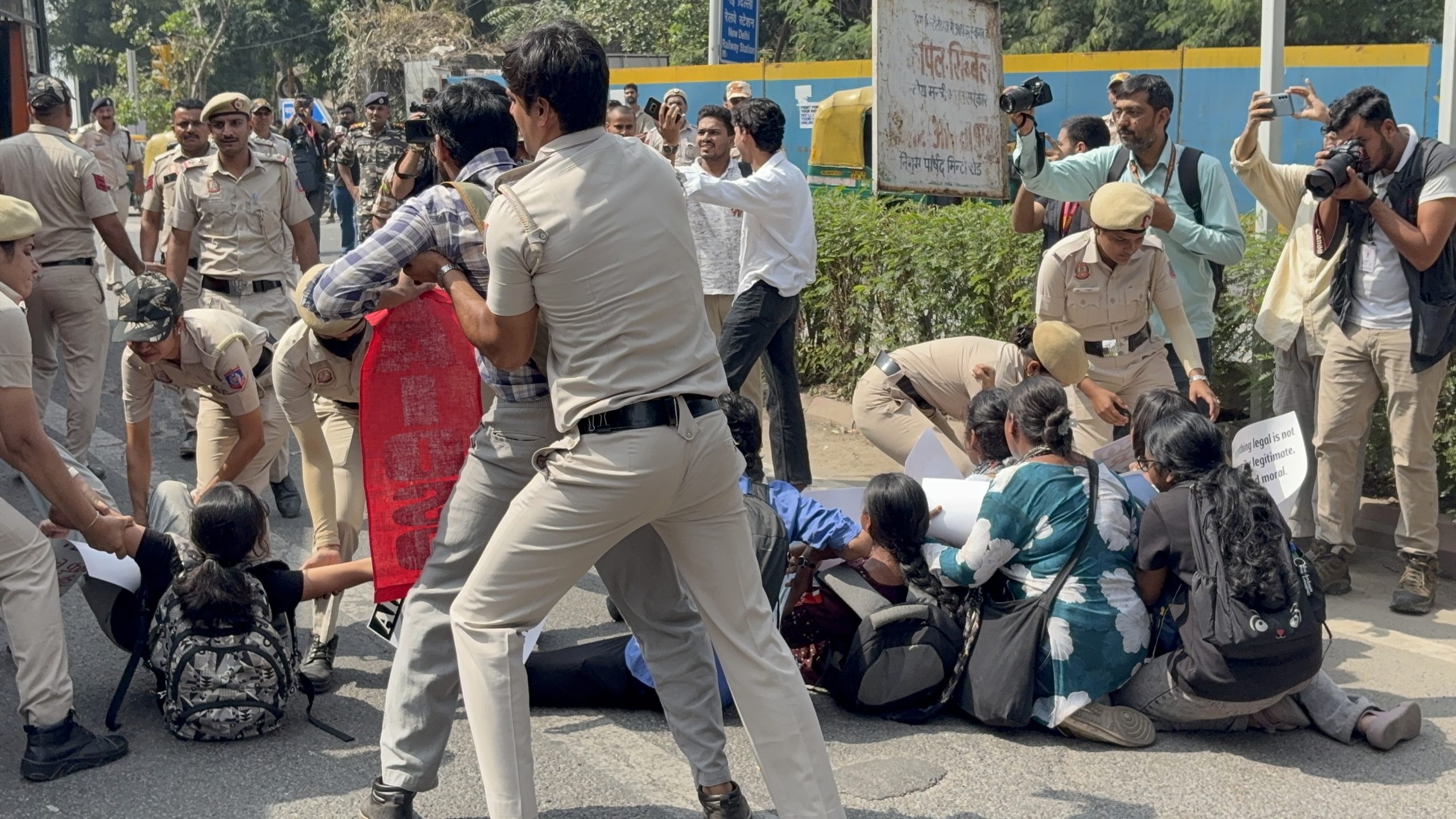
Police whisked away the detained students on waiting buses.

Synopsis: On any other day, Jantar Mantar is a short ride from almost anywhere in Delhi. On Saturday, 45 metro stations were shut, the internet was suspended, and buses and cabs into Connaught Place were badly hit. Police and armed personnel were heavily deployed on every major road into central Delhi, barring everyone, including the media, from entry.
Fear failed to hold Anjali back on Saturday, 10 October.
The Linguistics student at Jawaharlal Nehru University did not hide her fear when this correspondent joined her small group of comrades from the All India Democratic Students’ Organisation (AIDSO).
“This is my first time,” Anjali told South First at Zakir Husain Delhi College on Jawaharlal Nehru Marg. “It is true that I am scared. But what is happening is wrong, and I decided I should be part of the protest against the ECI (Election Commission of India).”
On any other day, Jantar Mantar is a short ride from almost anywhere in Delhi. On Saturday, 45 metro stations were shut, the internet was suspended, and buses and cabs into Connaught Place were badly hit. Police and armed personnel were heavily deployed on every major road into central Delhi, barring everyone, including the media, from entry.
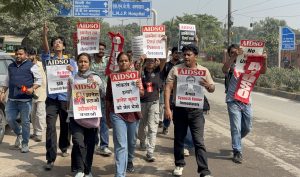
Protesters moved in small groups to avoid being detained early.
Before I could report on the protest, I had to do what the protesters were doing. I had to find a way in. That is how I met Anjali through Shreya, AIDSO’s Delhi secretary.
The Cockroach Janta Party (CJP) called the protest, backed by Left student groups, trade unions and opposition parties. They are demanding the resignation of Chief Election Commissioner (CEC) Gyanesh Kumar over alleged irregularities in the Special Intensive Revision (SIR) of electoral rolls.
The city’s answer was visible hours before anyone set out. Police were deployed in strength from early morning. Barricades came up in student neighbourhoods, including Vijay Nagar near Delhi University and Jamia Nagar near Jamia Millia Islamia, and personnel were posted outside all major residential campuses.
At Jawaharlal Nehru University, barricades were installed around midnight. Students came out and staged a protest on the spot.
Authorities closed some runways at the airport and monitored arrivals. Traders shut the Connaught Place market for the day. Delhi Police expected around 7,000 protesters, and personnel were told to detain arrivals and shift them to designated detention centres.
Phone calls that morning told the same story from every side. CJP sources said the movement would wait for its key leaders, Abhijeet Dipke, Saurav Das and Ashutosh Ranka, whose flight was due to land at 10.15 am from Bengaluru. No one knew whether they would be allowed to leave the airport.
A CJP zonal coordinator told South First they had received no message so far and were waiting for a call. With the internet down, they were unsure how to reach the venue.
The Left had a plan. The Students’ Federation of India (SFI) and the Democratic Youth Federation of India (DYFI) gathered their cadre at two offices, AKG Bhawan and HKS Bhawan. The All India Students’ Association (AISA) and others had members inside Gurdwara Bangla Sahib, a short walk from Jantar Mantar, where police had stationed a large force and more than 45 buses.
Several CPI(M) central committee members staying at Kerala House, on the same road as Jantar Mantar, announced they would march to the site later in the day.
By mid-morning, detentions looked likely before any gathering could take shape. The organisations moved without communicating, and fear and panic spread through the student areas.
Also Read: Rahul, Priyanka slam government, back India’s youth
Shreya’s members split into groups of four to reach as close as possible to the protest site. I moved with Anjali’s group, through the narrow gallis (lanes) of Basti Hazrat Khwaja Mir Dard. The narrow lanes led to the Municipal Corporation of Delhi’s Civic Centre.
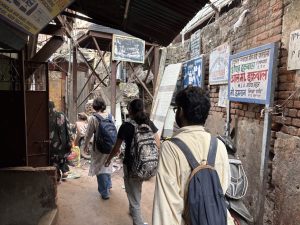
Students took narrow colony lanes to avoid the police.
More than 15 AIDSO activists joined. A large police contingent marched ahead. The group did not hesitate. Slogans against CEC Kumar filled the air. The group, including Anjali, stood their ground as the police surrounded them. Waiting buses whisked the young protesters away to different locations.
I spent the rest of the day trying to reach the other points from which marches had set out. The pattern was the same everywhere. Group after group arrived at the roads leading to Jantar Mantar, found them sealed by the Delhi Police and paramilitary personnel, raised slogans where they stood and were taken away in buses.
By Saturday evening, around 3,000 people had been detained across the capital, according to Delhi Police sources. Among them were four former chief ministers, the top leadership of the CJP, senior lawyers, journalists, and the leaders of nearly every student organisation that had set out for Jantar Mantar.
The airport answered the morning’s question. Authorities detained Dipke, Das, and Ranka on their flight after they landed in Delhi. The CJP said authorities took the three to an undisclosed location and denied them access to their lawyers.
Dipke recorded a video the previous night, anticipating arrest. With the leadership in custody, the CJP’s organisation in-charge, Ajinkya Shinde, took over and told supporters, “Wherever the Delhi Police try to stop you, make it your Jantar Mantar.”
The CJP said its legal affairs head Ratna Singh and its policy lead were also detained. Police picked up YouTuber Dhruv Rathee from his Gurugram residence early in the morning.
Also Read: Special Intensive Removal: The Telangana model!
The major Left student and youth organisations chose to court detention. The SFI, the DYFI, the All India Students’ Federation (AISF) and the All India Youth Federation (AIYF) tried to march from HKS Bhawan and AKG Bhawan. Around 500 people were detained.
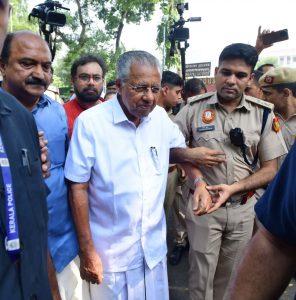
Pinarayi Vijayan being detained by the Delhi Police. John Brittas and K N Balagopal are also seen.
AISA came in batches and kept the protest going till the end of the day. The first and most notable batch set out from Dilli Haat, where AISA national president Neha Bora walked hand in hand with senior advocate Prashant Bhushan, activist Yogendra Yadav, and more than 200 students. All were detained. Other AISA batches followed on the same route through the day.
“I am in detention. The movement is not,” Bora said.
The Krantikari Yuva Sangathan (KYS) marched from the Red Fort and was detained there.
Some had come from outside Delhi. Around 200 students from Punjab, mobilised by the Punjab Students Union and Naujawan Bharat Sabha, along with members of other Left organisations, had spent the night at Gurdwara Bangla Sahib and set out for Jantar Mantar in the morning. Several were detained on the way.
Student leaders said police took the detained to stadiums in the city, while others were driven out in buses and dropped along the Sonepat road. With 75 trains cancelled, students changed routes and took sleeper buses to Delhi.
Also Read: Gen Z deserves better than an undeclared Emer-Gen Z
Pinarayi Vijayan, Manik Sarkar, Arvind Kejriwal and Mamata Banerjee were detained at different places as they tried to join the protest. Police detained Banerjee outside her South Avenue residence along with five Trinamool MPs.
CPI(M) MP John Brittas said police drove him, Vijayan, and KN Balagopal around the city before taking them to Chhatrasal Stadium. CPI(M) leaders MA Baby and Brinda Karat were detained at Jantar Mantar.
Bhushan, Yadav and other civil society members were among those detained. The Supreme Court Bar Association passed a resolution condemning the detention of advocates protesting near the court and sought intervention from the Chief Justice of India.
A plea was also filed in the Supreme Court seeking contempt action against the authorities over the closure of metro stations.
Also Read: Delhi police denied food, water and medicines to Pinarayi Vijayan
Reporting the day was its own obstacle course. The media was barred from entering the protest area on every major road, and several journalists were detained while trying to cover the marches.
Three journalists from Newslaundry, Ashwin Singh, Savyasachi and Anmol Pritam, were detained. So were Ayush Tiwari of Scroll, Hritik Joshi and Rahul Charas of Navbharat Times, and Sarthak Jaiswal of The Quint, along with several freelance and independent journalists and digital content creators.
DIGIPUB issued a statement condemning the detentions. It demanded that authorities release all journalists immediately and return their seized devices. The CJP, too, alleged a clampdown on journalists across the city.
Officials alleged that a group of 25 to 30 protesters jumped barricades near Akashvani Bhawan on Parliament Street around noon and pelted stones, injuring two police personnel.
BJP president Nitin Nabin accused the CJP and the INDIA bloc of trying to destabilise the country.
Also Read: ‘Modi should ask what happened to Hitler’
The call for 10 October was the CJP’s. On the ground, it was hard to find the CJP.
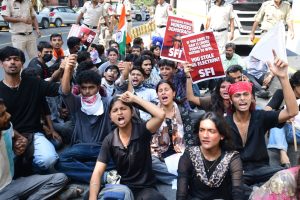
SFI activists stage a sit-in after the police prevented them from marching to the protest site.
At the march points I reached, the people courting detention were overwhelmingly Left cadre and democratic student organisations. Some CJP supporters did try the different roads leading to Jantar Mantar, but their numbers were marginal.
CJP sources I spoke to through the day did not dispute this. They said the situation had turned hostile. Unlike the student organisations, the CJP has no stable cadre. Its strength is a spontaneous crowd of young people, and on Saturday that crowd did not gather the way it had for the movement’s earlier protest in Delhi.
That earlier protest, over examination paper leaks, held Jantar Mantar through June and July and ended with the exit of Union minister Dharmendra Pradhan. CJP members told South First it had felt like a festival. People felt safe coming, and were eager to be part of it. This time, they said, the government had made it hostile and threatening for ordinary students to step out.
The morning had already shown the weakness. An online-organised movement was asked to assemble on a day the internet was switched off, and its leaders were taken off a plane.
A national general secretary of one of the Left organisations said that, for the sake of the movement’s future, the CJP, the INDIA bloc and everyone else protesting should join hands. He said Rahul Gandhi still does not mention the CJP, which weakens the movement as a whole.
He added that the CJP should reach out to people instead of relying on virtual calls, which may not always work. “But the nature of their organisation has evolved differently,” he said.
Dipke, for his part, has said the CJP will stay out of political parties’ programmes and remain an independent movement.
Also Read: Sonam Wangchuk warns of hunger strike
Around six in the evening, the releases began. Shreya and many of the students who had been held since morning were let go slowly, some with injuries they said they had sustained while being detained.
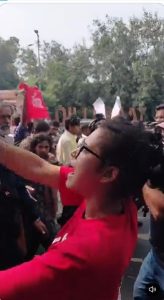
AISA’s Neha Bora leading the march to Dilli Haat before she was detained and taken away.
Key leaders remained in custody. Dipke was among them. His grandmother died in Maharashtra’s Hingoli district while he was in detention, and it was not clear whether he would be allowed to travel for her last rites.
Later in the evening, at a news conference called by the AISF, the SFI and the CJP, Shinde said the protest would not stop until Kumar steps down. He condemned the Delhi Police for what he called unconstitutional detentions and the curbing of protests.
SFI general secretary Srijan Bhattacharyya said the SFI would soon announce the form and manner of the next phase of the protest. The Congress-led INDIA bloc, meanwhile, plans a massive protest on Monday, 12 October, and in the days after.
The small group of students I walked with never saw Jantar Mantar. Their protest lasted as long as it took the police to surround them near the Civic Centre. For Anjali, her first protest ended on a police bus. She is not scared anymore.
By the CJP’s own measure, they had still arrived. Wherever the police stopped them had become their Jantar Mantar.
(Edited by Majnu Babu).



